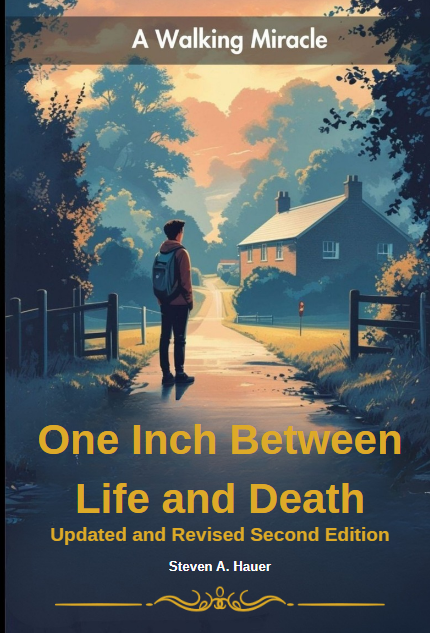
Buy this Book:
Biography & Memoir
One Inch Between Life And Death Updated And Revised Second Edition
by Steven A. Hauer
Listen to this review
One Inch Between Life and Death: Updated and Revised Second Edition is a deeply sincere memoir that turns a single catastrophic moment into a meditation on faith, family, and the fragile grace of survival. Steve Hauer writes not as a polished literary poseur, but as a witness—someone who lived through an event so sudden and consequential that the ordinary details surrounding it become luminous. What begins as a boyhood outing with Kurt and Chris on a Sunday afternoon gradually expands into a moving testimony about what it means to be spared, to recover, and to understand that life can change by the width of an inch.
One of the book’s greatest strengths is its immediacy. Hauer structures the narrative with a clear, chronological momentum that carries the reader from the carefree planning of the hunt, through the accident in the woods, and into the harrowing sequence of the drive, the emergency room, and the long hospital stay. The title event—the bullet stopping one inch from his heart—lands with genuine force because the author patiently builds the ordinary world around it first. The opening chapters, including “How It All Began,” “Sunday Just Hanging Out With Friends,” “Moving The Pigs,” and “The Shot That Changed Everything,” are especially effective in grounding the story in the rhythms of rural life, teenage friendship, and the almost reckless confidence of youth. That contrast between everyday familiarity and sudden trauma is what gives the memoir its emotional power.
Hauer’s prose is direct and accessible, and that works to the memoir’s advantage. He favors clarity over ornament, and the result is a voice that feels candid and unfiltered. The sensory details are often especially vivid: the rain hammering the car roof, the muddy field drive, the hospital’s antiseptic chill, the beeping of monitors in intensive care. In the hospital chapters—particularly “The Hospital,” “Surgery or Not,” and “A Night in Intensive Care”—the emotional stakes become both physical and spiritual. The repeated references to prayer, last rites, the priest’s visit, and the doctor’s verdict that surgery would be more dangerous than leaving the bullet in place give the book its central tension and its most memorable image: a life balanced on a medical and spiritual edge.
What distinguishes this memoir from a purely procedural account of an accident is its insistence on meaning. Hauer is not content simply to recount what happened; he wants to understand why it mattered. That theme gathers strength in the later chapters, especially “Released from the Hospital,” “Recovery at Home,” and “Back to School and Reality.” Here the book becomes less about emergency medicine and more about return—return to family, return to school, return to a changed self. The construction of the new home alongside his physical recovery is a particularly thoughtful structural choice. As the house rises frame by frame, Hauer’s own life is shown mending in parallel. It is a simple but effective symbolic thread, and it helps the memoir achieve a quiet grace in its final section.
The family portrait embedded throughout the book is another of its highlights. His mother and father emerge as steady presences, while Jane, Joe, John, and Tony help transform what could have remained an isolating trauma into a communal experience of care. The acknowledgments reinforce this beautifully, especially in the affection shown toward his parents, who have since passed away, and toward Kurt and Chris, whose guilt and loyalty are both treated with compassion. Hauer’s refusal to reduce the accident to blame alone gives the memoir a humane center. Even the young men involved are allowed complexity, fear, and grace.
The book’s devotional material, including “Verses That Helped Me Through My Journey” and “Tools in Prayers That Helped Me Along My Journey,” will likely be especially meaningful to readers who share Hauer’s Christian faith. These sections are earnest and heartfelt, and they deepen the memoir’s purpose-driven framework. Readers looking for a more restrained or secular treatment of trauma may find these passages more explicit than necessary, but even then, they are presented with conviction rather than coercion. They reflect the author’s authentic worldview, and they are integral to the book’s emotional architecture.
If there is a modest limitation, it is that the memoir sometimes leans toward repetition in its emphasis on gratitude and divine purpose. Yet this is also part of its sincerity: Hauer is clearly writing from a place of lived testimony rather than literary calculation. A few readers may wish for even more interior reflection on the long-term psychological effects of the accident, but the book’s strength lies in its straightforward witness and its hopeful arc.
Ultimately, One Inch Between Life and Death is a moving, faith-filled memoir that honors survival without sentimentalizing it. Its scenes are memorable, its message is uplifting, and its emotional honesty is real. For readers drawn to inspirational true stories, Christian testimony, or memoirs of resilience and second chances, this is an engaging and worthwhile read. I recommend it warmly and without hesitation.
Share-ready review images
Download square and vertical images for posts, stories, newsletters, and media kits.

For authors
Want a review page like this for your book?
Upload your manuscript, choose a review tier, and get a permanent public editorial review page you can share with readers.
Review My BookRelated reviews
← Back to Reviews
