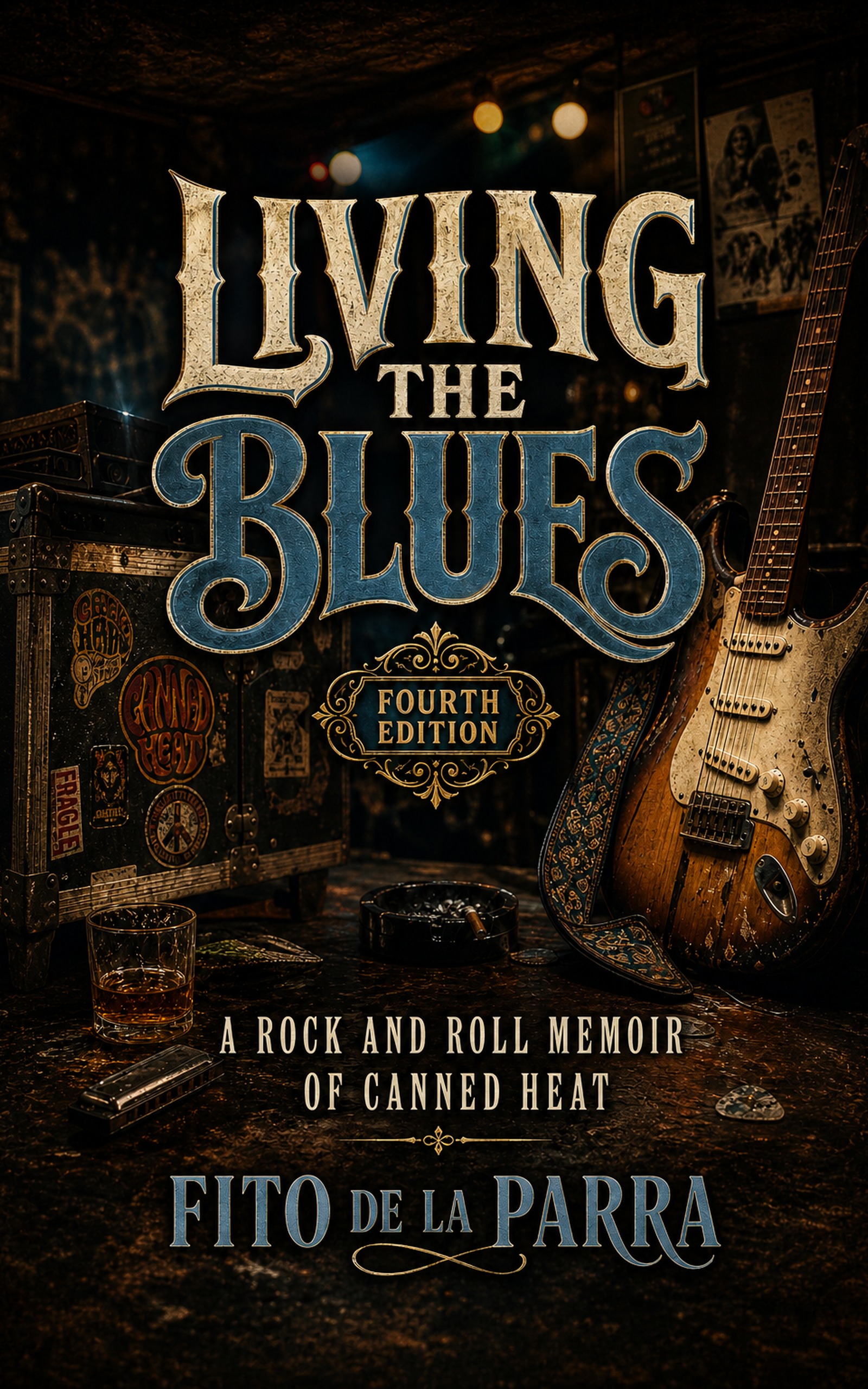
Buy this Book:
MUSIC / Genres & Styles / Rock (MUS035000)
Living the Blues
by Fito de la Parra
Listen to this review
Living the Blues is exactly the kind of rock memoir that reminds readers why music history, when told from the inside, can feel stranger, funnier, sadder, and more vivid than fiction. Fito de la Parra’s account of Canned Heat is not a polished mythology or a sanitized nostalgia trip. It is a bruised, exuberant, and deeply human chronicle of ambition, excess, brotherhood, cultural collision, and survival. What makes the book so compelling is that it never loses sight of the music, even when the narrative plunges into arrests, addiction, lawsuits, touring chaos, and grief. De la Parra writes with the momentum of a drummer who knows how to build and release tension, and the result is a memoir that reads like a long, propulsive blues riff—alive, unruly, and impossible to fake.
One of the book’s greatest strengths is its voice. De la Parra is blunt, funny, self-aware, and unafraid to be unflattering when honesty demands it. He can describe a scene with comic swagger one moment and then pivot into genuine heartbreak the next. His portraits of bandmates are especially memorable. Alan “Blind Owl” Wilson emerges as a brilliant, fragile, environmental-minded eccentric, a man so absorbed in trees, old records, and spiritual discipline that he feels almost otherworldly. Bob “The Bear” Hite, by contrast, is pure appetite, charisma, and force of nature, a larger-than-life frontman whose love of food, alcohol, and chaos becomes both comic engine and tragic burden. The contrast between these two figures gives the book much of its emotional weight, and de la Parra handles both with affection rather than easy caricature.
The early chapters are particularly strong in the way they root the story in Mexico City and the author’s formative years. The account of teenage rock-and-roll discovery, the neighborhood band The Sparks, and the thrill of seeing Bill Haley, Jerry Lee Lewis, and other American acts in Mexico creates a rich cultural backdrop. De la Parra doesn’t simply tell us that he loved music; he shows how music crossed borders, defied language, and gave a young Mexican drummer his sense of destiny. The school scenes are equally vivid, especially the moment when he leverages his band’s performance at a graduation dinner to negotiate better treatment from the principal. It is one of the book’s best examples of how music becomes power, not just pleasure.
The middle sections, which cover the rise of Canned Heat, are where the memoir really comes alive as a historical document. The book captures the band’s formation, their blues scholarship, the importance of Topanga Canyon, the Monterey Pop Festival, and the wildly precarious balance between commercial success and artistic identity. De la Parra is excellent on the mechanics of the music business and on the absurdity of the era’s contradictions: the band could be huge, yet still broke; celebrated, yet exploited; famous, yet unable to control its own image or royalties. The chapter that frames the band as “outlaws” while also insisting on its deep respect for the blues lineage gives the whole memoir a sharp thematic center. This is not just a story about partying; it is a story about cultural inheritance, authenticity, and the price of living hard.
The emotional range of the book is impressive. The death of Alan Wilson, the long decline of Bob Hite, and the recurring sense of a band being pulled apart by drugs, bad management, and bad luck are handled with real sorrow. De la Parra never pretends the story is simply one of triumph. He understands that the same energy that makes a band electrifying can also destroy it. That tension gives the book its lasting force. The memoir also becomes unexpectedly moving in its reflections on fatherhood, especially when his son Adolfo enters the narrative and gives the author a renewed sense of purpose amid the wreckage of rock stardom.
Stylistically, the book has a rambunctious, oral quality that suits the subject perfectly. It often feels as though de la Parra is speaking directly to the reader over a long night of stories, and that immediacy is part of its charm. The prose is richly detailed and frequently funny, though readers who prefer a more restrained, literary style may occasionally find the language intense or sprawling. The extensive discography and later career documentation are also generous, though at times they read more like an archive than narrative. Even so, that completeness will be a gift to fans who want the full record of Canned Heat’s evolution.
What ultimately makes Living the Blues so satisfying is its emotional honesty. It is a memoir about survival, but not in a simplistic sense. Survival here means lasting through fame, loss, addiction, business betrayal, and the disillusionment that follows youthful dreams. It also means preserving the spirit of the music when the original glory days are long gone. De la Parra’s devotion to Canned Heat never feels sentimental; it feels earned. He knows exactly what was lost and what remains. By the end, the book leaves the reader with a deeper appreciation not only for the band’s place in rock history, but for the stubborn human will required to keep playing when everything else has gone wrong.
Highly recommended for readers of music memoirs, 1960s counterculture history, and anyone who wants a vivid, unsparing, and genuinely entertaining backstage account of one of rock’s most distinctive bands.
Share-ready review images
Download square and vertical images for posts, stories, newsletters, and media kits.
For authors
Want a review page like this for your book?
Upload your manuscript, choose a review tier, and get a permanent public editorial review page you can share with readers.
Review My Book← Back to Reviews
