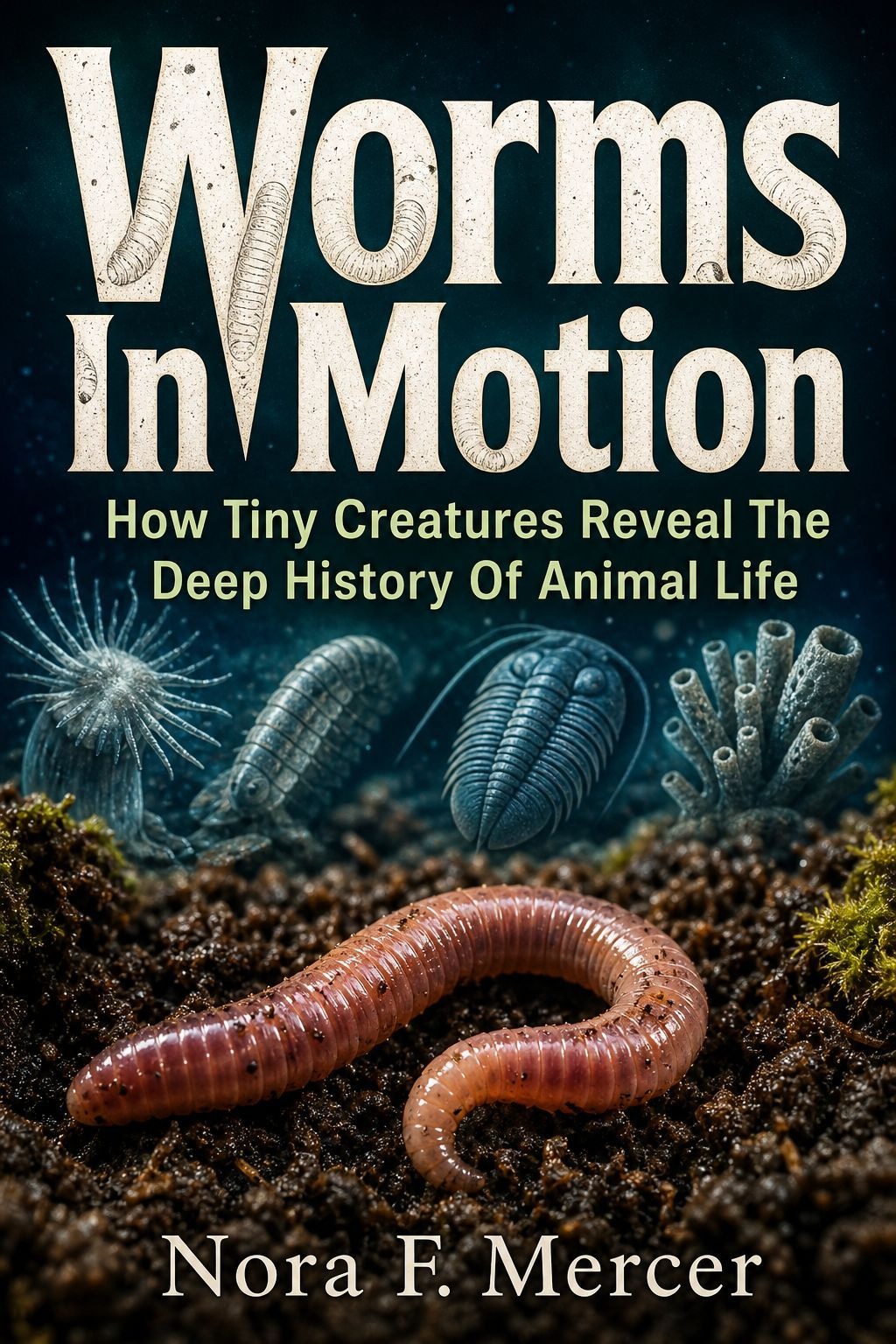
Buy this Book:
Science / Life Sciences / Evolution (SCI027000)
Worms in Motion
by Nora F. Mercer
Listen to this review
Worms in Motion is an ambitious work of popular evolutionary biology that takes an unfashionable subject and uses it to ask genuinely large questions. Its central wager is that worms are not biological leftovers but revealing forms: bodies simple enough to study closely, yet diverse enough to expose some of the deepest patterns in animal evolution. Across its ten chapters, the book builds this case with admirable consistency, moving from why worms matter at all, to the origins of movement, body architecture, genetics, development, nervous systems, fossils, ecosystems, and finally the human relevance of all that worm research. The result is a book that is less about one animal group than about the logic of animal life itself.
Its strongest quality is conceptual clarity. The prose repeatedly returns to a few large organizing ideas — simplicity versus sameness, form versus function, ancestry versus convergence — and each chapter develops one of those ideas in a way that feels cumulative rather than repetitive. Chapter 1, “Why Worms Matter,” is especially effective in establishing the book’s intellectual agenda: worms are useful precisely because they strip away some of the anatomical distractions that complicate comparisons in more elaborate animals. That theme is sharpened by the warning that “worm” is a convenient label that can obscure genuine evolutionary differences, a point the book revisits with growing sophistication in Chapter 4, “Worms as Evolutionary Experiments.” There, the discussion of annelids, flatworms, and roundworms shows that the shared wormlike outline can hide radically different histories and solutions to survival.
The book’s treatment of movement is another major strength. Chapter 2, “The First Animal Movements,” is one of the clearest sections in the text, especially in its insistence that motion began not as graceful locomotion but as a stepwise coordination of contraction, traction, and sensory feedback. The argument that muscles and nerves evolved together because movement required both force and timing gives the chapter real explanatory force. Similarly, the discussion of trace fossils is strong because it stays appropriately cautious: the text never pretends that a groove in sediment can be read as a simple one-to-one record of a particular species, but it does show how surface trails, burrows, and changes in direction can suggest increasingly active behavior. That balance between evidence and inference is one of the book’s best habits.
Another notable virtue is the way the book links structure to development. Chapter 3, “Building a Body from the Inside Out,” and Chapter 6, “Development, Form, and the Making of a Worm,” are especially good at showing that anatomy is not a static inventory of parts but the outcome of developmental decisions. The text’s emphasis on tissue layers, cavities, symmetry, and segmentation makes a persuasive case that what looks like “simplicity” is usually an organized solution to very specific mechanical problems. The embryo-centered chapters also connect well to the book’s broader evolutionary claims: if small changes in timing, placement, or gene regulation can alter the whole adult body, then development becomes the bridge between inherited instructions and visible form. That is one of the book’s most valuable insights, and it is handled with real discipline.
Chapter 5, “The Genetics of Simple Animals,” is among the book’s most successful sections because it explains molecular comparison without reducing it to jargon. The discussion of conserved developmental toolkits, including Notch signaling, makes a persuasive case that evolutionary novelty often comes from redeploying old genes in new contexts rather than inventing entirely new molecular parts. This point is reinforced by the later chapter on human relevance, which argues that shared ancestry is visible not in identical bodies but in shared biological logic. The book is at its most engaging when it treats genomes as historical documents rather than abstract code.
Its ecological scope is equally impressive. Chapter 9, “Worms, Ecosystems, and the Living Earth,” turns worms into ecosystem engineers without overstatement. The text explains how burrowing changes soil structure, oxygen flow, nutrient cycling, and microbial conditions, and it does so with memorable physical analogies: worms as wedges, pistons, mixers, and pumps. That chapter effectively widens the book’s moral and scientific lens, reminding readers that some of the most consequential organisms are also the least visually dramatic. The book’s ecological thinking is strongest when it links tiny bodies to large-scale processes in soils, seafloor mud, and freshwater and terrestrial systems.
Still, Worms in Motion is not without limitations. Its greatest strength — its steady explanatory movement from one big idea to the next — can also make it feel more synthetic than narratively driven. Readers hoping for a book anchored in vivid natural history, laboratory scenes, or recurring case studies may find the presentation somewhat abstract. The chapters are carefully structured and intellectually coherent, but they often prioritize general principles over concrete examples beyond the major worm groups. Even where the text names annelids, flatworms, nematodes, Platynereis dumerilii, or trace-fossil evidence from the Ediacaran and Cambrian, it usually does so to advance a larger argument rather than to dwell on a memorable organism or episode.
There is also a stylistic tradeoff in the book’s recurring reliance on explanatory repetition. The prose is lucid, but it is also built from many parallel formulations — “not X but Y,” “simple yet diverse,” “shared ancestry versus convergence” — that make the argument durable at the cost of occasional sameness. That is not a fatal flaw in a scientific overview, but it may limit the book’s appeal for readers who prefer more surprise in sentence-level style or more sharply dramatized stakes. At times the book reads like an extended, highly polished lecture: effective, thoughtful, and methodical, but not especially propulsive.
Even so, the book’s ambition is genuine, and much of its method is sound. The appendix, with its guide to common worm groups, glossary, and advice on observing worms responsibly, suggests a book designed not just to inform but to extend the reader’s curiosity beyond the page. That practical ending is well chosen, because it matches the book’s larger argument: worms matter most when they are seen as living participants in evolution, ecology, and development rather than as simplified placeholders for something supposedly higher.
Overall, Worms in Motion is best suited to readers who want a careful, conceptually organized introduction to evolutionary biology through an unexpectedly rich subject. It will reward general readers with patience for scientific explanation, students looking for a coherent framework for worm diversity and animal evolution, and anyone interested in how development, movement, genetics, and ecology fit together. Those seeking a more literary natural history or a more vividly anecdotal popular science book may find it a bit schematic. But for readers willing to follow its sustained argument, this is a thoughtful and often illuminating study of why the humble worm remains one of biology’s most instructive animals.
Share-ready review images
Download square and vertical images for posts, stories, newsletters, and media kits.
For authors
Want a review page like this for your book?
Upload your manuscript, choose a review tier, and get a permanent public editorial review page you can share with readers.
Review My Book← Back to Reviews
