BUSINESS & ECONOMICS / Bookkeeping (BUS005000)
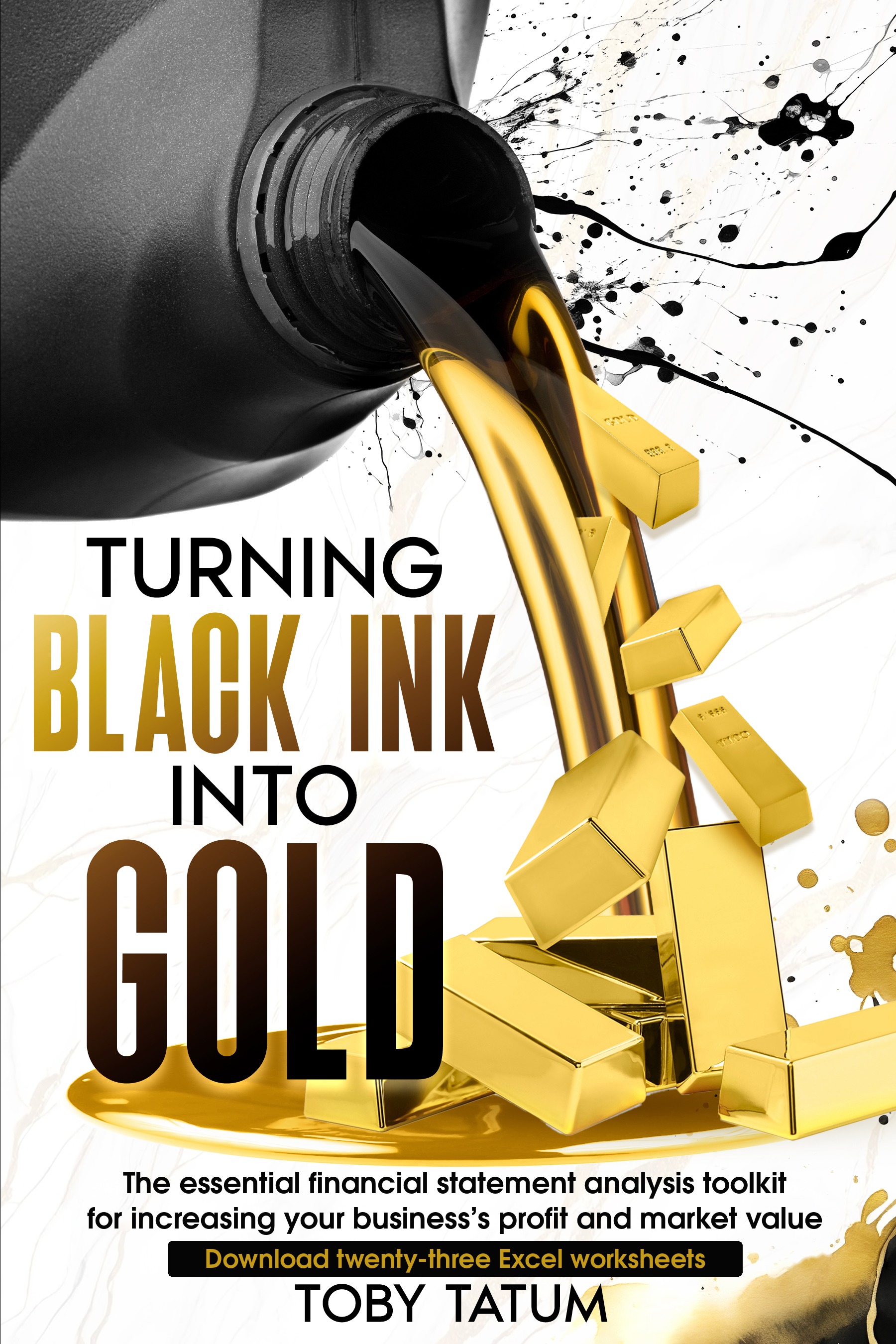
Turning Black Ink Into Gold
by Toby Tatum
Listen to this review
Toby Tatum’s Turning Black Ink Into Gold is a practical guide to using financial statements not merely to record what a business has done, but to manage its costs, anticipate cash needs, and prepare for a possible sale. Its central argument is consistent throughout: reliable reporting makes a business easier to control and more credible to buyers. Rather than offering a general introduction to finance, Tatum concentrates on small and midsized businesses, translating accounting concepts into operating questions: Is labor productive? Are costs rising faster than sales? Could a buyer trust the earnings being presented?
The book’s strongest feature is its insistence on context. A line showing “Cost of Goods Sold $29,170.91,” Tatum argues, cannot be meaningfully analyzed on its own; its percentage of sales and a reasonable expected range matter more. This principle informs the discussions of variable costs, management by exception, and the proposed rolling twelve-month control charts. The examples make the method concrete. In the restaurant case, labor cost as a percentage of sales initially appeared unusually high; tracking customers served per labor hour helped explain the difference and identify a productivity target. The auto-repair example likewise shows how excessive owner compensation can quietly exhaust working capital. Such stories help connect financial metrics to decisions that owners can actually make.
Tatum is also persuasive when explaining why clean records have value beyond compliance. The account of the business owner whose tax-minimizing adjustments left prospective buyers distrustful gives the book’s marketability argument a human consequence. The episode supports a broader theme: decisions that make earnings harder to verify can impair planning, borrowing, and sale prospects. Later chapters extend that theme through discussions of leases, franchise transfers, owner dependence, and buy-sell agreements. The emphasis on preparing a business well before a sale is a useful corrective to the assumption that valuation begins only when an owner decides to exit.
The author’s background as a former restaurant operator and business appraiser is reflected in the book’s attention to operational detail. Recommendations such as separating direct labor from labor overhead, recording fair-market rent when the owner holds the property, and distinguishing owner perks from ordinary expenses show a practical concern with how financial statements are interpreted. The sections on accrual accounting, balance-sheet ratios, debt, cash flow forecasting, break-even analysis, and business valuation form a broad toolkit. Particularly helpful is the explanation that a balance sheet is a snapshot, while a profit-and-loss statement accumulates activity over a period; the analogy of balance-sheet analysis as a financial checkup makes the purpose of ratios accessible.
The structure is logical in broad strokes, moving from reporting foundations through operating control and financial health to forecasting, valuation, deal structure, and sale preparation. The companion worksheets are a major part of the book’s teaching method. The user’s guide explains how to reformat a P&L, update control charts, track labor productivity, and analyze changes in cash. This hands-on approach may help readers turn advice into routine practice rather than leave it at the level of theory.
That same workbook-centered design is also a limitation. The book’s promised practical value depends on the reader downloading and operating the Excel files, entering historical data, and maintaining consistent procedures. The guide is detailed, but readers unfamiliar with spreadsheets, accounting terminology, or macros may find the process demanding. The author acknowledges that comprehension can take months or longer; that candor is welcome, though it also signals that this is not a quick, accessible primer. The volume is best approached as a working reference, not read once and expected to produce immediate mastery.
The prose is direct and emphatic, sometimes to a fault. Tatum’s anecdotes give the advice energy, but key propositions recur in several forms, particularly the importance of high-quality financial reporting and the danger of distorting earnings. Some passages move from useful rules of thumb to prescriptions that may feel more universal than the surrounding evidence can establish. For example, recommended ratios, cost targets, and valuation multiples require careful adjustment for industry, location, business model, and accounting circumstances. The book does discuss industry comparisons and buyer perceptions, but readers should not mistake its examples or general benchmarks for individualized professional advice. The treatment of tax, lease, and transaction matters also touches areas where expert review may be important.
The valuation discussion is ambitious and distinctive, especially its explanation of using comparable transactions and sample averages to estimate a likely multiple. Yet the statistical presentation may be harder to follow than the operational chapters, and its conclusions depend on the quality and relevance of the underlying transaction data. More explicit reminders about the limits of such comparisons would strengthen this section. The book’s confident tone is useful for motivating action, but can occasionally obscure how much judgment remains in applying its methods.
Turning Black Ink Into Gold is most valuable for owner-managers, bookkeepers, and advisers to small businesses who want a disciplined system for understanding costs and improving sale readiness. Readers seeking a concise overview, a substitute for an accountant, or a universally applicable valuation formula may find it too detailed and prescriptive. For practical-minded readers willing to work with the spreadsheets and adapt the guidance to their circumstances, it offers a substantial, experience-shaped framework for making financial information more useful.
Share-ready review images
Download square and vertical images for posts, stories, newsletters, and media kits.
For authors
Want a review page like this for your book?
Upload your manuscript, choose a review tier, and get a permanent public editorial review page you can share with readers.
Review My Book← Back to Reviews
