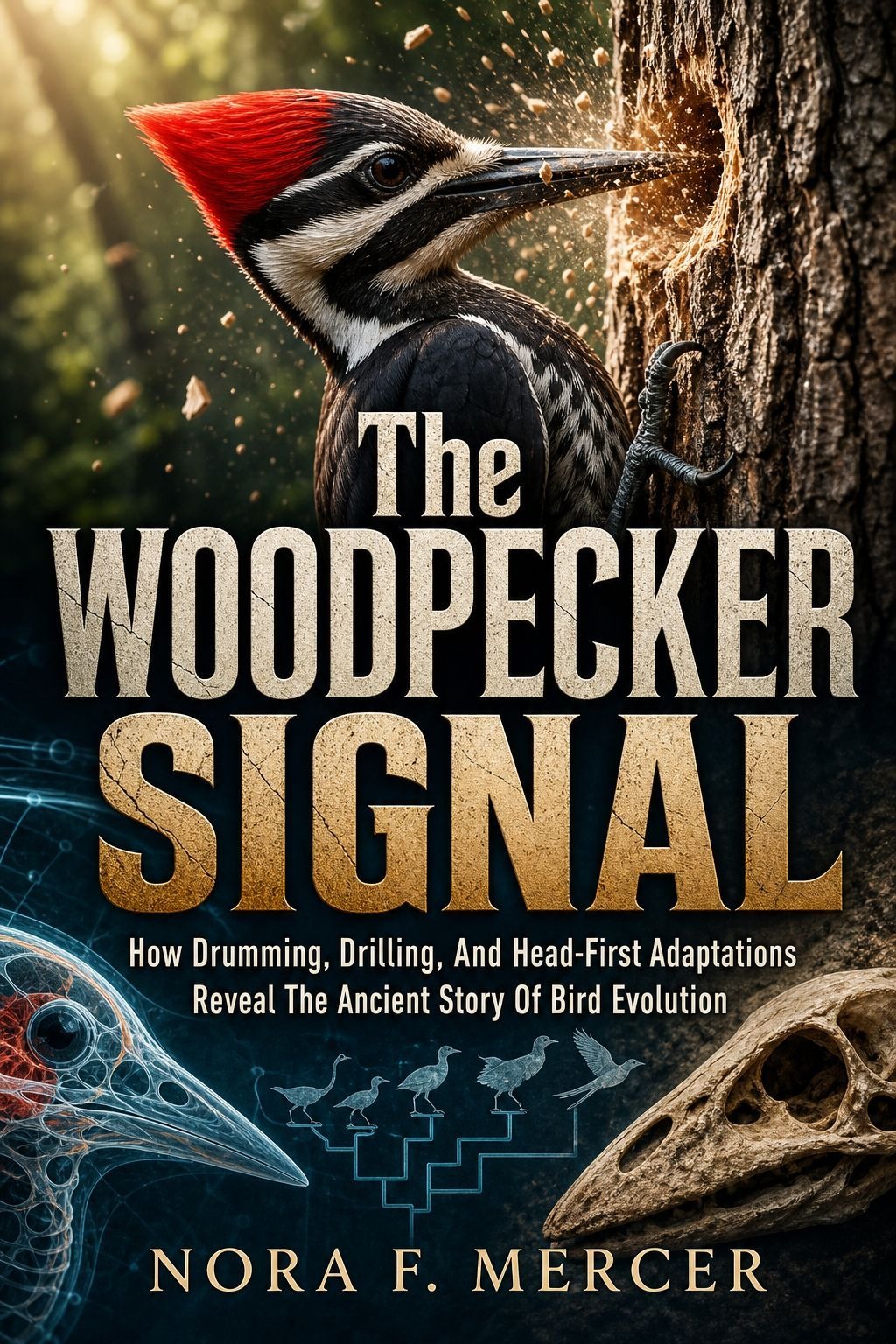
Buy this Book:
Nature / Ecology (NAT010000)
The Woodpecker Signal
by Nora F. Mercer
Listen to this review
The Woodpecker Signal is an ambitious, intelligent work of popular science writing that uses one bird family to think about behavior, biomechanics, evolution, and habitat change at once. Across its nine chapters, it repeatedly returns to the same deceptively simple image—a woodpecker at a trunk—but each time the lens shifts. In “The Mystery in the Tree Trunk” and “Why Woodpeckers Peck,” pecking is unpacked as three distinct behaviors: drumming as communication, foraging as extraction, and excavation as construction. That distinction is one of the book’s best early moves, because it immediately resists the flattening habit of treating “pecking” as a single instinctive act. Instead, the bird becomes a case study in how function changes meaning. The writing here is clear and careful, especially when it describes a trunk as a layered structure of bark, cambium, sapwood, and decay rather than simply a surface.
The book’s chief strength is the way it integrates multiple scales of explanation without losing sight of the bird itself. Chapter 3, “Built for Impact,” and Chapter 4, “The Physics of Drumming,” are especially effective in combining anatomy with mechanics. The skull is treated not as a static helmet but as a system for routing force; the neck, feet, and tail are folded into the explanation so that the reader sees the whole body as part of the strike. This is a sophisticated way to write about biology for a general audience. Likewise, the discussion of drumming as impulse rather than sustained pressure gives the book a strong explanatory spine. It does not merely celebrate a bird that can hit wood repeatedly; it explains why repeated impact is a different mechanical problem from slow loading, and why posture and alignment matter as much as hardness or toughness.
There is also real thematic coherence in the book’s treatment of evolution. Chapter 1 distinguishes local adaptation from deep inheritance, Chapter 6 frames trunk-foraging as an ecological opportunity turned into a way of life, and Chapter 8 broadens the view to the vertebrate head as an evolutionary platform. These chapters are not just repeating the same point in different vocabulary. They build a persuasive argument that woodpecker specialization is both highly contingent and deeply constrained: selection can fine-tune a lineage, but only within the materials history has already supplied. That is a compelling idea, and the book states it with admirable patience. The reader comes away with a stronger sense of how evolution can be inventive without being omnipotent.
The chapter organization is generally logical, moving from behavior to mechanics to evolution to habitat, and then ending with conservation. That progression works well because it mirrors the way the bird can be understood: first as a visible act, then as a machine, then as a lineage, and finally as a species dependent on forest complexity. Chapter 9, “Living in a Changing World,” is particularly important because it grounds all the earlier abstraction in ecology. Dead wood, standing snags, forest structure, and human land use are treated not as peripheral concerns but as conditions that make the bird’s entire lifestyle possible. That is one of the book’s most valuable contributions: it refuses to isolate the woodpecker’s marvels from the habitat that sustains them.
At its best, the prose has the measured confidence of someone explaining a complex system without overclaiming. The recurring caution that woodpeckers are not “nature’s concussion-proof birds” is a useful corrective, and the book is strongest when it insists on limits: a protective trait in a bird is not automatically a transferable solution for humans. The inclusion of the cited research by Smoliga and by Lyons, Rosset, and Picasso gives the text a scholarly grounding, though the book remains readable for non-specialists. The Appendix also suggests a genuinely pedagogical intent, with glossary terms, representative species, and field observation tips extending the book beyond exposition into practical engagement.
That said, the book is not without limitations. Its commitment to explanatory clarity sometimes leads to repetition. The same core claims—specialization, integration, inherited body plan, whole-body mechanics—are revisited across multiple chapters, and while this reinforces the argument, it can also make the middle sections feel more cumulative than necessary. Readers already comfortable with evolutionary biology may find that some passages linger in summary mode rather than advancing a fresh line of inquiry. In addition, the book’s reliance on broad conceptual framing means that the scientific claims are often presented at a high level of generality. For example, the text references developmental studies and biomechanical findings, but the discussion remains more interpretive than empirical, which may leave technically minded readers wanting more specific data than the prose provides.
There is also a stylistic limitation tied to the book’s pedagogical mission. Because it is intent on clarifying how many different systems intersect—skull, neck, feet, tail, tongue, behavior, forest structure—the language can become formulaic in its emphasis on “integration,” “coordination,” and “modification.” Those are legitimate concepts, but their frequent repetition slightly flattens the imaginative range of the writing. The result is lucid, but occasionally more instructive than memorable. Readers seeking narrative momentum, anecdote, or species-by-species color may find the book restrained.
Even so, The Woodpecker Signal succeeds as a thoughtful meditation on form and function, and as a model of how natural history can illuminate broader questions in evolution and conservation. Its best chapters show genuine intellectual discipline: they do not romanticize the bird, and they do not reduce it to a mechanical curiosity. Instead, they present the woodpecker as both organism and argument. I would recommend it most strongly to readers interested in animal behavior, evolutionary biology, biomechanics, and conservation-minded natural history, especially those who appreciate a reflective, concept-driven style over anecdotal storytelling. It is less likely to satisfy readers looking for vivid field narrative or deeply technical primary research, but for an audience willing to follow a careful, layered explanation, it offers substantial insight and a clear-minded view of why a bird at a trunk can reveal so much about life’s design under constraint.
Share-ready review images
Download square and vertical images for posts, stories, newsletters, and media kits.
For authors
Want a review page like this for your book?
Upload your manuscript, choose a review tier, and get a permanent public editorial review page you can share with readers.
Review My Book← Back to Reviews
