PHILOSOPHY / Logic (PHI011000)
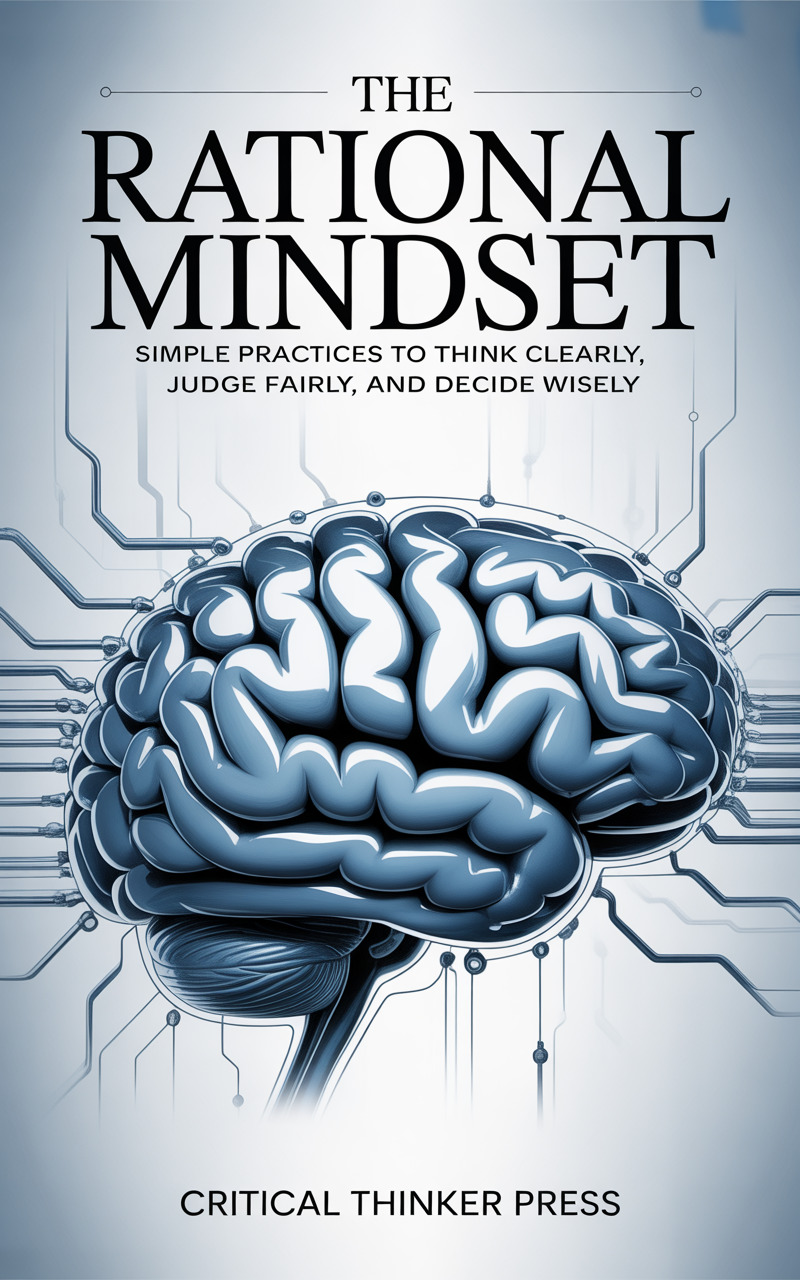
The Rational Mindset
by Critical Thinker Press
Listen to this review
Logical Thinking: Foundations, Clarity, and Fair Judgment is an admirably steady, practical, and intellectually generous guide to thinking better in a world that constantly rewards haste. Rather than treating logic as an abstract discipline reserved for philosophers or mathematicians, this book brings it down to the level of daily life, workplace judgment, digital discernment, and personal self-correction. Its greatest strength is its accessibility: the prose is clear, methodical, and reassuring, making a potentially intimidating subject feel navigable without becoming simplistic.
What makes the book especially effective is the way it builds its argument cumulatively. Chapter 1, with its emphasis on “Foundations of Logical Thinking,” establishes the core idea that sound reasoning begins not with perfection, but with awareness—of assumptions, of hidden premises, of the cognitive traps that distort judgment. The discussion of deductive versus inductive reasoning, along with “analytical decomposition” and the use of flowcharts and concept maps, gives readers a concrete starting point. Rather than merely defining logical thinking, the book shows how to practice it. That practical bent continues throughout, giving the book a distinctly useful, workshop-like quality.
The treatment of cognitive bias is another major strength. The book doesn’t simply list errors; it animates them through familiar, memorable examples. Confirmation bias is likened to “wearing blinders,” emotional reasoning is shown as a subtle way feelings can masquerade as facts, and anchoring is grounded in a negotiation scenario that immediately makes the concept tangible. Likewise, hindsight bias, the availability heuristic, the bandwagon effect, halo and horn effects, and group-related assumptions are all handled with sufficient detail to feel substantive while remaining readable. The author’s tone here is constructive rather than scolding, which is important: the book repeatedly reminds us that bias is human, not shameful, and that self-awareness is the path forward.
I was particularly impressed by the book’s emphasis on fairness as a moral and practical extension of logic. Chapter 3, “Cultivating Fair Judgment,” adds real depth to what might otherwise have been a purely technical manual. It insists that fairness means more than neutrality; it involves empathy, transparency, consistency, accountability, awareness of power dynamics, and intellectual humility. That broader framing gives the work genuine ethical weight. In a section that stands out for its clarity, the book argues that fair decisions are easier to accept when the reasoning is visible and the criteria are consistent. That may sound straightforward, but the book handles it with a nuance that makes the point resonate.
The structure is one of the book’s most effective qualities. Each chapter progresses in a logical sequence, moving from foundational thinking, to clarity, fairness, critical thinking, practical reasoning, professional strategy, problem-solving, communication, bias management, rational habits, digital literacy, and finally long-term maintenance of a rational mindset. This creates a strong pedagogical arc. The reader is not simply fed advice in fragments; they are led through a disciplined intellectual development. Chapter 6, on decision trees and cost-benefit analysis, is especially helpful in this regard, because it takes the earlier principles and shows how they can be translated into professional action. The same is true of Chapter 8’s attention to constructing logical arguments and listening to understand, which gives the book a welcome interpersonal dimension.
Another noteworthy strength is the book’s originality in blending logic with lived experience. It does not isolate critical thinking from the body, the environment, or the emotional life. Chapter 2’s discussion of sleep, nutrition, exercise, mindfulness, journaling, and mental clutter is a good example. So is Chapter 10’s attention to routines, “thinking logs,” and environmental design. These sections remind readers that rationality is not just an abstract virtue; it is shaped by habits, spaces, and states of mind. That holistic approach makes the book feel modern and humane.
If there is any limitation, it is that readers hoping for highly technical logic theory or formal philosophical debate may find the coverage intentionally concise. Likewise, because the book ranges so widely—from fake news to workplace decisions to emotional regulation—some sections understandably prioritize breadth over extended case study depth. But these are minor trade-offs in a book whose purpose is clearly educational and practical. Its value lies precisely in its broad applicability and its willingness to translate complex ideas into everyday tools.
One of the book’s most admirable recurring themes is intellectual humility. Again and again, it urges the reader to ask, in effect, “What am I missing?” That question animates the sections on questioning assumptions, evaluating evidence objectively, verifying sources in the digital age, and sustaining rational habits over time. Chapter 11, in particular, feels especially timely in its treatment of misinformation, fake news, and the illusory truth effect. The advice to cross-reference claims, inspect the source, check the date, and slow down before sharing is not only sensible; it is urgently necessary.
In the end, Logical Thinking: Foundations, Clarity, and Fair Judgment succeeds because it treats clear thinking as both a discipline and a form of care—care for truth, for other people, and for one’s own decision-making integrity. It is practical without being dry, ethical without being preachy, and structured without becoming rigid. Readers looking to strengthen their judgment, reduce bias, communicate more persuasively, and make fairer decisions will find this book genuinely rewarding. I highly recommend it to anyone who wants to think more clearly, act more responsibly, and build a more rational everyday life.
Share-ready review images
Download square and vertical images for posts, stories, newsletters, and media kits.
For authors
Want a review page like this for your book?
Upload your manuscript, choose a review tier, and get a permanent public editorial review page you can share with readers.
Review My Book← Back to Reviews
