Literary Fiction
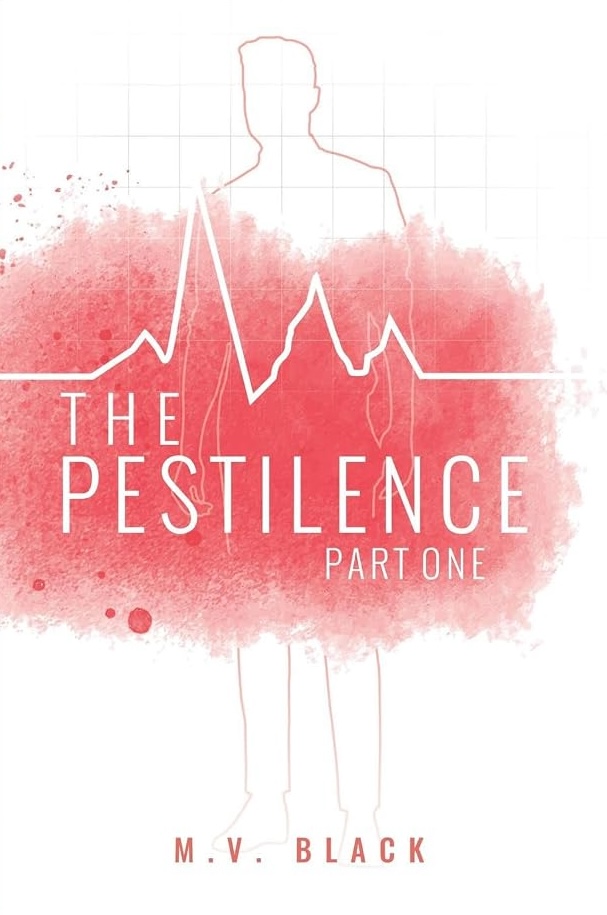
THE PESTILENCE
by M.V. Black
Listen to this review
M.V. Black’s The Pestilence, Part One is a daring, intellectually ambitious book that refuses to flatter the reader with easy certainties. Instead, it invites us into a relentless, often mesmerizing meditation on language, identity, morality, memory, and the fragile human need to define what is real. From its opening pages, the book establishes an unmistakable voice: incantatory, recursive, and unsettlingly precise. This is not a novel that simply tells a story; it builds a conceptual world out of syntax itself, making the act of reading feel like both a trial and an awakening.
What is most striking is the author’s commitment to form as meaning. The repeated, broken, and reassembled phrases in Section 1 and beyond are not mere stylistic ornament. They enact the book’s central concerns: the instability of perspective, the difficulty of naming, and the way thought itself circles around truth without ever quite settling. The early passages on “First,” “Day One,” and “Day Two” already suggest that chronology, like identity, is not fixed but interpretive. The prose does not simply discuss uncertainty; it performs it. That formal daring gives the book a rare originality.
At its core, The Pestilence is deeply concerned with human consciousness and the moral burdens that come with it. The recurring focus on hands, palms, right and left, self and other, turns the physical body into a site of philosophical inquiry. The narrator’s contemplation of “my right hand,” “my left hand,” and what is “right” or “wrong” becomes a subtle but powerful exploration of agency and responsibility. The book repeatedly asks who chooses, who decides, who permits, and who is permitted to be. These questions echo far beyond the page, touching on autonomy, conscience, and the pressure of social expectation.
One of the work’s great strengths is the way it moves from intimate inwardness to expansive metaphysics without losing emotional force. The sections on memory and forgetting are especially affecting. The text weighs whether forgetting can be freedom, whether memory can be a chain, and whether to remember is always to suffer. That tension feels humane rather than abstract. Likewise, the passages on love and selfhood are unexpectedly moving in their candor. The book recognizes that love is not merely a feeling but an ethical act, bound to fairness, trust, care, and the difficult business of not losing oneself while caring for others. The lines about caring “for myself” and being “my own advocate” carry a quiet dignity that anchors the book’s more abstract reflections.
Black’s prose style is uncompromising, but it is also carefully engineered. The rhythm of repetition creates a kind of verbal music, and the gradual accumulation of meaning through variation is one of the book’s most impressive achievements. The reader begins to sense that each phrase is being tested from multiple angles, as if the book is turning an idea in the light to see every facet. That method is especially effective in the sections on truth, faith, and belief. The book does not sneer at spirituality or certainty; rather, it examines how belief may coexist with doubt, and how meaning may remain elusive without becoming worthless. In that sense, the work has a serious philosophical integrity.
There is also a notable courage in the book’s refusal to simplify moral experience. The narrator does not present love, justice, fairness, or truth as slogans. Instead, these concepts are shown to be contingent, relational, and sometimes painful. The text’s sustained attention to “good for whom,” “right to whom,” and “fair according to what” makes it feel acutely contemporary, especially in a world where language is often used to conceal as much as reveal. The book’s insistence that words are not the same as things, and that naming can both create and trap, is one of its richest recurring insights.
If there is any gentle reservation, it is that readers looking for conventional plot development or narrative clarity may find this book deliberately spare in that regard. It asks for patience and active engagement. Similarly, its dense philosophical style can be demanding, and some readers may wish for occasional moments of repose. But these are not shortcomings so much as part of the book’s chosen design. The challenge is integral to the experience.
The Pestilence, Part One is the work of a writer with a fearless mind and a highly individual vision. It is intellectually rigorous, stylistically original, and unexpectedly moving in its exploration of what it means to think, to remember, to love, and to choose. For readers who appreciate literature that stretches language to its limits in pursuit of deeper truth, this is a rewarding and memorable book. Highly recommended.
Share-ready review images
Download square and vertical images for posts, stories, newsletters, and media kits.
For authors
Want a review page like this for your book?
Upload your manuscript, choose a review tier, and get a permanent public editorial review page you can share with readers.
Review My Book← Back to Reviews
