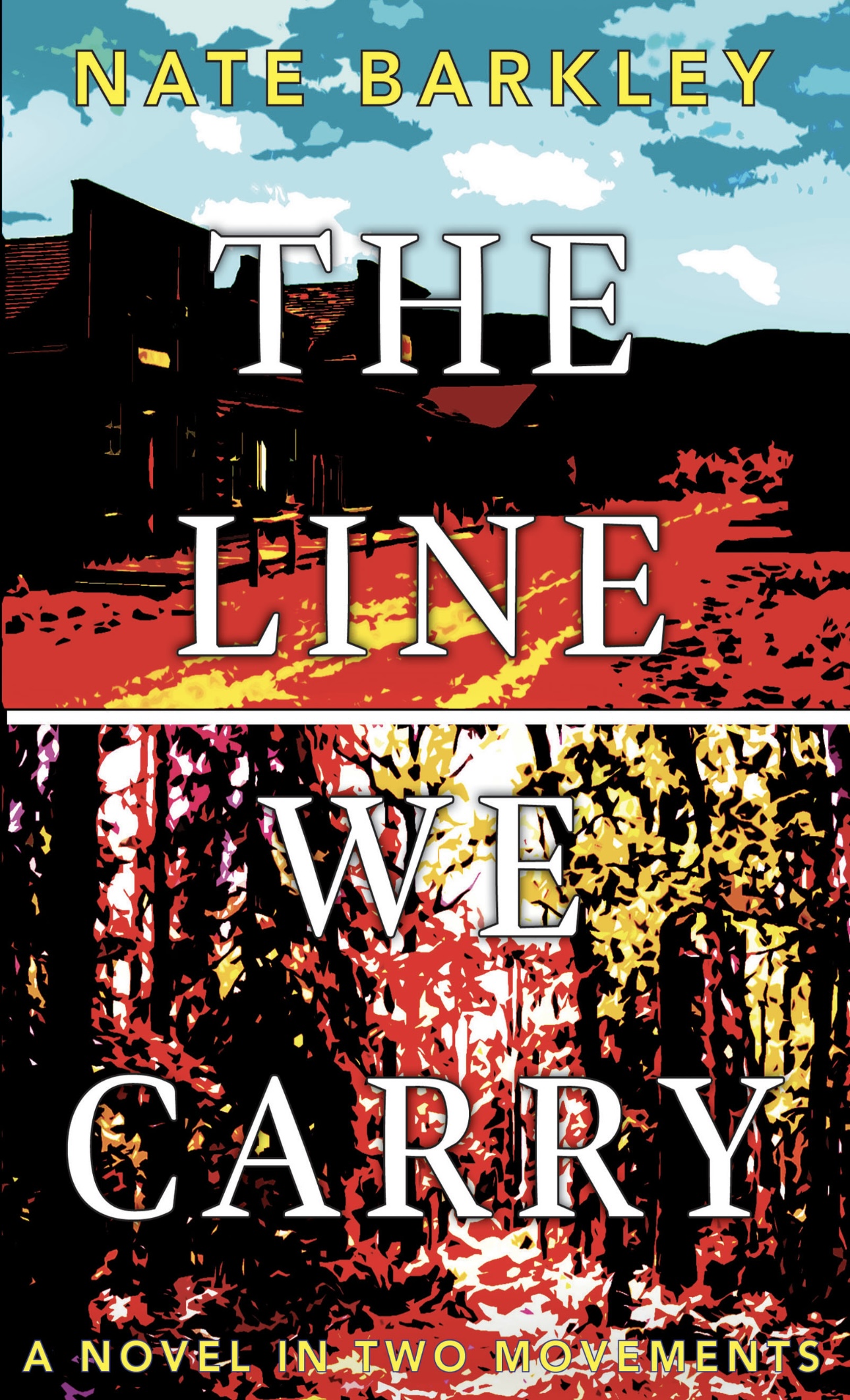
Fiction — Literary
The Line We Carry
by Nate Barkley
Listen to this review
The Line We Carry is built around an image that serves as both its organizing principle and its burden: a line drawn in dirt, imperfect and vulnerable to erasure, that marks the boundary between violence and restraint, memory and forgetting, one person’s past and another’s inheritance. Nate Barkley’s novel unfolds in two movements that initially seem far apart. “The Silent Echo” is a haunted Western about Cass Graves, the silent boy Shiloh, and the menace of Boone; “The Last Season” follows an isolated man in a snowy cabin as memory and time loosen their hold. Fire, carried objects, and acts of attention connect them more strongly than conventional plot does.
The first movement has the firmer narrative frame. Cass takes in Shiloh without asking his name, and the two travel through a landscape that seems to retain the marks of past violence. Ash Valley’s abandoned buildings and the uncanny basin at Badwater give the journey an unsettling, almost mythic dimension. Boone is less a conventional pursuer than a force that alters the atmosphere around him: in Jarrow’s account, he walks through fire as though it makes room. The novel’s tension comes not only from the prospect of a showdown, but from the question of what Cass’s example will teach Shiloh.
Barkley gives that question material form through recurring objects. The bullet with Cass’s initials, the Sparrow Hotel matchbook, and the two halves of a red scarf move between characters, gathering significance through use rather than explanation. At the ridge, Shiloh fires into the dirt between himself and Boone, crossing Cass’s remembered boundary without immediately turning the gun on a person. The gesture briefly interrupts the expected Western logic of draw and revenge. Cass’s own history complicates any easy moral authority: his account of helping cover the bodies after a Navajo massacre confronts the violence hidden behind his later code. That confession deepens the novel’s themes of complicity, conscience, and what can—and cannot—be passed on.
The prose is most effective when its lyricism remains grounded in physical detail: the tin bell at Mabel Gray’s store, dust that refuses to rise at Badwater, a match catching in a cold cabin. Barkley’s clipped sentences and spare dialogue suit characters who struggle to speak plainly about what they carry. His settings are not merely backdrops; the desert and winter woods seem to preserve traces that the characters themselves cannot fully interpret. The recurring fire motif is especially apt, shifting from a threatened source of warmth to an emblem of memory and possibility.
That same style can become overinsistent. The book repeatedly returns to silence, waiting, lines, weight, and fire, often in similar sentence rhythms and aphoristic exchanges. Some repetition builds a deliberate ritual quality, particularly in the cabin movement, where routine is gradually disrupted. Elsewhere, however, the prose restates an emotional point after an image has already made it. The result can be less cumulative than circular. Readers who prefer psychological realism, brisk pacing, or dialogue that reveals character without explicit symbolic framing may find the narration too mannered.
“The Last Season” makes a bolder structural choice. Its protagonist, called Ansel in the encounter with a woman in the grove, returns to a cabin with a sealed letter and an increasingly uncertain grasp of time, place, and memory. The book declines to clarify whether the woman is a visitor, a remembered presence, or something between those categories. The shifting impressions, failed routines, and objects that seem to move create an effective experience of disorientation. The later discovery of a folded letter fragment—“You were nev— alone”—offers a modest emotional counterweight to the section’s isolation without resolving its mystery.
The cost of that approach is substantial stillness. Long stretches follow the man as he tends a fire, studies snow, or sits beside the unopened letter. This accumulation makes small changes feel consequential, but the middle chapters often repeat the same pattern of observation, uncertainty, and return. The final movement toward the woods loosens the protagonist’s effort to recover a stable identity, yet the quietness can feel less like development than suspension. The closing newspaper account, identifying N. Emory Hale as a novelist who died alone, reframes the cabin narrative and brings a striking change of register. Its connection to the preceding scenes is suggestive rather than fully explained, an ambiguity likely to divide readers.
The two movements are not seamless, and the book does not supply a single clear key to their relationship. Instead, it trusts echoes: a line in dirt and a path pressed into snow, a matchbook and a fire, a burden transferred and then perhaps set down. That design is a source of originality, but also a limitation. The novel’s symbols sometimes carry more weight than its characters’ relationships, and its mysteries do not all resolve into satisfying revelations. Still, its strongest passages linger because they make moral inheritance tangible without pretending it can be cleanly escaped. The Line We Carry is best suited to readers drawn to meditative, formally linked fiction, lyrical Westerns, and stories of memory that leave room for uncertainty. Those readers may find its silences resonant; readers seeking a tightly plotted or plainly resolved novel may be less persuaded.
Share-ready review images
Download square and vertical images for posts, stories, newsletters, and media kits.
For authors
Want a review page like this for your book?
Upload your manuscript, choose a review tier, and get a permanent public editorial review page you can share with readers.
Review My Book← Back to Reviews
