Buy this Book:
Self-Help
The Language That Raised Us
Listen to this review
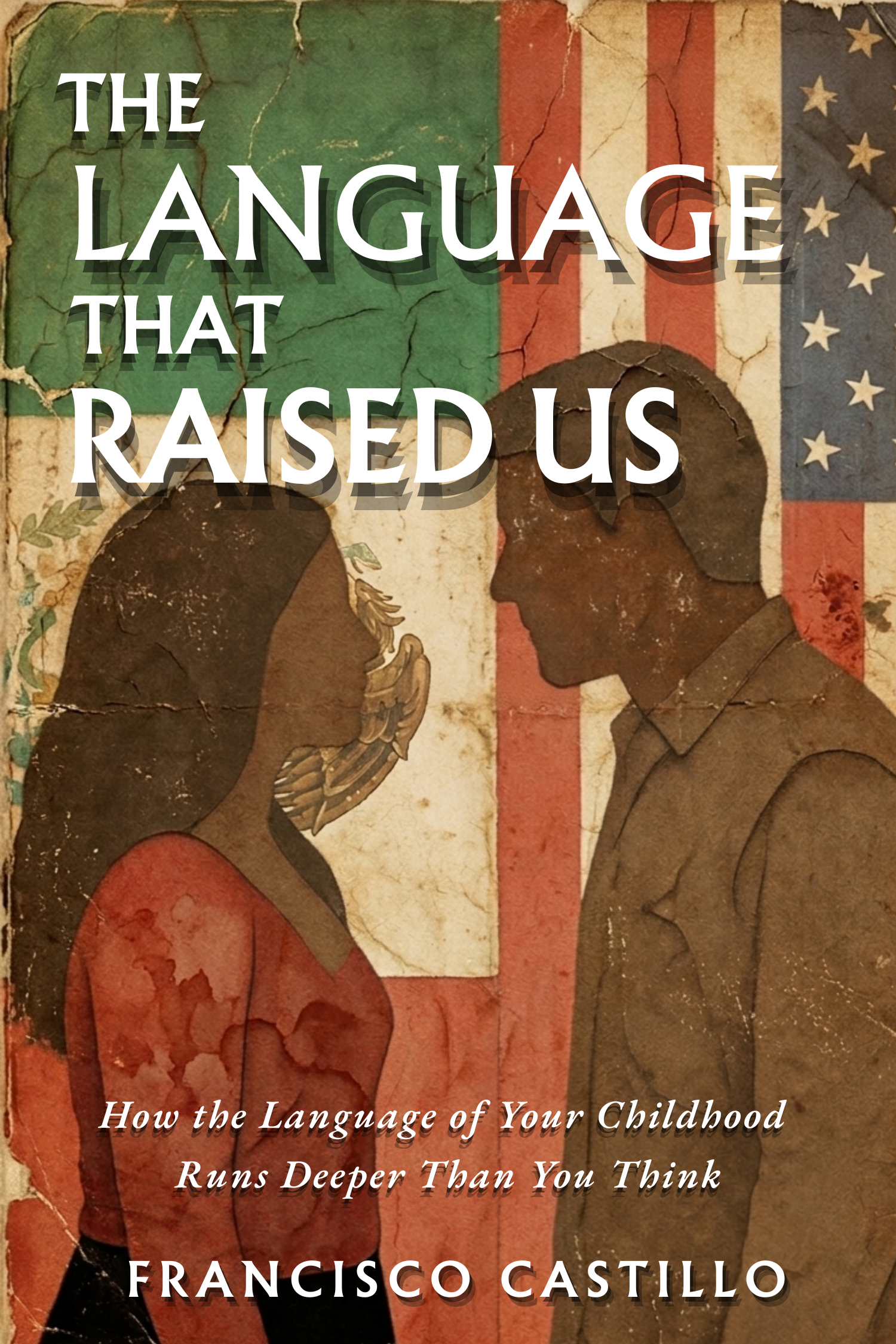
Francisco Castillo’s The Language That Raised Us is a deeply felt, intellectually nimble, and unusually compassionate examination of how childhood phrases become lifelong emotional architecture. Rather than treating family sayings as harmless cultural quirks, Castillo approaches them as inherited systems of survival, authority, shame, and love. The result is a book that feels both personal and social in scope: a close reading of the Mexican household as a site where language did not merely communicate, but programmed the body, shaped identity, and determined what kinds of feeling were safe.
What makes the book so compelling is Castillo’s ability to move between lived intimacy and structural analysis without losing either. He opens with the unforgettable phrase, “Te voy a dar una razón para llorar”, and immediately shows how a child’s tears can be shut down not by argument, but by fear. From there, he builds a rigorous and moving case that phrases like No llores, Aguántate, Porque yo lo digo, ¿Qué va a decir la gente?, and Calladito te ves más bonito are not incidental. They are training mechanisms. They teach endurance, obedience, self-erasure, and vigilance. Castillo’s prose is strongest when it insists that these messages were not invented in a vacuum: they emerged from colonization, labor exploitation, instability, religious regulation, and the daily mathematics of survival.
The book’s structure is one of its great strengths. After an elegant opening that establishes the emotional thesis, Castillo organizes the work into sharply focused chapters, each centered on a phrase and the emotional system it encodes. Survival Before Softness lays the historical groundwork beautifully, linking emotional restraint to scarcity, hierarchy, and necessity. When Language Becomes Law clarifies how a phrase such as Porque yo lo digo can function as a miniature regime of authority. The Survival That Never Ended is especially affecting in its discussion of inherited vigilance, explaining how a parent’s nervous system can keep a household living as though danger is still present long after the original threat has changed. This is one of the book’s most persuasive insights: that what looks like personality in adulthood may actually be an old survival instruction replaying itself.
Castillo’s writing is emotionally intelligent and culturally specific in a way that gives the book real force. He does not flatten Mexican family life into critique alone. Again and again, he acknowledges the tenderness inside these homes: the plate piled higher than requested, the hand on a fevered forehead, the father who worked himself to exhaustion, the mother who could not name feelings but offered labor, blessing, and protection. That balancing act keeps the book from becoming simplistic or accusatory. His insistence that readers can honor their parents’ sacrifices without romanticizing the harm is one of the book’s most mature and humane gestures. The line between explanation and excuse is handled with care.
There is also admirable sophistication in the way Castillo frames emotional inheritance as bodily, not merely intellectual. The book repeatedly returns to throat tightness, jaw clenching, bracing, silence, and the automatic interruption of feeling. This embodied focus gives the argument urgency. He is not describing abstract habits; he is describing reflexes that live in the nervous system. That insight becomes especially powerful when paired with the DECODE framework and the WUCOU-style steps introduced early in the book: Detect, Examine, Challenge, Override, Download, Evolve. These steps lend the book a practical backbone without diminishing its reflective depth. In fact, the method enhances the emotional resonance because it gives readers a way to work with what they recognize.
Several chapters stand out as particularly vivid. Obedience Over Understanding captures the psychic cost of being raised to comply before you can ask why, and does so with notable clarity. Your Truth Is Dangerous is equally strong, especially in its treatment of phrases like Me vas a matar de un coraje and the way a child comes to believe that honesty itself is harmful. The chapter on The World Is Always Watching offers a sharp analysis of shame, reputation, and the internalized gaze of the community, while remaining sensitive to the reality that in tight-knit or immigrant communities, appearances often did matter materially. Castillo’s best pages are the ones that hold both truths at once: surveillance can be oppressive, and it can also arise from real vulnerability.
If there is a limitation, it is only that readers seeking a more expansive comparative or regional analysis may wish for even broader coverage beyond the Mexican and Spanish-language frameworks the book so carefully centers. A few passages also lean toward reiteration, though the repetition is often purposeful, echoing the very phrases the book seeks to disrupt. These are minor points in an otherwise sharply observed and emotionally generous work.
The Language That Raised Us is ultimately a book about reclamation. It asks what happens when a generation learns that silence was once necessary but no longer has to be the whole story. It offers readers not just recognition, but relief: the possibility that the rules they absorbed are not their identity, and that what was inherited can be examined, revised, and, in time, transformed. Thoughtful, compassionate, and psychologically astute, this is a profoundly valuable book for anyone interested in family systems, emotional inheritance, and the hidden power of language. I recommend it wholeheartedly.
Share-ready review images
Download square and vertical images for posts, stories, newsletters, and media kits.
For authors
Want a review page like this for your book?
Upload your manuscript, choose a review tier, and get a permanent public editorial review page you can share with readers.
Review My Book← Back to Reviews
