Popular Science
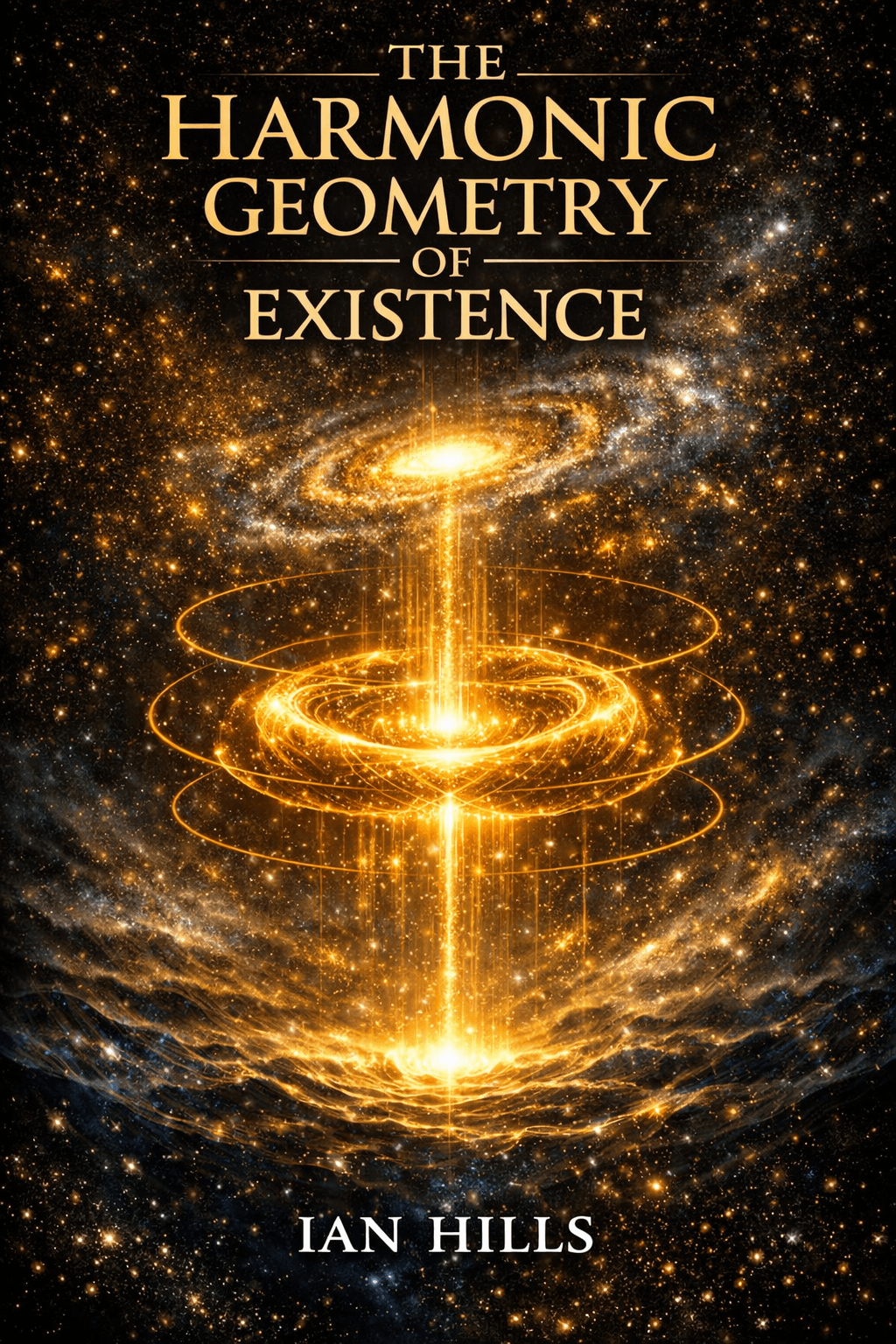
The Harmonic Geometry of Existence
by ian hills
Listen to this review
Ian Hills’s The Harmonic Geometry of Existence is an unusually ambitious and conceptually unified work: a book that seeks not merely to interpret a field, but to reorganize reality itself around a single governing principle. Read as a piece of speculative system-building, it is both bold and internally consistent, carrying forward its central conviction with remarkable steadiness. Across its long arc—from the opening “Author’s Note” and “Academic Abstract” to the final “Cosmic Conclusion” and “Temporal Relativity” synthesis—it offers readers a sustained vision of the universe as a harmonic field structured by curvature, rotation, boundary, and temporal rate. That level of structural commitment gives the book a distinctive force.
One of the book’s most impressive qualities is its formal design. The unified edition is not presented as a loose anthology, but as a reconstruction: earlier works are absorbed into a single framework, rewritten in “modern operator language,” and arranged so that each domain appears to emerge from the same underlying geometry. The “Technical Reader’s Map” is especially effective in this regard. It does not simply point to topics; it creates the sense that the volume is an engineered intellectual system, with every section linked to derivations, limiting cases, and proposed measurements. Even when the reader is skeptical of the claims, it is difficult not to admire the architecture. The book knows exactly what it wants to be, and it maintains that identity with confidence.
Stylistically, Hills writes in a declarative, cumulative mode that is well suited to the book’s ambitions. Repetition is not a flaw here so much as a rhetorical strategy: phrases such as “the operator,” “the temporal rate,” “coherence,” and “geometry” recur like motifs in a symphony, gradually building a sense of conceptual inevitability. This is particularly effective in sections such as “Time Across Scales,” where the same principle is traced from atoms to cells to brains to planets, and again in “Consciousness as a Temporal Mode,” where subjective experience is reframed as a rhythm of coherence rather than a mysterious inward realm. The prose often has the cadence of a manifesto, but it is one that remains organized, legible, and surprisingly patient with the reader.
The book’s strongest thematic achievement is its insistence on unity. It repeatedly argues that phenomena commonly treated as separate—physics, chemistry, biology, meteorology, consciousness, and civilisation—are expressions of one geometry. That idea gives the work real philosophical momentum. In “Chemistry Reinterpreted Through Geometry,” for example, orbitals become standing-wave geometries, bonds become shared boundaries, and catalysis becomes “geometric scaffolding.” In “Viruses as Icosahedral Disruptors,” biology is rendered as a conflict of curvature programs rather than a merely chemical struggle. And in the meteorology chapters, the sky becomes a visible demonstration of the same principles, with tornadoes, fallstreak holes, mammatus fields, and noctilucent clouds described as manifestations of toroidal or dusty plasma modes. Whether one accepts these claims scientifically or not, their imaginative reach is undeniable. Hills has the rare ability to make abstraction feel inhabited.
The book is also at its most compelling when it moves from theory to interpretation of scale. “Time Across Scales” is a particularly elegant chapter because it gives the framework a human rhythm: confinement at the smallest scales, coherence in biology, resonance in consciousness, rotation on the planetary scale, depth in stars, flow in galaxies, and geometric continuum at the cosmic level. That progression is not just conceptually neat; it creates a feeling of ascent. Similarly, the later chapters on being, experience, knowledge, ethics, aesthetics, and society extend the framework into human meaning without losing the book’s core vocabulary. The result is a work that does not confine itself to technical speculation, but tries to answer larger questions about how meaning, beauty, and collective life arise. That breadth is one of its greatest strengths.
At the same time, the book’s density can be demanding. Readers seeking a more conventional argument with frequent pauses, narrative transitions, or dialogic counterpoints may find the coverage intentionally compressed. The same can be said of the treatment of evidence: the book is most powerful as a visionary synthesis, and in places it would have benefited from a little more signposting for readers who want help moving between formal claims, observational examples, and interpretive leaps. These are minor concerns, however, and they are best understood as the tradeoffs of a project that aims for comprehensiveness and conceptual unity rather than incremental exposition.
What ultimately makes The Harmonic Geometry of Existence memorable is its confidence in re-enchantment through structure. Hills does not merely propose another theory; he proposes a way of seeing, one in which the cosmos, the body, the atmosphere, and civilisation all participate in the same hidden architecture. The book’s final movement toward “Temporal Relativity” gives that vision a name, and with it a philosophical center: not time as a universal background, but time as local, relational, and generative. Whether approached as speculative science, philosophical cosmology, or grand intellectual synthesis, the book offers a rare experience of totalizing coherence.
Recommended strongly for readers drawn to ambitious systems thinking, cross-disciplinary cosmology, and books that dare to unify the material, biological, cognitive, and civilizational worlds into one expansive and imaginative framework.
Share-ready review images
Download square and vertical images for posts, stories, newsletters, and media kits.
For authors
Want a review page like this for your book?
Upload your manuscript, choose a review tier, and get a permanent public editorial review page you can share with readers.
Review My Book← Back to Reviews
