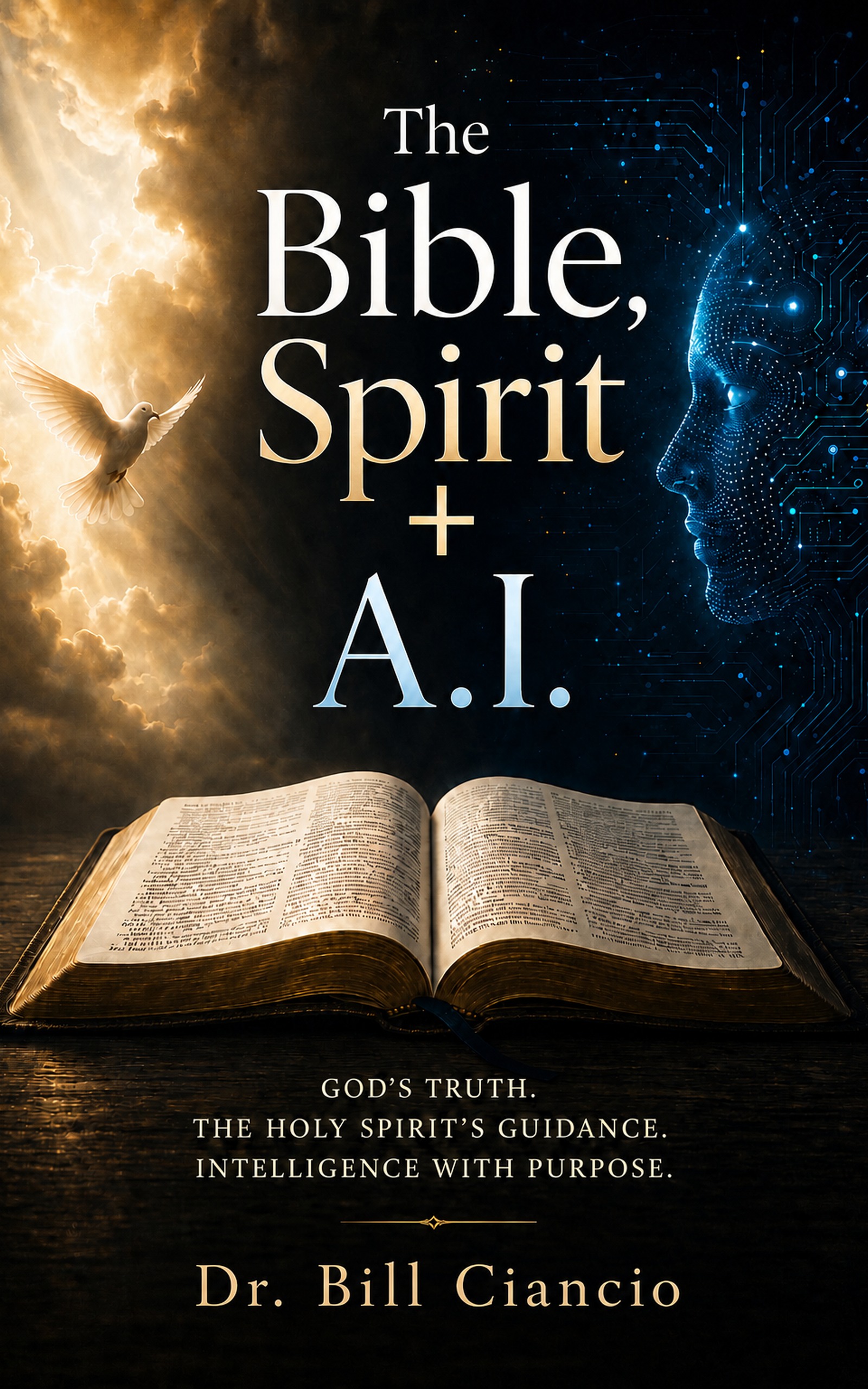
Buy this Book:
Bibles / General (BIB000000)
The Bible, Spirit + A.I.
by Dr. Bill Ciancio
Listen to this review
The Bible, Spirit + A.I. is an unusually timely and energetic contribution to the growing conversation about faith and technology. What makes the book compelling is not merely its premise—that artificial intelligence can assist Bible study—but the author’s earnest conviction that A.I., when guided by the Holy Spirit, can become a practical tool for spiritual growth, evangelism, and deeper understanding. This is a book that wants to help readers read more attentively, ask better questions, and approach Scripture with renewed curiosity, and that mission gives it real momentum.
From the opening chapter, Our Mission, the book establishes its central thesis with admirable clarity: “to know God” by combining the Bible, Spirit, and A.I. That three-part framework is the backbone of the entire work, and it is repeated with consistency across the chapters on summaries, charts, lists, comparisons, pictures, places, and archaeological investigations. Rather than treating A.I. as a gimmick, the book presents it as a research companion—one that can help believers move from a first reading to fuller contemplation. In that sense, the book is at its best when it is practical. The discussion of how to use A.I. to summarize 1 Samuel 25, chart the Beatitudes in Matthew 5, or compare the Christian Bible and the Quran gives the reader concrete ways to begin experimenting immediately.
One of the book’s strongest qualities is its enthusiasm for learning. The author writes with the kind of conversational immediacy that makes the material feel accessible, even when the subject turns technical. Chapters such as What is A.I., Why Use A.I., and Types of A.I. Applications succeed in demystifying the field for readers who may be new to tools like ChatGPT, Gemini, Perplexity, Copilot, and NotebookLM. The repeated emphasis on specificity—asking targeted questions, using rabbit trails wisely, and checking context—gives the book a genuine instructional value. The reader comes away not only with theological prompts, but with a workable method for using contemporary technology responsibly.
The book also has a distinctive devotional pulse. Its strongest theological moments arise when the author connects technology back to Scripture’s larger spiritual architecture. The treatment of the Great Commission in Chapter 1, the note about the Bible being “God talking to you,” the meditation on Acts 19:11 in the chapter on one-verse study, and the pairing of the Sermon on the Mount’s inner attitudes with outward actions all show a writer who sees Bible study as transformative rather than merely informational. That is an important distinction. The book consistently insists that knowledge should lead to understanding, understanding to wisdom, and wisdom to action. This progression gives the work a satisfying moral shape.
Equally effective is the author’s use of examples. The chapter on pictures is especially vivid, not because the A.I.-generated images are always perfect, but because the author notices the differences between textual description and visual interpretation. The explorations of Revelation 2:1, Revelation 7:1, Revelation 12:7, and Daniel 2:31–33 are memorable precisely because they dramatize how imagination, language, and digital tools interact. Likewise, the chapters on places and things—Jericho, En Gedi, the Dead Sea Scrolls, and biblical artifacts—add a welcome sense of historical and archaeological texture. The book becomes most engaging when it is exploring the physical world behind the biblical text.
There is also a pleasing originality to the structure. Rather than proceeding as a conventional theology manual, the book unfolds through a sequence of practical categories: summaries, charts, lists, comparisons, unusual comparisons, pictures, places, things, and understanding. That design mirrors the way many readers actually study Scripture—piecemeal, inquisitively, and by following questions wherever they lead. The repeated invitation to “rabbit trail” is charming, and it captures a real feature of contemporary research culture. The result is a book that feels less like a lecture and more like a guided workshop in holy curiosity.
That said, readers who prefer a more tightly edited academic style may occasionally wish for greater concision and a more restrained repetition of core ideas. Some sections revisit the same claims about A.I.’s usefulness, sometimes in slightly different language, and a few factual assertions are presented with more confidence than some scholars would grant them. But even here, the book’s intent is constructive: it is trying to empower lay readers, not overwhelm them. Its voice remains sincere, generous, and encouraging throughout.
What ultimately gives The Bible, Spirit + A.I. its appeal is its optimism. It sees technology not as a threat to faith, but as an opportunity for believers to study more deeply, ask more specifically, and speak more confidently about what they believe. The tone is earnest, the examples are plentiful, and the practical applications are genuinely helpful. If you are a Christian reader curious about how A.I. might support Bible study, or if you simply enjoy books that connect old truths with new tools, this is a rewarding and stimulating read. I recommend it warmly and wholeheartedly.
Share-ready review images
Download square and vertical images for posts, stories, newsletters, and media kits.
For authors
Want a review page like this for your book?
Upload your manuscript, choose a review tier, and get a permanent public editorial review page you can share with readers.
Review My Book← Back to Reviews
