Buy this Book:
Science / Life Sciences / Evolution (SCI027000)
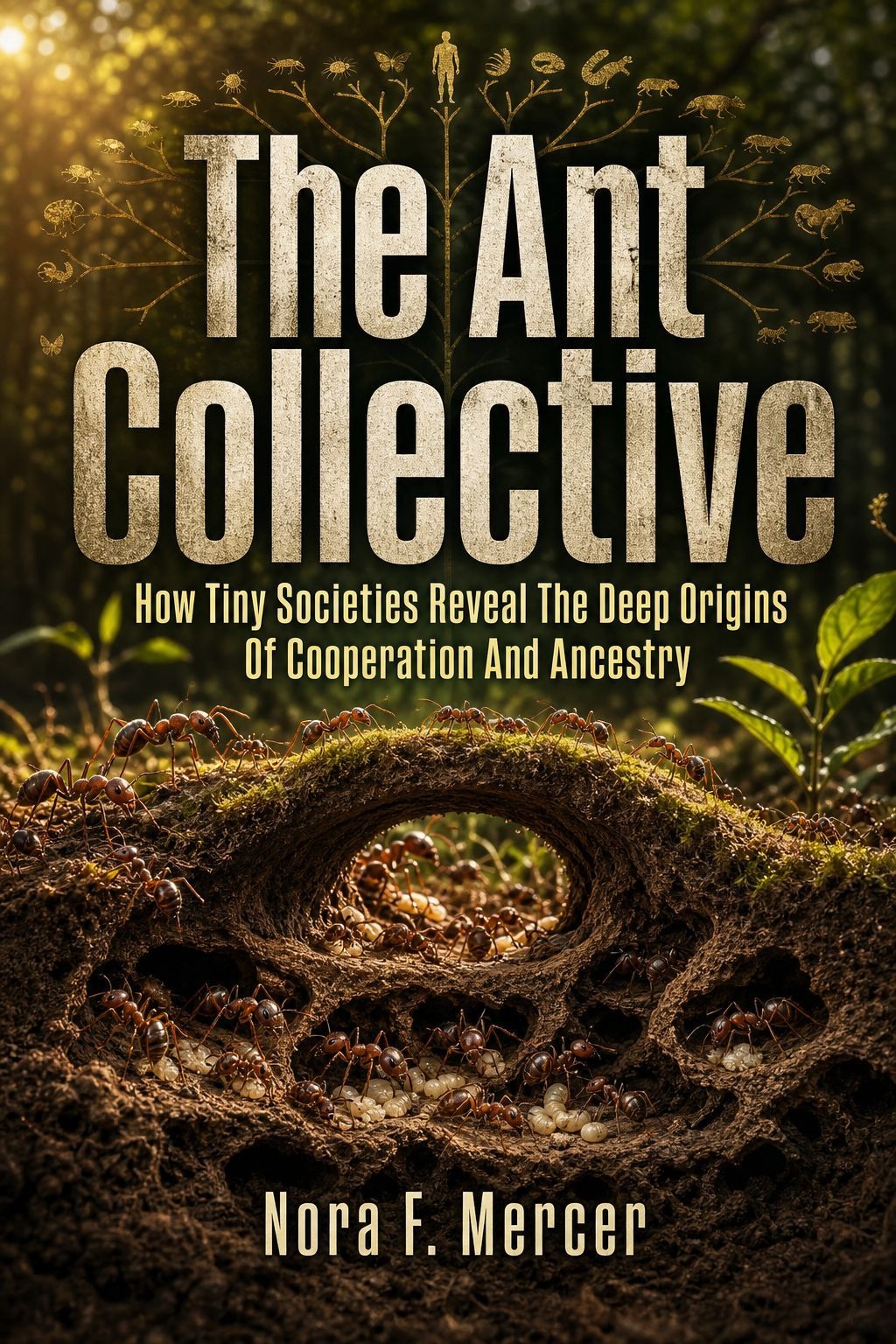
The Ant Collective
by Nora F. Mercer
Listen to this review
The Ant Collective is an ambitious synthesis of ant biology that aims to do more than catalogue insect facts. Across its ten chapters, it builds a sustained argument that ant societies are among the clearest natural examples of cooperation becoming an evolutionary system. The book’s chief strength is that it treats ants simultaneously as ecological actors, social systems, and biological experiments in individuality. In Chapter 1, for instance, the discussion of ants as “ecological engineers” is especially effective: soil excavation, seed dispersal, predation, and nutrient cycling are not presented as isolated curiosities but as linked processes through which colonies alter the environments that then shape plant and insect life. That ecological framing gives the book a strong opening premise and a wider relevance than a purely natural-history survey.
The writing is at its best when it explains large ideas with controlled precision. Rather than relying on metaphor alone, the book steadily accumulates evidence for how colony life works. Chapter 2’s account of the costs and benefits of living together is clear about the trade-offs: brood care, food pooling, and nest construction become more efficient, yet crowding also increases disease risk and the temptation to cheat. Chapter 7 extends that logic by showing how cooperation must be stabilized through policing, recognition systems, and reproductive control. The book is persuasive precisely because it does not romanticize ant societies. It understands them as systems held together by both collaboration and constraint, and it repeatedly returns to that tension in a way that gives the argument coherence.
One of the book’s more compelling intellectual moves is its insistence that ant colonies can be discussed as emergent biological units without erasing the individuality of workers. Chapter 3, on “The Ant Body, the Ant Brain, and the Limits of Individuality,” is particularly strong in this respect. It explains how antennae, pheromones, tactile contact, and environmental traces distribute information across bodies and nest space, so that intelligence becomes partly externalized. This is not a flashy claim in the text; it is built patiently through examples of recruitment, identity cues, and local perception. Similarly, Chapter 6’s treatment of the superorganism concept is careful and useful. The book does not overstate the analogy between colony and body, and that restraint makes the concept more convincing, not less. By emphasizing boundaries, internal regulation, and the division between reproductive and nonreproductive castes, the author gives readers a serious account of why the superorganism idea remains valuable in social insect biology.
Structure is another of the book’s assets. The chapter sequence moves logically from ecological importance to evolutionary origin, communication, division of labor, superorganismality, conflict, deep time, cross-species comparison, and finally human implications. That progression allows the book to build conceptual complexity without losing the reader entirely in technical detail. The later chapters, especially Chapter 9 on cooperation across the tree of life and Chapter 10 on human ancestry and society, work as a useful widening of scope. They remind readers that ants are not treated here as a sealed-off curiosity but as part of broader questions about how cooperation evolves, how it is stabilized, and where analogies to human social life are illuminating or misleading.
The book is also commendably cautious in its comparative sections. Chapter 10 is a good example: it explicitly states that humans are not ants, and that the comparison matters only if the differences are respected. That is an intellectually responsible stance, especially in a topic where analogies can easily become overreach. The text’s discussion of human flexibility, symbolic reasoning, institutions, and non-kin cooperation gives the comparison real limits. As a result, the book avoids the familiar trap of using ants as a simplistic model for human society.
Still, the book’s strengths come with some limitations. Its voice is consistently explanatory, but that consistency can also make the prose feel more programmatic than vivid. Chapter after chapter, the same analytical cadence dominates: ant colonies “do not merely” occupy habitats, they remake them; the colony “therefore” becomes more than the sum of ants; selection “can” favor this or that mechanism. The argument is sound, but the style is sometimes repetitive, and readers looking for narrative momentum, field anecdotes, or a more varied rhetorical register may find the experience somewhat uniform. The excerpted table of contents suggests a useful appendix on observation and a glossary, yet the main text presented here is more conceptual than experiential.
There are also moments when the book’s ambition exceeds the specificity of its evidence as presented. Chapter 8 promises “Ant Evolution in Deep Time,” but within the supplied material the fossil record is treated largely as an inferential framework rather than as a sequence of concrete examples. That is not a flaw in itself, since the fossil record of ants is necessarily incomplete, and the book acknowledges that. But readers hoping for a richly illustrated paleobiological narrative may find the discussion more synthetic than granular. Likewise, Chapter 9 reaches across microbes, multicellular organisms, vertebrates, and mammals to identify common principles of cooperation, yet the breadth of that sweep can flatten important differences among very dissimilar systems. The book is at its most convincing when it stays close to ants; it is somewhat less compelling when it tries to unify too much of biology under one set of social principles.
In sum, The Ant Collective is a thoughtful, well-structured, and intellectually serious introduction to ant societies and what they reveal about cooperation in nature. Its strongest chapters explain ecological engineering, communication, division of labor, and conflict management with clarity and discipline. Its main weakness is not error but density: the book is more analytical than immersive, more synthetic than dramatic. Recommended for readers with an interest in evolutionary biology, social insects, and the science of cooperation—especially those who value conceptual rigor over storytelling—but less well suited to readers seeking a lively field-guide style or a richly anecdotal natural history.
Share-ready review images
Download square and vertical images for posts, stories, newsletters, and media kits.
For authors
Want a review page like this for your book?
Upload your manuscript, choose a review tier, and get a permanent public editorial review page you can share with readers.
Review My Book← Back to Reviews
