Buy this Book:
Juvenile Nonfiction / Sports & Recreation / General (JNF054000)
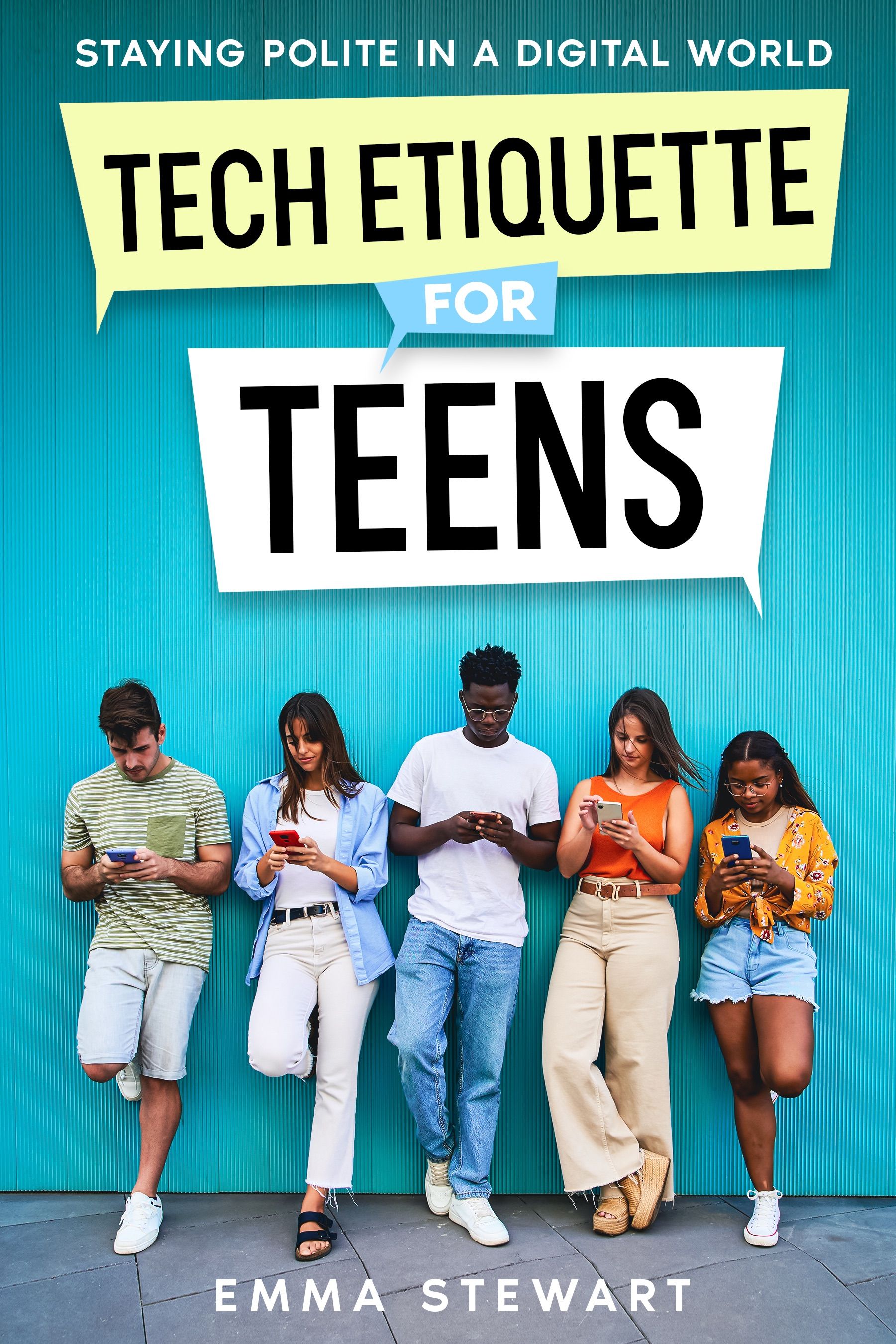
Tech Etiquette for Teens
by Emma Stewart
Listen to this review
Tech Etiquette for Teens is a plainspoken, highly practical guide that aims to bridge a gap many families know well: the distance between adult concern and teen habit in a digital culture that seems to change by the week. Its central premise is clear from the outset in Chapter 1, “Introduction” and “Why This Book?”: online life is not an add-on to adolescence but part of its core social and emotional terrain. That message gives the book immediate relevance. It is not trying to be trendy for its own sake; it wants to be useful, especially for teens and parents who are looking for a shared language around screens, social media, and boundaries.
The book’s greatest strength is its accessibility. The prose is conversational, direct, and consistently oriented toward the reader’s everyday experience. It uses approachable analogies throughout: navigating technology is compared to learning to drive, tech etiquette to social manners at a party, and digital life to a “town square” or “playground.” These comparisons are not especially subtle, but they do help make abstract concerns concrete for younger readers. In the chapter “What is Tech Etiquette?” the book defines the concept in a way that is easy to absorb, emphasizing respect, privacy, and awareness of digital footprints. Likewise, the sections on “How Technology Use Impacts the Teen Brain” and “How Technology Use Impacts Teen Behavior” frame screen time not as a moral panic but as a matter of balance, attention, sleep, self-esteem, and habit formation.
Another strong feature is the book’s broad scope within a focused mission. It does not merely scold teens for using phones; it explores multiple domains of digital life: family relationships, friendships, online romance, email, texting, and social media. That structure gives the book a real-world utility. The chapter on “How Technology Use Impacts Relationships with Friends” is especially effective in identifying recognizable tensions such as phubbing, FOMO, and the strain caused by constant availability. The “Navigating Love and Friendships Online” and “Dating and Technology Use” sections are similarly valuable because they acknowledge the speed and ambiguity of digital intimacy while repeatedly returning to the importance of boundaries, privacy, and authenticity. For a teen audience, that combination of caution and permission is likely more workable than a lecture about abstinence from technology.
The “Cheat Sheet” sections are also among the book’s most useful features. The lists on email, texts, and social media posting break etiquette into manageable habits: writing clear subject lines, avoiding late-night texts, respecting privacy in group photos, and thinking before posting. These sections give the book a workshop-like quality. They are practical, memorable, and easy to revisit. For parents or educators seeking a quick reference rather than a theoretical treatment, these lists provide the clearest value in the book.
That said, the book has some limitations that are hard to ignore. The most obvious is its repetitiveness. The same ideas—think before you post, protect privacy, be kind, maintain balance, model good behavior, use technology intentionally—are reiterated in nearly every chapter. Repetition can aid younger readers, but here it often blunts momentum and makes the argument feel more circular than cumulative. Because the language leans heavily on motivational phrasing, the book sometimes reads less like an evolving discussion and more like a series of variations on the same core advice. Readers looking for a more nuanced or layered exploration of digital culture may find this frustrating.
A related weakness is the book’s reliance on generalizations. The chapter “How Technology Use Impacts the Teen Brain” refers to “studies” and makes claims about attention span, memory, sleep, and mental health, but the supplied text does not show the kind of specific evidence, counterargument, or citation trail that would make those claims feel fully grounded. The book’s position is sensible, but it is more assertive than analytical. Likewise, the discussion of teens and technology sometimes slips into broad assumptions about “teens today” in ways that simplify a diverse audience. The result is a guide that is easy to follow, but not especially probing.
There is also a tonal imbalance. The book is earnest to a fault, and its upbeat moral clarity is both a virtue and a constraint. It keeps the tone reassuring, but it can also flatten the complexity of the subjects it addresses. Online friendship, family surveillance, digital identity, and teen romance are all treated as issues that can be resolved through awareness and etiquette. In practice, the book seems more comfortable prescribing good habits than wrestling with deeper tensions about power, autonomy, and the social pressures built into platforms themselves. Readers hoping for a sharper critique of technology’s structures will not find it here.
Even so, the book succeeds on its own terms as a family-facing primer. The concluding “Online Safety Guides and Tutorials” section is a sensible addition, and the named resources, including ConnectSafely.org, Common Sense Media, Internet Matters, Google Family Link, Apple Screen Time, Qustodio, StopBullying.gov, and teen crisis resources, strengthen the book’s practical usefulness. This closing section extends the book beyond advice into action, which is appropriate for a subject where guidance matters as much as interpretation.
In the end, Tech Etiquette for Teens is best understood as a sturdy introductory manual rather than a sophisticated cultural study. Its strengths lie in clarity, sincerity, and usability; its weaknesses lie in repetition, limited nuance, and a tendency to overstate familiar lessons without deeply interrogating them. I would recommend it most strongly to parents, caregivers, and younger teens who want an accessible starting point for conversations about screen time, social media behavior, and digital boundaries. Readers seeking a more rigorous or less repetitive examination of technology’s effects may want something more substantial.
Share-ready review images
Download square and vertical images for posts, stories, newsletters, and media kits.
For authors
Want a review page like this for your book?
Upload your manuscript, choose a review tier, and get a permanent public editorial review page you can share with readers.
Review My Book← Back to Reviews
