Buy this Book:
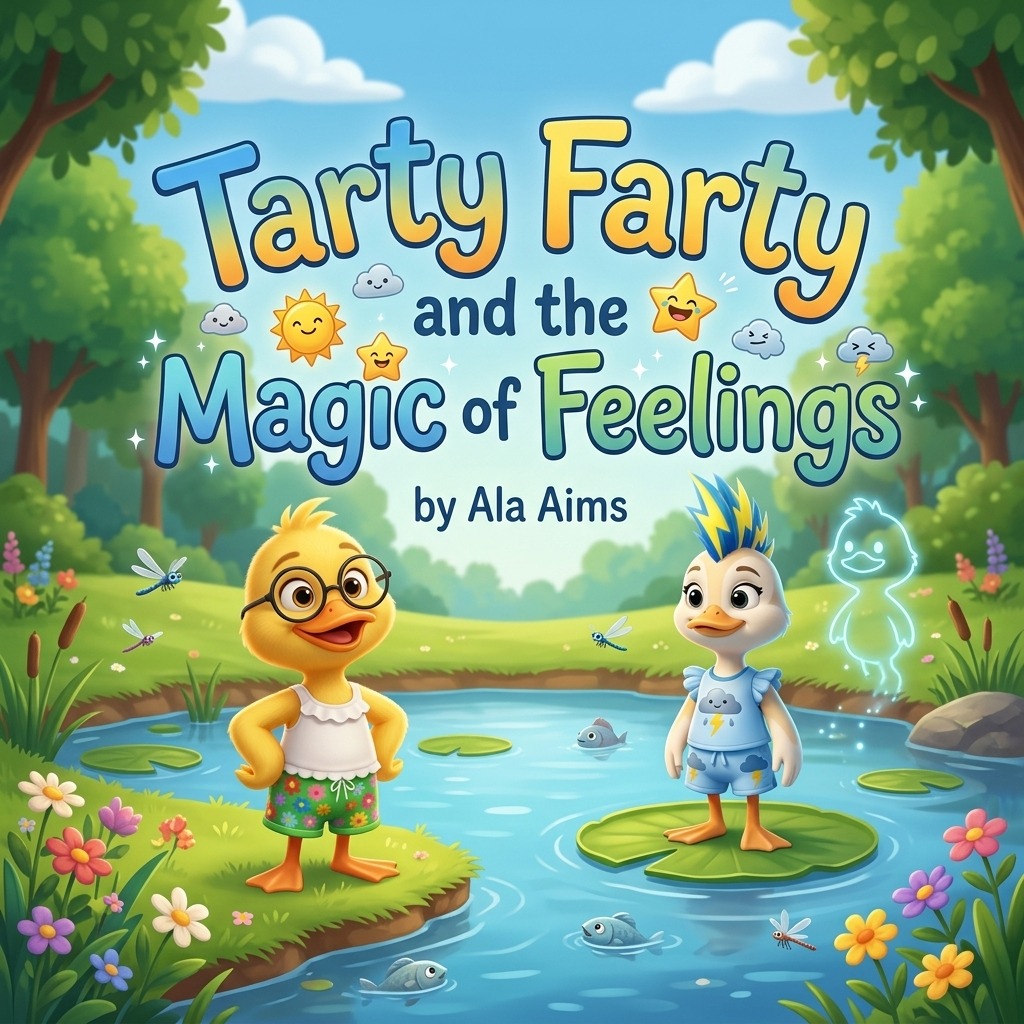
Tarty Farty and the Magic of Feelings
by Ala Aims
Listen to this review
Tarty Farty and the Magic of Feelings is an earnest, plainly written picture-book fable about self-belief, comparison, and emotional regulation. On the page, it offers a compact moral arc: the cheerful duck Tarty Farty helps her imaginary companion Sucky Ducky move from self-doubt to confidence through patient reassurance, breathing exercises, and repetition of affirmations. The story’s intentions are immediately legible, and for very young readers or adults seeking a gentle confidence-building read-aloud, that clarity is one of its chief assets. At the same time, the book’s heavy-handed messaging and schematic character development limit its literary range. It is more a statement of purpose than a fully dramatized story, and that will matter for readers looking for nuance.
The strongest feature here is the book’s emotional accessibility. The central metaphor in which feelings are compared to weather—“Sometimes it storms, but you do not have to be perfect to be amazing”—is simple enough for children to grasp while still opening the door to discussion. Likewise, the scene of Sucky Ducky struggling with a lopsided mud teapot and a missed melody gives concrete form to everyday disappointments that children recognize: the imperfect craft project, the botched attempt, the instant leap to “I can’t do anything right” or “I am a total failure.” These are familiar emotional distortions, and the book deserves credit for naming them in language young readers can understand. The inclusion of breathing exercises, “Take a deep breath in through your beak... and let it out slowly,” also makes the story practical rather than merely reassuring; it offers a behavior children can imitate.
The book’s conceptual originality lies less in plot mechanics than in its symbolic structure. Sucky Ducky is introduced as imaginary, then becomes physically real once she learns self-acceptance. That transformation gives the story a neat visual logic: inner belief becomes outer substance. For a picture book, this is an appealing conceit because it externalizes a psychological change in a way that can be illustrated vividly. The setting of Lilypad Hollow, the “lightning-bolt feathers,” the shimmering light at the moment of transformation, and the final shared sunsets all suggest a soft, whimsical world that fits the book’s therapeutic aims. The result is a story that feels designed to soothe rather than challenge.
Still, the very neatness of the arc is also a limitation. The book moves quickly from self-doubt to affirmation to magical reward, and that progression may feel too tidy for readers who need a more realistic account of how confidence is built. Sucky Ducky’s problems are reduced to two or three incidents, after which Tarty Farty’s supportive dialogue and a few weeks of practice appear to resolve everything. There is little sense of struggle beyond the repetition of positive phrases. Because of that, the story risks implying that emotional growth is mainly a matter of saying the right words until they work. Children who have experienced deeper anxiety or persistent comparison may not see their experience reflected in such a streamlined remedy.
The characterization is similarly broad. Tarty Farty is consistently kind, patient, and instructive; Sucky Ducky is consistently insecure and receptive. Their roles are functional, almost emblematic. That is not necessarily a flaw in a picture book, where economy matters, but it does mean the book rarely surprises. Tarty Farty’s responses are so reliably affirming that the emotional beats can become predictable. The ending, in which the imaginary friend becomes real and the pair live “happily ever after,” closes the story with certainty rather than complexity. The message is wholesome, but also unmistakably predetermined.
The prose itself is clear and direct, though at times it leans into repetition and exclamation in ways that flatten its rhythm. The repeated declarations—“I am learning. It is okay to make mistakes. I am enough!”—do reinforce the book’s therapeutic intent, but they also verge on slogan. Similarly, the emphatic phrases “BIG, ANGRY FRUSTRATION” and “magic happens when you believe in yourself” make the book’s lesson impossible to miss, yet leave little room for subtext. Some young children will benefit from that directness; others, especially those who prefer stories with a little more narrative tension or linguistic play, may find it didactic.
The author’s note adds useful context by explaining that the story grew out of observing someone loved struggle with comparison and lost confidence. That personal origin gives the book sincerity, and the note strengthens the reading of the story as an act of care rather than a generic moral lesson. The closing reminder that “the world doesn't need another somebody else. It needs the only you there will ever be” nicely encapsulates the book’s aim. Yet the note also confirms what the story already suggests: the book is built around a message first and a narrative second. Readers who appreciate explicit emotional coaching in a picture-book format will likely respond warmly to that prioritization.
In the end, Tarty Farty and the Magic of Feelings is best understood as a gentle confidence booster for children who benefit from straightforward reassurance, simple metaphors, and an uncomplicated emotional arc. It is likely to be most valuable as a read-aloud for very young children, for caregivers looking for a conversation starter about self-esteem and frustration, and for settings where affirmations and coping strategies are welcome tools. Readers wanting richer character development, greater psychological realism, or a less instructional approach will probably find it too tidy and repetitive. It is a caring book with a clear heart; it will serve its intended audience best when approached as a comforting lesson rather than a layered literary fable.
Share-ready review images
Download square and vertical images for posts, stories, newsletters, and media kits.
For authors
Want a review page like this for your book?
Upload your manuscript, choose a review tier, and get a permanent public editorial review page you can share with readers.
Review My Book← Back to Reviews
