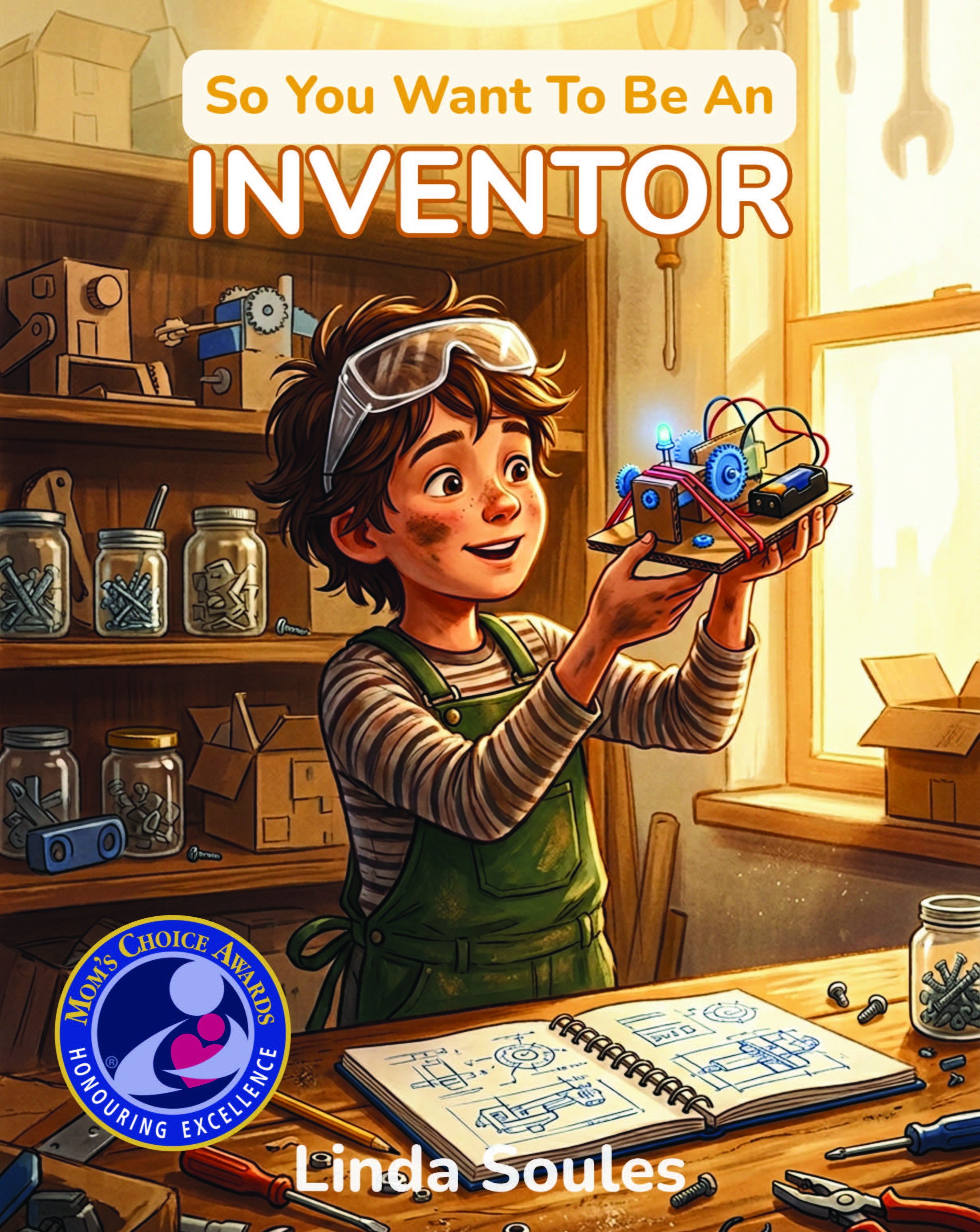
Children's Nonfiction
So You Want To Be An Inventor
by Linda Soules
Listen to this review
So You Want to Be an Inventor makes a persuasive case that invention is less a flash of genius than a habit of attention. Its central invitation—to notice what frustrates people, build a rough solution, and learn from its failures—is both encouraging and practical. Rather than presenting inventors as remote prodigies, Linda Soules addresses the reader directly: curiosity is already a starting point, and a child can begin by sketching an improvement or taking apart a broken toy. The book’s strongest achievement is turning that broad idea into a recognizable process without making the work sound effortless.
The account of invention is clearest when it follows that process through concrete stages. “What An Inventor Actually Does” moves from identifying a problem to research, prototyping, testing, and revision; the explanations of prototypes and iterative work are plain enough for younger readers without reducing them to slogans. The sample “Day in the Life” gives the process welcome texture. Its jar opener for people with limited hand strength is tested across different jar sizes, revised with textured rubber, and still requires further testing after it works at dinner. This is a useful counterweight to the book’s more inspirational passages: success is provisional, and a working device is not necessarily a finished one.
The book also treats failure as information rather than a personal verdict. That theme recurs in the chapters on difficult parts of the job, inventor qualities, and the glossary, where iteration and failure are presented as ordinary features of the work. The emphasis has real value for readers who might assume that a failed experiment means they lack talent. Soules reinforces the point with accessible examples, including the Post-it Note adhesive and Lonnie Johnson’s accidental discovery of the Super Soaker. The suggested activities—keeping a notebook, identifying household annoyances, searching for prior art, and making a cardboard prototype—extend the book beyond career description and give readers reasonable first steps.
Its account of invention is also notably social. The text stresses that useful ideas begin with other people’s difficulties, and it gives due attention to how race and gender can shape who is taken seriously. The profiles of Garrett Morgan and Hedy Lamarr describe barriers to recognition as part of their working lives, not as incidental details. Gitanjali Rao’s example supports the book’s claim that young people can participate in problem-solving now. These profiles broaden a subject that might otherwise default to familiar stories of solitary male inventors, and they connect invention to access, public benefit, and the uneven distribution of credit.
Soules writes in an energetic, conversational style, using short emphatic sentences, direct questions, and vivid comparisons. “Your brain is a lightning storm of ideas” and the notebook as “your net” make the advice memorable. That voice should suit many readers in the stated 10–14 age range, particularly those encountering career exploration through independent reading or with an adult. The organization is easy to navigate: sections on tools, workplace, colleagues, preparation, and vocabulary offer different entry points, while the glossary makes technical terms less intimidating. The closing resource list further directs interested readers toward books, websites, makerspaces, and competitions.
There are, however, limits to the book’s approach. The motivational voice sometimes becomes so emphatic that it blurs the difference between possibility and promise. The closing assurance that “the invention is coming” may inspire, but it suggests a certainty the rest of the book’s honest discussion of failure does not support. Likewise, the repeated claim that persistence and curiosity can lead to invention risks underplaying the resources, training, time, collaboration, and financial support that many projects require. The text does acknowledge professional teams, manufacturing, investors, and commercialization, but these constraints receive less attention than the personal virtues of the inventor.
Some explanations are also compressed enough to warrant more qualification. The glossary says a patent means an idea is “legally yours,” a simple formulation for young readers but one that may leave them with an overly broad impression of what patent protection covers. The historical anecdotes and numerical claims—including the scale of the Super Soaker’s sales and the assertion that invention is accelerating—are presented without citations in the supplied text. A short source note or further-reading trail for these claims would strengthen a book that repeatedly encourages research and careful testing. The “multiple discovery” section is engaging, though its examples could use more context to distinguish the broad pattern from the particular circumstances of each case.
The book is therefore most successful as an encouraging introduction, not as a comprehensive guide to inventing or intellectual property. Its accessible explanations, practical exercises, and attention to overlooked innovators make it a useful starting point for curious children, especially readers who enjoy making things or noticing everyday problems. Adults sharing it with younger readers may want to supplement the patent discussion and explore the historical claims together. For children who want a first, friendly account of how an idea becomes a testable object—and who need reassurance that revision is part of the work—this is a worthwhile choice.
Share-ready review images
Download square and vertical images for posts, stories, newsletters, and media kits.
For authors
Want a review page like this for your book?
Upload your manuscript, choose a review tier, and get a permanent public editorial review page you can share with readers.
Review My Book← Back to Reviews
