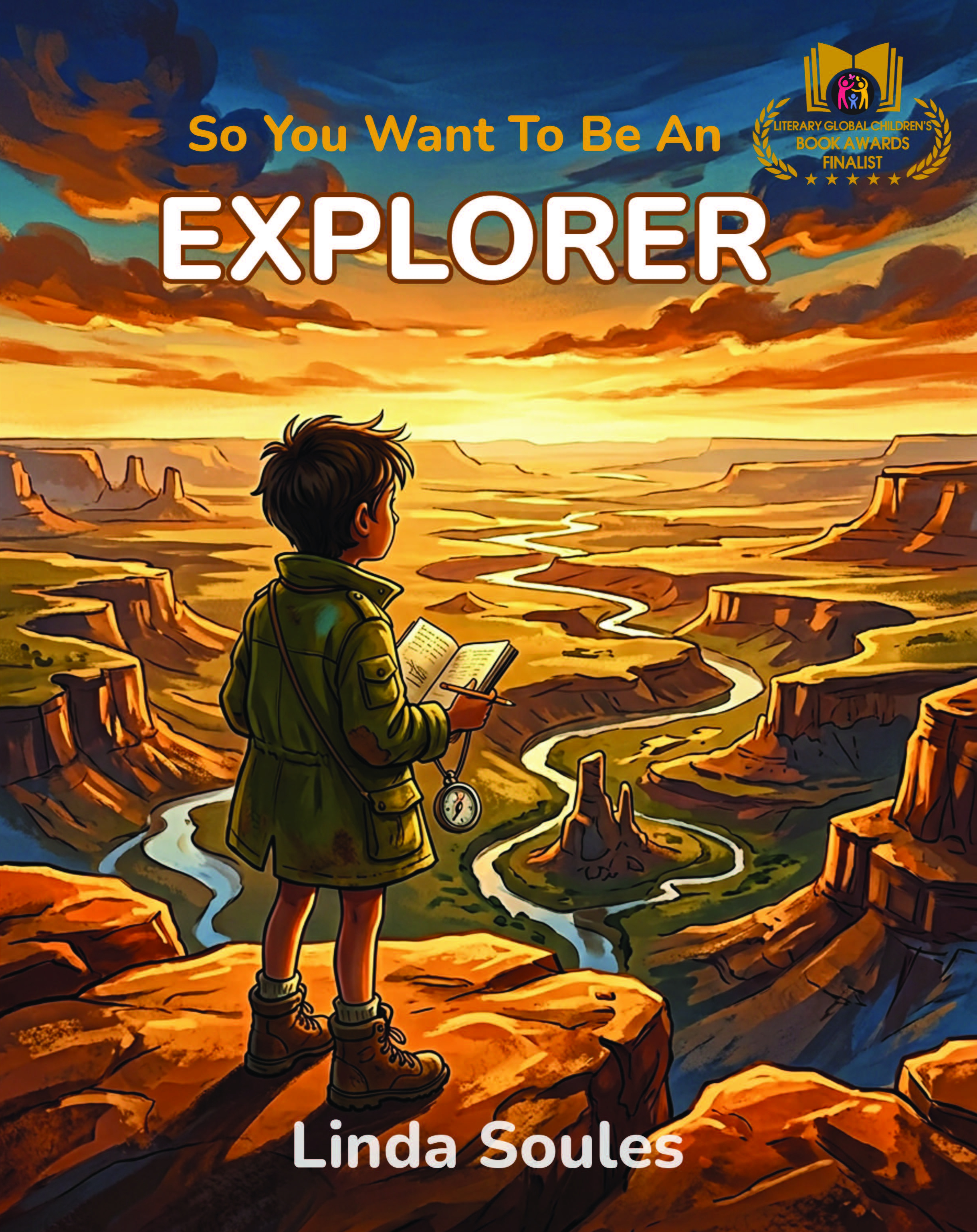
Children's Nonfiction
So You Want To Be An Explorer
by Linda Soules
Listen to this review
So You Want to Be an Explorer makes a persuasive case that exploration is not a vanished age of heroic voyages but a continuing practice of asking questions, gathering evidence, and sharing what is learned. Aimed at young readers, it ranges from deep-sea mapping and cave systems to backyard observation, presenting exploration less as a distant career fantasy than as a disciplined way of paying attention. Its best quality is this shift in scale: the book can make an unexplored seafloor and an overlooked rock near home feel part of the same larger curiosity.
The writing is direct, energetic, and often vivid. Short sections, second-person address, and concrete details give the material an approachable pace. The account of the Naica crystals, discovered when miners Juan and Pedro Sánchez drilled into a hidden chamber, turns an accidental opening into a lesson in observation and reporting. The book also makes useful distinctions between adventure and professional work: “Exploration without documentation is just travel,” it argues, emphasizing field notes, measurement, preparation, and communication. The practical advice—start a notebook, map a familiar route, identify local plants or birds—gives readers ways to act on the book’s enthusiasm without needing an expedition budget.
Several sections usefully complicate the romance of the explorer’s life. The discussion of months away from family, failed expeditions, isolation, and uncomfortable conditions gives the work a human cost. The “People You Work With” section widens the picture beyond the figure at the center of an expedition, noting logistics staff, scientists, support teams, and local guides. Most importantly, the author’s note addresses exploration as a form of power: naming and publicizing a place can change it, and a discovery may affect the people or habitat already there. That ethical framing is among the book’s strongest ideas, especially for readers encountering the genre’s older “first to discover” language.
The historical profiles add breadth and help unsettle narrow ideas about who counts as an explorer. Sacagawea’s role is described as more consequential than the familiar label of guide suggests; Matthew Henson’s knowledge and delayed recognition expose racial inequities in how achievement is credited; and Meg Lowman’s work in the rainforest canopy illustrates how a frontier can be overlooked simply because researchers have not learned how to reach it. The accounts of Zheng He and Sylvia Earle extend the range further, while the Magellan anecdote shows how the familiar story of a first circumnavigation can obscure the people who completed it. These portraits are brisk, but they often leave readers with a useful question about recognition, knowledge, and whose accounts become history.
The book is also well organized as a reference for browsing. Sections on tools, working environments, personal qualities, and preparation give the career overview a clear framework, while the glossary and “How We Know” list make scientific language and selected claims more accessible. The final suggestions—such as watching NOAA’s ocean dives or contributing to projects on Zooniverse—extend the invitation beyond the page. Together, these features make the book suitable for independent reading as well as for conversations with a parent or teacher.
There are, however, tensions in the book’s presentation. Its repeated language of going where “no one has stood” sits uneasily beside its later recognition that many supposedly new discoveries were already known to Indigenous peoples and local communities. The author acknowledges this problem thoughtfully, but the earlier rhetoric sometimes reproduces the very “blank space” idea the book later asks readers to question. The encouragement to “go there” and “fill it in” can also sound simpler than responsible fieldwork is; the book’s later emphasis on permission, preparation, and leaving places unharmed is a necessary corrective, but those cautions could be integrated more consistently from the outset.
The “Day in the Life” schedule offers a readable picture of field routines, but its precise timeline and canyon discovery are presented as a representative day without identifying whose experience it describes. That makes the section feel more illustrative than documentary. More broadly, readers seeking a practical guide to becoming an explorer may want more about educational routes, relevant fields of study, entry-level work, and how expeditions are funded. The book explains what explorers do and how young readers can begin observing, but gives less attention to how curiosity becomes a sustainable profession.
Some emphatic lines also simplify the balance between risk and reward. The assertion that the discomfort is “worth every cold night and every dead end” sits awkwardly beside the book’s frank account of family separation and isolation. A more measured treatment might better honor the different costs explorers and their families face. Still, the book’s overall message is not reckless adventure: its emphasis on preparation, documentation, and ethical responsibility provides a meaningful counterweight.
So You Want to Be an Explorer will be most valuable to curious readers, particularly those around the series’ stated ages of 10 to 14, who enjoy natural science, maps, fieldwork, and stories of overlooked contributors. It is less comprehensive as a career-planning manual, but succeeds as an engaging introduction to exploration’s methods and moral questions—and as an invitation to look more closely at the world already within reach.
Share-ready review images
Download square and vertical images for posts, stories, newsletters, and media kits.
For authors
Want a review page like this for your book?
Upload your manuscript, choose a review tier, and get a permanent public editorial review page you can share with readers.
Review My Book← Back to Reviews
