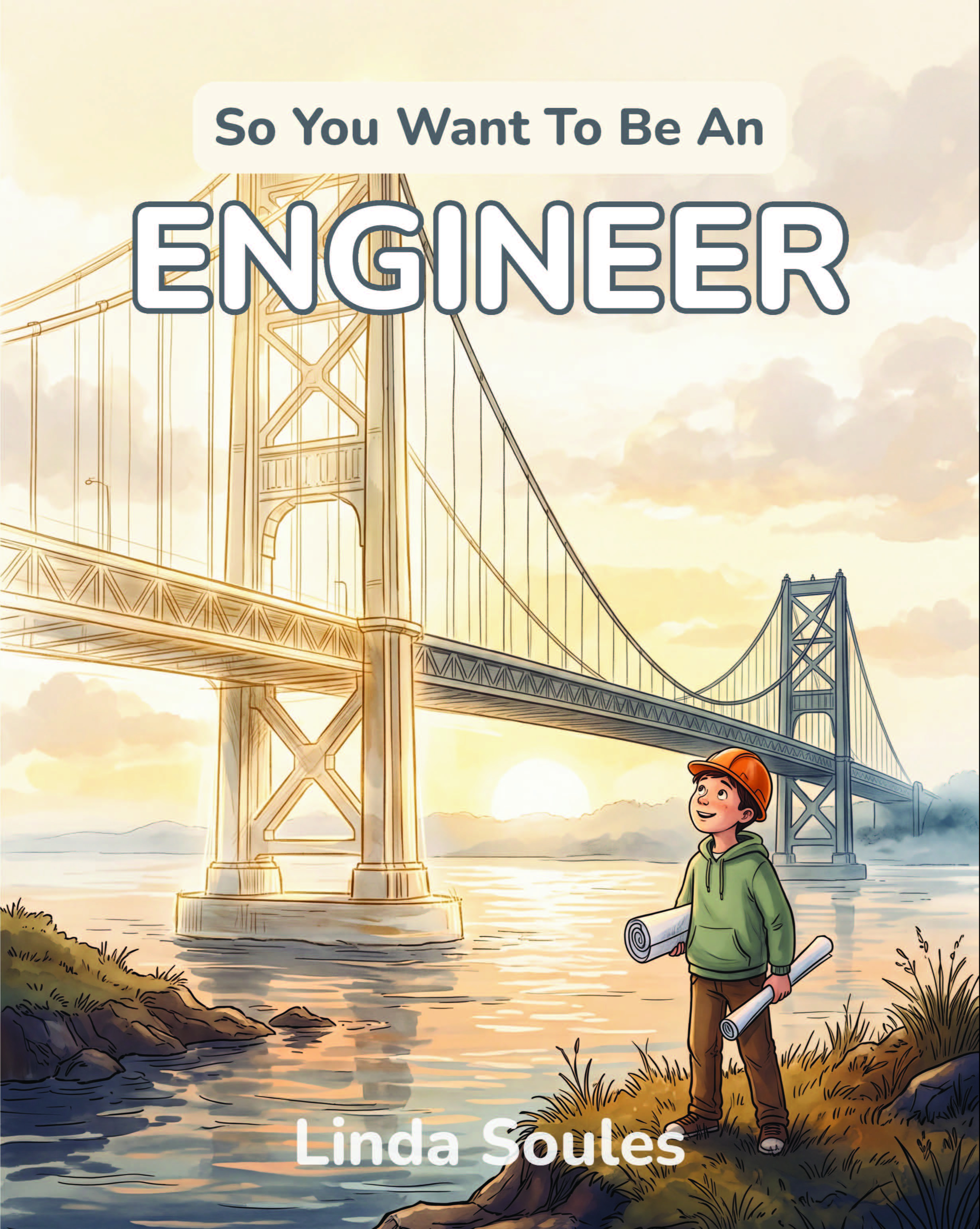
Children's Nonfiction
So You Want To Be An Engineer
by Linda Soules
Listen to this review
So You Want to Be an Engineer makes a strong case that engineering is less about solitary flashes of genius than about curiosity, collaboration, and learning from failure. Its central idea—that careful attention to what might go wrong is a form of care for other people—gives this career guide more substance than a catalogue of jobs and gadgets. Written for young readers, it is lively and approachable without pretending the work is easy or glamorous all the time.
The book’s most effective teaching device is its recurring design cycle: define a problem, generate ideas, build a prototype, test it, and revise. The account of a vacuum cleaner developed through 5,127 prototypes makes persistence memorable, while the explanation that a crack in a test model is useful information gives failure a practical meaning. That principle carries through later sections, from deliberately dropping a prosthetic hand to testing bridge designs in wind tunnels. The book understands that engineering is not simply making things; it is asking whether they work safely under real conditions.
Soules’s prose is direct, conversational, and fond of well-timed jokes. The space toilet, the “chicken gun” used to test aircraft windshields, and the fake material used to rate toilets give technical subjects an immediate foothold in a young reader’s imagination. The humor generally serves the explanation rather than replacing it. Even the rubber duck used in software debugging opens onto a useful lesson: explaining a problem clearly can help reveal its cause. Short definitions and the glossary support readers encountering terms such as “constraint,” “tolerance,” and “single-point failure” for the first time.
The book also broadens its picture of engineering beyond bridges and machines. Its survey covers civil, mechanical, electrical, chemical, biomedical, environmental, aerospace, and software engineering, among other fields. The chapter on where engineers work includes food production, sports equipment, underwater cables, and Mars missions. This variety helps counter the idea that engineering leads to only one kind of job. More important, the text repeatedly emphasizes teamwork and communication: technicians, machinists, construction crews, inspectors, project managers, and the people who use a design all have knowledge engineers need.
Some of the book’s strongest material comes when it gives engineering a human or historical scale. The Tacoma Narrows Bridge disaster shows why safety testing matters, while the Citicorp Center story presents a more complicated ethical example: engineer William LeMessurier disclosed a dangerous design problem and organized repairs before a storm struck. The book wisely remembers student Diane Hartley, whose question about diagonal winds helped focus attention on the risk. Emily Warren Roebling, Mary Jackson, Fazlur Rahman Khan, Margaret Hamilton, Shuji Nakamura, and William Kamkwamba further expand the range of people and routes represented. These accounts make engineering feel like a human practice shaped by persistence, opportunity, and responsibility.
The imagined workday of a biomedical engineer is particularly effective because it turns abstract principles into a sequence of decisions. A slipping thumb joint leads to redesign and simulation; a failed drop test identifies a weakness; an eleven-year-old user points out that the hand is too heavy and difficult to use for tying shoes. His feedback changes what the team must solve. This episode gives proper weight to the people a product is meant to serve, rather than treating them as an afterthought. The author’s closing reflection extends that ethic, describing infrastructure as work done for strangers, including people not yet born.
The book’s breadth is also a limitation. With so many branches, anecdotes, records, facts, and suggested activities, some subjects receive only a brief introduction. Readers looking for a sustained account of what one engineering specialty involves, or a deeper explanation of the mathematics and scientific principles behind a design, may find the overview too wide-ranging. The stated focus is career exploration, not technical instruction, and the volume is most successful when read on those terms. Its many short sections make browsing easy, though they can also give the book a reference-guide rhythm rather than a continuous narrative arc.
There are also visible editorial irregularities in the text provided, including repeated fragments and misspellings or malformed times in the “Oops!” and “A Day in the Life” sections. These may be artifacts of the supplied text rather than defects in the published book, but if they appear in the finished edition they would interrupt an otherwise carefully structured presentation. The material is dense with facts, too, and younger readers may benefit from reading it with an adult, especially when the historical and technical examples invite follow-up questions.
Overall, this is a thoughtful, engaging introduction that treats young readers as capable of understanding both the excitement and the obligations of engineering. Its strongest audience is curious readers roughly in the middle grades who enjoy how-things-work questions, hands-on challenges, and real stories about problem-solving. It should also be useful to parents and teachers looking to start conversations about careers and design. Readers seeking a detailed technical textbook will need more depth, but for an inviting first exploration of the field, the book offers a generous and humane starting point.
Share-ready review images
Download square and vertical images for posts, stories, newsletters, and media kits.
For authors
Want a review page like this for your book?
Upload your manuscript, choose a review tier, and get a permanent public editorial review page you can share with readers.
Review My Book← Back to Reviews
