Children's Nonfiction
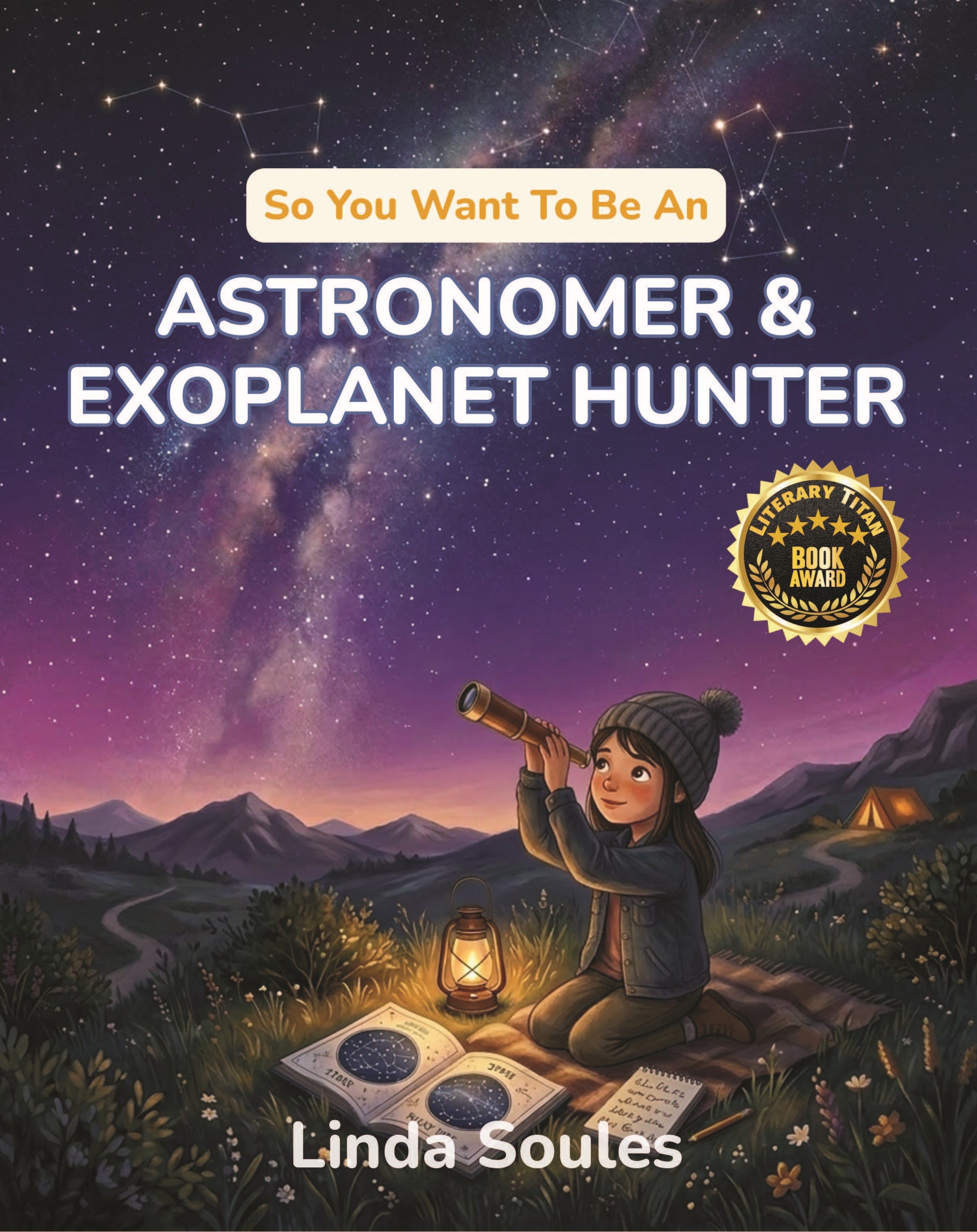
So You Want To Be An Astronomer & Exoplanet Hunter
by Linda Soules
Listen to this review
So You Want To Be An Astronomer & Exoplanet Hunter introduces young readers to astronomy through a question large enough to hold a child’s attention: are we alone? Linda Soules makes that question the book’s narrative engine, moving from the basics of finding distant planets to the everyday work, frustrations, and skills of the people who search for them. The result is an inviting career guide with a stronger sense of wonder than many books in the genre, though its lyrical enthusiasm sometimes outruns its practical detail.
The book’s clearest strength is its explanation of how astronomers detect objects they cannot directly see. The account of the transit method turns an abstract process into a comprehensible sequence: a planet crosses its star, the star dims slightly, and repeated dips form a light curve. The comparison to finding a planet’s shadow before seeing the planet itself is apt, and the Kepler example—monitoring 150,000 stars for small, recurring changes—gives the explanation scale. Elsewhere, the descriptions of spectroscopy, radial velocity, and TESS widen the picture without losing sight of the central idea: astronomers interpret light as evidence.
Soules is also good at showing that the work is not a string of dramatic discoveries. The sample observing shift, from the 4 p.m. wake-up through dawn and a promising signal, makes the profession tangible. So do the less glamorous realities: cloud cover, scarce telescope time, misleading signals, years-long observation, and competitive funding. The chapter on the hardest parts is especially valuable because it treats rejection and uncertainty as ordinary conditions of research rather than obstacles a gifted person simply overcomes. Its emphasis on rigorous skepticism—being “the first person not fooled”—counterbalances the book’s more romantic passages.
The prose is conversational, direct, and often memorable. Soules moves comfortably between concise explanations and reflective passages about what it means to study worlds that cannot be touched. The dedication’s pairing of feeling “very small and very important” anticipates the book’s larger theme: cosmic scale can unsettle us while enlarging our sense of possibility. The author’s note develops this idea thoughtfully, presenting astronomy as a discipline that learns by attending to patterns in distant light. The claim that no life beyond Earth has been confirmed is stated plainly, and the book’s wonder is strongest when it leaves that uncertainty intact rather than pretending to answer the question it raises.
Historical examples give the field human dimension. Caroline Herschel’s comet discoveries and long years of observation, Vera Rubin’s evidence for dark matter despite barriers to women astronomers, and Michel Mayor and Didier Queloz’s discovery of 51 Pegasi b offer distinct glimpses of persistence and scientific change. Natalie Batalha’s path from a business major to astronomy is particularly useful for readers who may assume that a career must begin with an obvious childhood plan. These profiles support the book’s recurring message that curiosity and sustained effort matter, while also showing that astronomy is collaborative: observers, instrument specialists, statisticians, engineers, and students all contribute.
The organization is easy to navigate, with sections on tools, workplaces, personal qualities, preparation, and a glossary. The preparation advice is concrete for a young reader: learn constellations, visit a planetarium, try citizen science, and begin coding in Python. The Planet Hunters discussion is an engaging way to make research feel accessible, and the book appropriately notes that people without astronomy degrees have contributed to confirmed discoveries. Still, the distinction between joining a citizen-science project and building a professional career could be made sharper. The book names mathematics, physics, and computing as essential, but offers little account of the educational route into the profession or of the range of career paths beyond research. Readers seeking a practical roadmap will need another resource.
The style’s main limitation is its tendency to repeat its grandest ideas. The vastness of the universe, the abundance of planets, and the prospect of life beyond Earth recur in several forms; some repetition reinforces the book’s central question, but some passages restate what earlier sections have already established. At times, phrases such as “a handshake across deep space” give discovery a dramatic emotional finish that may feel more elevated than the careful, iterative work the book otherwise describes. The accessible analogies are useful, though they can simplify complex processes; the text’s reminders about noise, confirmation, and evidence help restore balance.
The closing material is generous, with books, websites, organizations, and activities for further exploration. However, the long series catalogue and mailing-list invitation shift the tone from a focused account of astronomy toward promotion of the broader book series. That material is not essential to this volume, and the author’s reflective note would provide a more satisfying final landing on its own.
Overall, this is a lively and thoughtful introduction for curious readers, especially children around the series’ stated middle-grade range who are drawn to space but want to know what astronomers actually do. Its combination of accessible science, honest discussion of setbacks, and practical first steps makes it a strong spark for exploration. Readers looking for detailed career planning or a more restrained, less repetitive science narrative may find it incomplete, but young readers who value both evidence and wonder are likely to come away with a clearer sense of the work—and a compelling reason to keep looking up.
Share-ready review images
Download square and vertical images for posts, stories, newsletters, and media kits.
For authors
Want a review page like this for your book?
Upload your manuscript, choose a review tier, and get a permanent public editorial review page you can share with readers.
Review My Book← Back to Reviews
