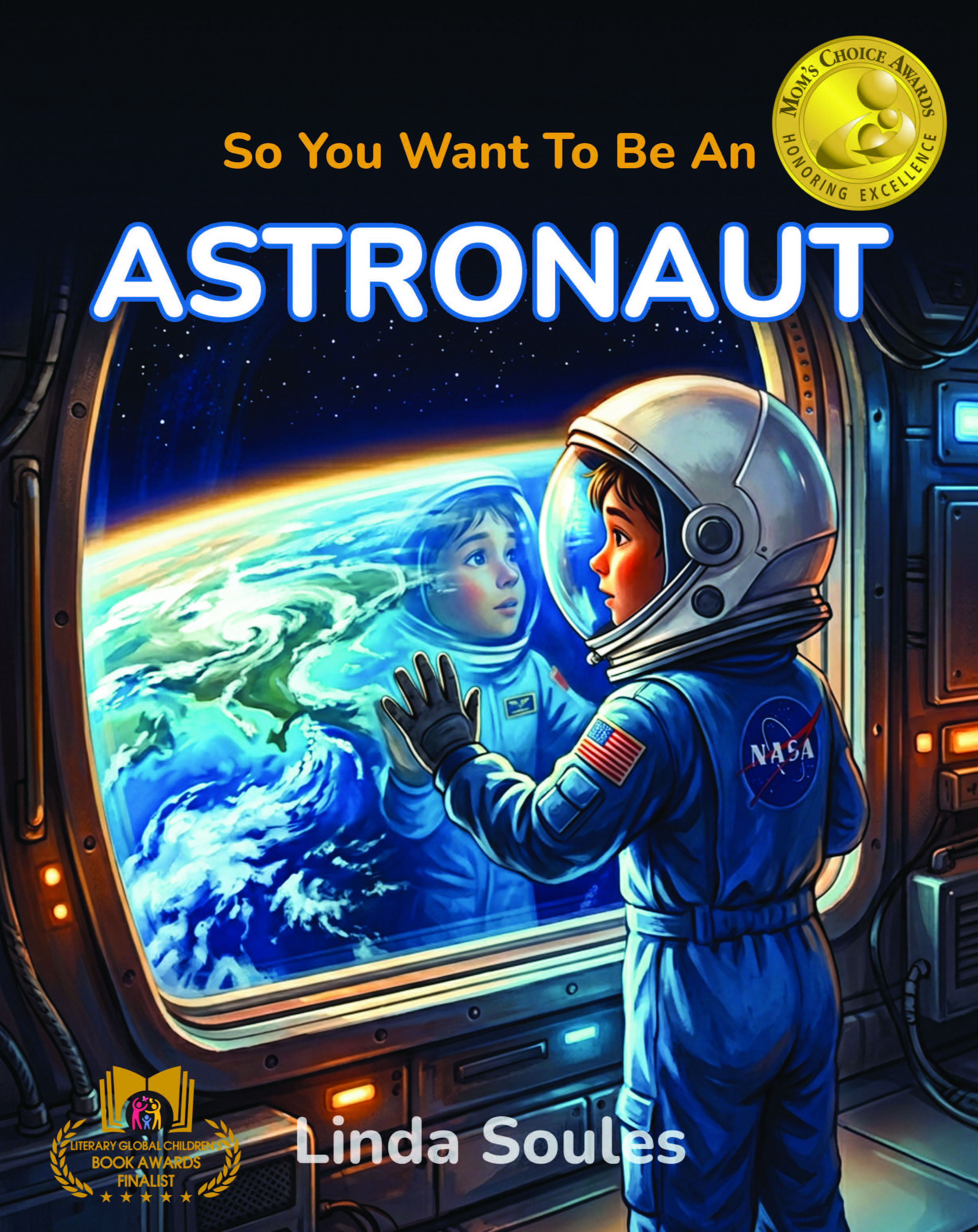
Children's Nonfiction
So You Want To Be An Astronaut
by Linda Soules
Listen to this review
So You Want To Be An Astronaut by Linda Soules is an energetic introduction to a profession that invites both practical curiosity and large-scale wonder. Its strongest instinct is to treat young readers as capable of understanding more than rocket launches and starry-eyed ambition: the book describes experiments, maintenance, teamwork, physical adaptation and the long stretches of preparation that precede a mission. It is at once a career guide and an argument for space exploration, and that combination gives it considerable appeal—though sometimes the argument’s excitement outruns the guide’s precision.
The opening is built for impact. Rockets become “a column of fire,” and the view of Earth is a “blue jewel”; the second-person address places readers in the capsule rather than at a distance from it. The launch sequence, with its countdown, acceleration and sudden silence, makes technical information feel embodied. The spacewalk passage is especially vivid, moving from the practical details of a 280-pound suit and a safety tether to the strangeness of stepping into open space. This lyrical approach is well suited to readers whose interest begins with awe, and the book repeatedly converts that awe into questions about science and responsibility.
There is welcome substance beneath the spectacle. Sections on the ISS, the spacesuit, Canadarm2 and astronaut training explain that the job involves far more than piloting: candidates study engineering, medicine and science, practise spacewalks underwater, learn Russian and prepare for emergencies. The “Day in the Life” schedule helps counter the impression that every hour in orbit is a grand adventure, showing exercise, experiments and attentive monitoring alongside time at the cupola. The book also takes seriously the costs of the work. Its account of isolation, missed family occasions, physical changes in microgravity and the difficult return to gravity gives the career guide an emotional and practical balance that many inspirational books for children lack.
The broader themes are equally clear. The “Overview Effect” section presents the view of Earth as a challenge to national divisions, while “How You Help People” connects space research with applications on Earth and astronauts’ public engagement. The biographies of Yuri Gagarin, Mae Jemison and Valentina Tereshkova offer useful historical entry points, and the closing “What You Can Do To Prepare Right Now” turns admiration into accessible actions: study widely, build fitness, learn the history of spaceflight and look through a telescope. The glossary and “Want To Learn More?” pages extend the book’s usefulness beyond a single reading, making it a promising starting point for classroom discussion or independent exploration.
Yet the book’s highly emphatic voice can flatten distinctions. Nearly every experience is presented as extraordinary, breathtaking or life-changing, and declarations such as “the most beautiful thing any human being has ever seen” substitute a universal verdict for a personal response. The overview effect is likewise described as something astronauts report “unanimously.” The book would be more persuasive if it allowed for varied reactions rather than making the same emotional transformation seem inevitable. Its final appeal—that a child with a particular “pull” toward the stars may become an astronaut—is motivating, but it risks making an exceptionally competitive career sound like the natural outcome of passion alone. The practical sections do mention years of training and demanding qualifications; they could do more to explain that there are many routes into space-related work, and that not every qualified candidate will fly.
Some explanations also need more careful qualification. The text alternates between describing microgravity as an absence of gravity and correctly explaining in the glossary that objects in orbit are continuously falling together. That distinction matters in a book intended to build scientific understanding. The spacesuit passage says pressure prevents an astronaut from “blowing up like a balloon,” an arresting image but a misleading account of what vacuum exposure does to the body. Similarly, the claim that the smell of a spacesuit is caused by “dying stars” is presented as settled fact, when the passage offers no qualification. Broad statements about research improving cancer treatment and other areas would also benefit from examples or clearer limits. These are not reasons to reject the book, but they are important opportunities for stronger fact-checking and more precise science writing.
Time-sensitive claims deserve particular attention. The book says Artemis II flew around the Moon in April 2026 and presents Artemis III and IV as a settled sequence of tests and a landing. Such details can date quickly, and the confident wording does not distinguish a mission plan from an accomplished event. A clearer indication of when the information was checked—and whether a schedule is proposed or confirmed—would help readers trust and revisit the book.
The supplied material does not include the illustrations, so their contribution cannot be assessed here. The appended series catalogue and author’s note explain the project’s ambitions, including its disclosure that illustrations are AI-assisted, but they also extend well beyond the astronaut guide itself. The main text is already expansive; trimming repeated appeals to wonder might leave more room for concise distinctions between fact, forecast and metaphor.
For readers roughly 10 to 14 who are drawn to space and respond to vivid, conversational nonfiction, this is an engaging introduction with strong moments of explanation and a valuable emphasis on teamwork, sacrifice and scientific work. It will be a weaker fit for readers seeking a compact reference book or consistently measured technical exposition. With tighter factual qualification, it could better unite its two central aims: inspiring children to look up and helping them understand what they are seeing.
Share-ready review images
Download square and vertical images for posts, stories, newsletters, and media kits.
For authors
Want a review page like this for your book?
Upload your manuscript, choose a review tier, and get a permanent public editorial review page you can share with readers.
Review My Book← Back to Reviews
