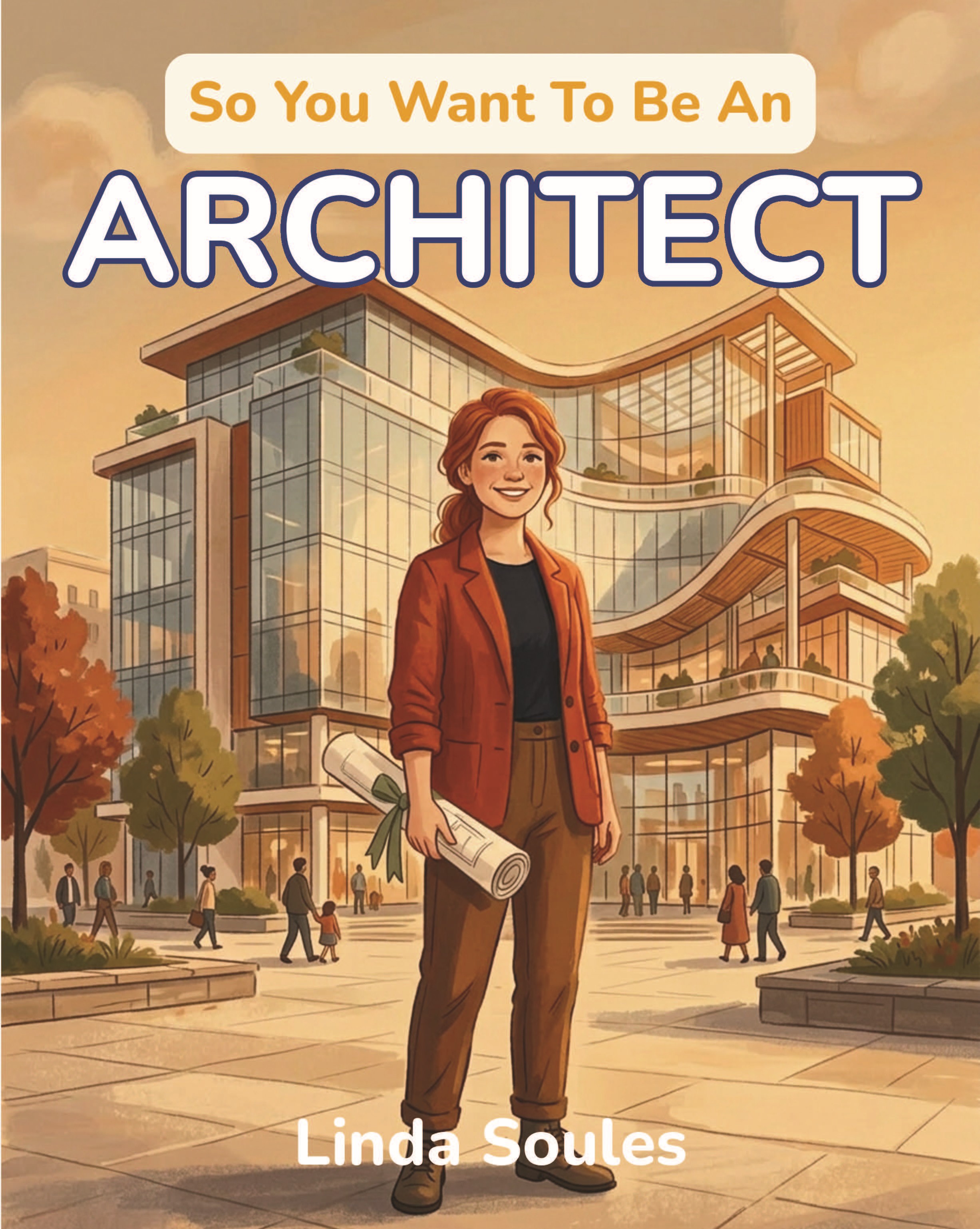
Children's Nonfiction
So You Want To Be An Architect
by Linda Soules
Listen to this review
So You Want To Be An Architect makes a persuasive case that architecture is not simply the art of drawing impressive buildings. It is the work of imagining how people will use a place, then reconciling that vision with budgets, materials, engineering, regulations, and time. Linda Soules introduces the profession through a lively, direct voice suited to curious young readers, while taking their questions seriously. The book’s central strength is its sense of architecture as both practical problem-solving and a lasting form of care for other people.
The opening offers an especially effective frame: buildings are places where people learn, sleep, gather, and remember. The image of buildings holding memories “the way photographs do” gives an abstract profession an intimate human scale. From there, the explanation of a project’s “program”—the full list of needs a building must meet—makes the design process tangible. A family’s wish for a kitchen facing the yard or a spot for muddy boots shows how everyday details can become architectural decisions. The account of construction documents, site visits, and revisions also usefully counters the idea that an architect’s work ends with a sketch.
Soules writes with clarity and rhythm, often turning technical ideas into memorable images. The comparison of the architect to a conductor coordinating engineers, builders, clients, and specialists efficiently conveys the collaborative nature of the job. Details such as Gaudí’s gravity-shaped strings for the Sagrada Família and the swinging damper inside Taipei 101 make structural ideas inviting without requiring prior knowledge. The glossary reinforces that accessibility: terms such as “cantilever,” “section,” and “daylighting” receive concise, practical explanations. The suggestions to sketch, build models, and pay attention to light translate the book’s enthusiasm into activities a reader can try now.
The profiles of architects provide welcome range in period, style, and experience. Brunelleschi’s solution to the Florence cathedral dome and Jørn Utzon’s struggle to realize the Sydney Opera House show the persistence and technical uncertainty behind celebrated designs. Maya Lin’s memorial and Norma Merrick Sklarek’s career bring attention to the ways age, race, and gender have shaped whose work is recognized. Zaha Hadid’s long wait for buildings to be realized adds another account of persistence. These sketches are brief, but they present architecture as a field shaped by both individual ideas and the conditions under which people are allowed to pursue them.
The book is also unusually candid for an introductory career guide about the less glamorous parts of the work. Projects may take years, designs may never be built, clients may change their minds, and architects must solve problems as construction proceeds. Soules acknowledges that early pay can be lean, though the discussion remains general. This realism gives weight to the final chapters’ emotional language about making a building and then handing it over to its users. The imagined “Day in the Life” makes the work vivid, from a site visit to a school-board presentation, although it would be helpful to label it explicitly as a composite example rather than a report of one particular architect’s day.
The book’s lyrical style is both a strength and a limitation. Phrases about buildings shaping lives and the profession as a kind of love give the subject warmth, but similar claims recur across chapters. The ideas that spaces affect people and that buildings outlast their designers are important; repeated in closely related language, however, they sometimes crowd out further practical detail. Readers seeking a fuller account of architecture as a career may want more on education, costs, internships, licensing, and the variation between countries and specialties. The book gives a broad outline of training and acknowledges financial realities, but does not turn them into a detailed career roadmap.
Its factual presentation also invites a little caution. The text makes broad claims about research on the effects of buildings and includes striking historical and contemporary facts, but the supplied pages do not provide source notes alongside them. Some details are explicitly current to 2026, making the accuracy of those references particularly dependent on timely checking. This is not a reason to dismiss the book’s engaging explanations, but educators or older readers who want to investigate further may appreciate a more visible trail to sources. The recommended books, organizations, and architecture programs at the end offer useful next steps, especially for readers who want to go beyond this introduction.
As a result, So You Want To Be An Architect works best as an invitation and orientation, rather than a comprehensive guide to entering the profession. Its combination of practical examples, history, hands-on prompts, and honest discussion of setbacks should appeal especially to readers around ages 10 to 14 who like drawing, building, design, or the question of how places shape daily life. Parents and teachers may also find it a strong starting point for conversation. For those readers, the book offers an expansive and humane picture of architecture—and a clear sense that the work involves far more than making buildings look beautiful.
Share-ready review images
Download square and vertical images for posts, stories, newsletters, and media kits.
For authors
Want a review page like this for your book?
Upload your manuscript, choose a review tier, and get a permanent public editorial review page you can share with readers.
Review My Book← Back to Reviews
