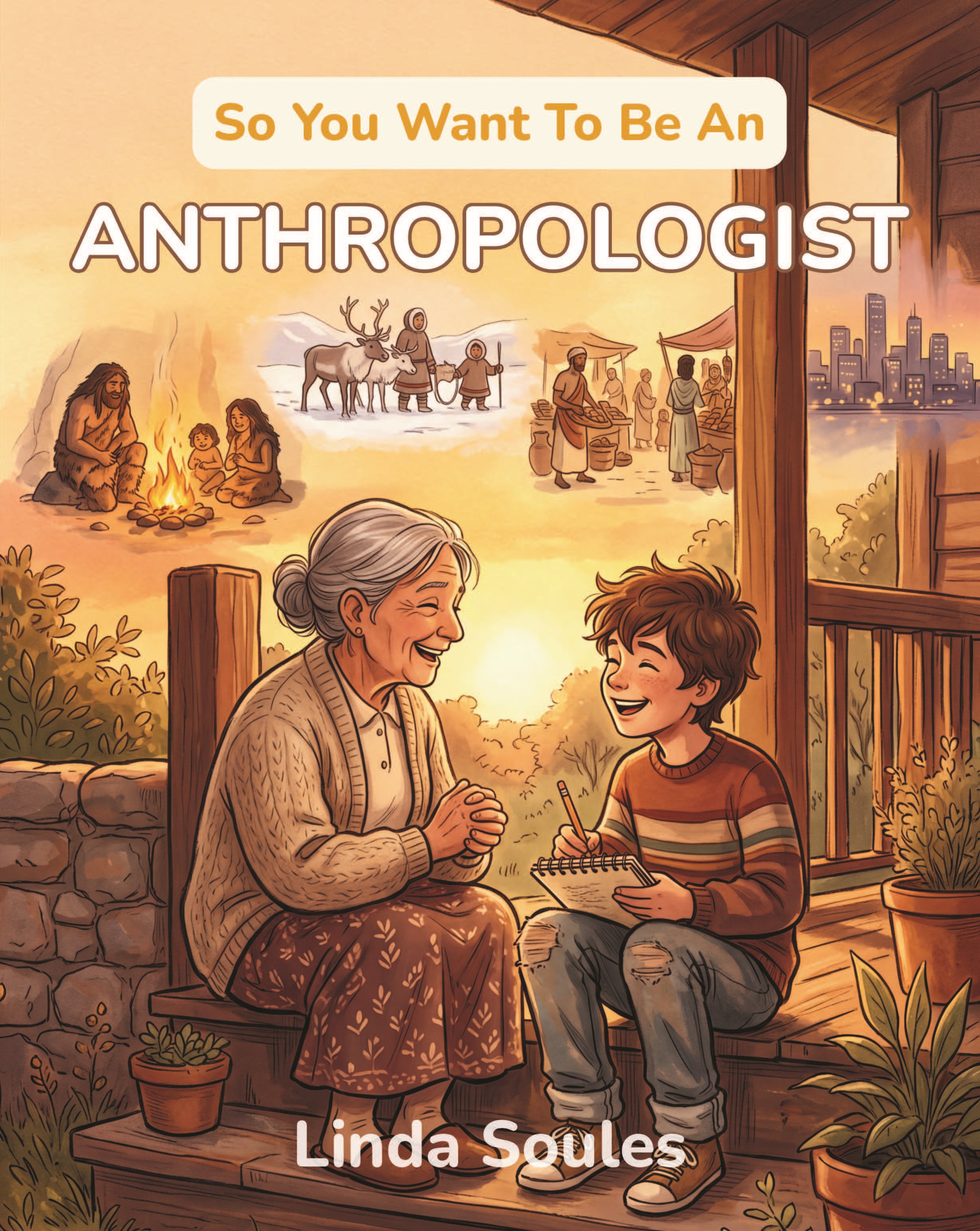
Children's Nonfiction
So You Want To Be An Anthropologist
by Linda Soules
Listen to this review
So You Want To Be an Anthropologist makes an expansive subject feel close at hand. Its central invitation is to look at people’s lives with curiosity rather than assumption: to understand unfamiliar customs from the inside, and to notice that familiar habits are customs too. The book explains anthropology as the study of humans across time and place, then turns that idea into a practical career guide for young readers. It is strongest when it joins those aims—showing not only what anthropologists study, but how patient attention can change the way a reader sees an ordinary day.
The writing is direct, warm, and notably good at making abstract methods concrete. The explanation of participant observation, for instance, moves from Malinowski’s stay in the Trobriand Islands to the everyday insight that seating arrangements at dinner can reveal ideas about respect. The “rich points” section makes confusion itself a research tool: a moment of bafflement signals an unspoken rule worth asking about. These examples give readers a usable sense of anthropological thinking, rather than presenting it as a collection of remote facts.
The book’s range is a major strength. It introduces cultural, biological, archaeological, and linguistic anthropology, then shows how those branches can overlap. A coprolite from Oregon’s Paisley Caves, ancient DNA preserved in birch tar, and a field notebook full of conversations and sketches all help convey the variety of evidence the discipline uses. The chapter on workplaces also usefully complicates the image of the anthropologist as a perpetual traveler: readers encounter cultural resource management, museums, government agencies, public health, technology, and forensic identification. The explanation of consulting work before construction projects is especially helpful because it connects the field to decisions that affect communities and land.
Stories carry much of the book’s emotional force. The Passamaquoddy recordings made by Jesse Walter Fewkes in 1890 acquire a different meaning when language keeper Dwayne Tomah helps restore and translate them, and the text emphasizes that the community now decides how its ancestors’ voices are shared. The account of jessie little doe baird’s work to revive Wôpanâak similarly makes linguistic anthropology legible as sustained community work, not simply the study of words. Elsewhere, the Simeulue “smong” tradition and anthropologists’ role in developing safe, dignified burials during the Ebola outbreak show how cultural knowledge can have practical consequences. Such examples give the book a strong human focus without reducing anthropology to fossil-hunting.
Several sections invite readers to try the method themselves. The suggested field notebook exercise, family oral-history interview, and “Curious Customs of Grown-Ups” report turn observation into an activity rather than a distant aspiration. The comic description of adults’ coffee rituals, glowing rectangles, and mysterious household drawers is particularly effective: it makes the book’s “familiar strange” principle memorable while encouraging children to ask questions at home. The imagined fishing-town workday also gives a convincing sense of research as a mixture of interviews, practical help, observation, and late-night note writing.
The treatment of the profession’s history and responsibilities is another substantive strength. The discussion of racist skull-measuring theories, the taking of Indigenous remains and sacred objects, NAGPRA, and repatriation prevents the book from presenting anthropology as uncomplicated benevolence. Its recurring questions—who benefits, whose voices are missing, and what should remain private—offer a useful ethical framework for young readers. The account of Nandy, a Neanderthal whose injuries suggest that others may have supported him, also gives the book a moving way to explore care across deep time, though the inference is presented as an interpretation rather than direct proof.
The approach has limits. The book contains a great deal of material, and its rapid succession of discoveries, named researchers, career paths, and striking facts can make some subjects feel more like snapshots than developed explanations. Readers may finish with a lively overview but little sense of how anthropologists evaluate conflicting evidence or how disagreements within the field are resolved beyond the brief example of Margaret Mead and later debate. The book does acknowledge uncertainty in places, but its brisk, accessible tone sometimes compresses complex histories into a clean takeaway. Its career guidance is also chiefly framed around the United States, including its employment categories, education path, and salary figure; those details will be less useful to readers elsewhere. Finally, although the “Want to Learn More?” section offers books, organizations, and websites, the main text does not provide detailed source notes alongside its many specific claims, so readers who want to check or pursue particular examples may need to do some searching.
Overall, Linda Soules has made a lively and thoughtful introduction to a discipline that can otherwise seem forbiddingly broad. Its best achievement is not simply listing what anthropologists do, but showing readers how to listen, observe, and question their own assumptions. It is most likely to appeal to curious readers roughly in the stated middle-grade range, especially those drawn to people, history, languages, or science—and to adults looking for a discussion-friendly introduction. Readers seeking a deeper academic account will need further reading, but as an invitation to explore anthropology and its responsibilities, the book is engaging and substantial.
Share-ready review images
Download square and vertical images for posts, stories, newsletters, and media kits.
For authors
Want a review page like this for your book?
Upload your manuscript, choose a review tier, and get a permanent public editorial review page you can share with readers.
Review My Book← Back to Reviews
