Children's Nonfiction
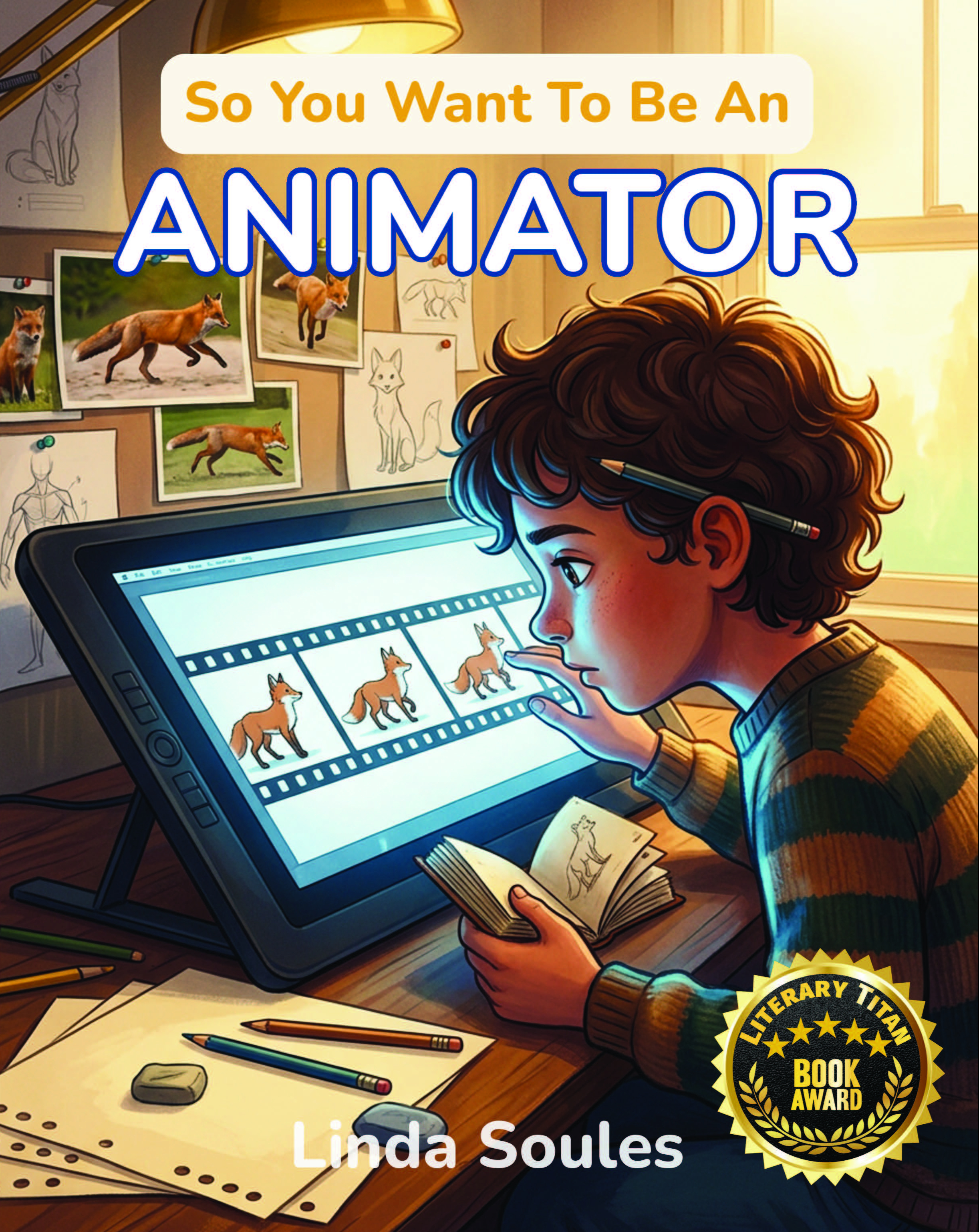
So You Want To Be An Animator
by Linda Soules
Listen to this review
So You Want to Be an Animator makes a persuasive case that animation is less a matter of making pictures move than of making audiences believe a character is thinking and feeling. Its strongest pages return to that distinction from several angles: a ball’s hesitation before bouncing, the timing of a character grieving over a dropped ice cream, and the small bodily adjustments that make lifting a heavy box feel convincing. For young readers curious about the profession, this emphasis on performance gives the book a more distinctive centre than a simple catalogue of tools and job titles.
Linda Soules writes in an energetic, direct style suited to independent middle-grade readers and to adults reading alongside them. The opening links a bison painted with overlapping legs in Chauvet Cave to contemporary digital animation, framing the craft as a long-standing human wish to bring images to life. That sweep is engaging, though it is best understood as an evocative framing device rather than a precise history of animation. The book is most vivid when it moves from grand claims to concrete observation: a slow blink suggesting weariness, a heavy bag swinging behind its carrier, or shoulders continuing to move after the rest of the body has stopped.
The explanation of the animator’s work is one of the book’s clearest achievements. Calling an animator an actor, physicist, timekeeper, observer, and “marathoner” gives young readers a memorable map of the job’s competing demands. The account of acting out a movement before drawing it, and the explanation of blocking, key poses, and in-betweens, make craft concepts approachable without reducing them to magic. The day-in-the-life sequence is especially useful: its rough poses, supervisor feedback, computer-generated in-betweens, and polishing pass show how a shot develops and why a smooth-looking result may still feel emotionally “mushy.” The text also acknowledges unglamorous realities, including slow production, repeated revisions, and work that may be discarded.
Its practical guidance extends the invitation beyond reading. The flipbook exercise, stop-motion activity, expression studies, and advice to act out a movement give readers manageable ways to test their interest. The glossary reinforces terminology introduced in the main text, while the suggested books, websites, and organizations offer routes for further exploration. The range of examples—from hand-drawn animation and stop-motion to 3D work—helps communicate that the field contains distinct techniques, not one universal process.
The history section makes a valuable effort to widen the familiar roll call of animation pioneers. Lotte Reiniger’s silhouette films and Floyd Norman’s work at Disney receive meaningful attention, including the barriers Norman faced as the studio’s first Black animator. These profiles give the book opportunities to discuss both invention and recognition: Reiniger’s influence outlasted the period in which her name was widely known, while Norman’s long career challenges the idea that an animator’s work must end with youth. The profiles are brief, however, and largely celebratory; readers seeking fuller accounts of these artists, their working conditions, or the industry’s history will need other sources.
The book’s chief limitation is that it is more inspiring introduction than comprehensive career guide. It describes artistic practice and collaboration well, but offers little practical detail about education, portfolios, entry-level roles, hiring, pay, or the uneven employment realities of creative industries. The section on workplace collaboration names many departments, yet leaves the reader with limited understanding of how an aspiring animator might choose among specialties or move toward a first job. The suggested resources partly address this gap, but the book’s invitation to imagine a career is more developed than its account of how to pursue one.
Some explanations also favour clarity over qualification. The claim that the audience’s brain “does the animating” is a lively way to introduce the perception of movement, but it compresses a complex subject into a memorable slogan. Likewise, descriptions such as animation being “the most collaborative art form” are rhetorical rather than demonstrated comparisons. These flourishes suit the book’s encouraging voice, but readers should not mistake every bold formulation for a carefully delimited technical claim. The repeated language of magic, generosity, and lifelong devotion can also make the work seem more spiritually rewarding than materially complicated, despite the welcome passages on repetition and revision.
The author’s note about AI-assisted illustrations is unusually transparent: it identifies the images as AI-assisted and describes the author’s approach to selecting and refining them. That disclosure is valuable, especially for a book about visual art, though the supplied text does not allow an assessment of how the illustrations function on the page or whether they consistently support the explanations.
For readers roughly in the series’ stated 10–14 age range—especially children who draw, make flipbooks, or want to understand why animated characters feel alive—this is an engaging and often instructive starting point. Parents and teachers may also find its activities and questions useful conversation prompts. Readers looking for a detailed, realistic guide to training and employment, or a more critical history of the animation industry, should pair it with other material. Its best recommendation is narrower but clear: for a young person intrigued by the craft itself, So You Want to Be an Animator offers both a strong first vocabulary and an invitation to begin practicing.
Share-ready review images
Download square and vertical images for posts, stories, newsletters, and media kits.
For authors
Want a review page like this for your book?
Upload your manuscript, choose a review tier, and get a permanent public editorial review page you can share with readers.
Review My Book← Back to Reviews
