Children's Nonfiction
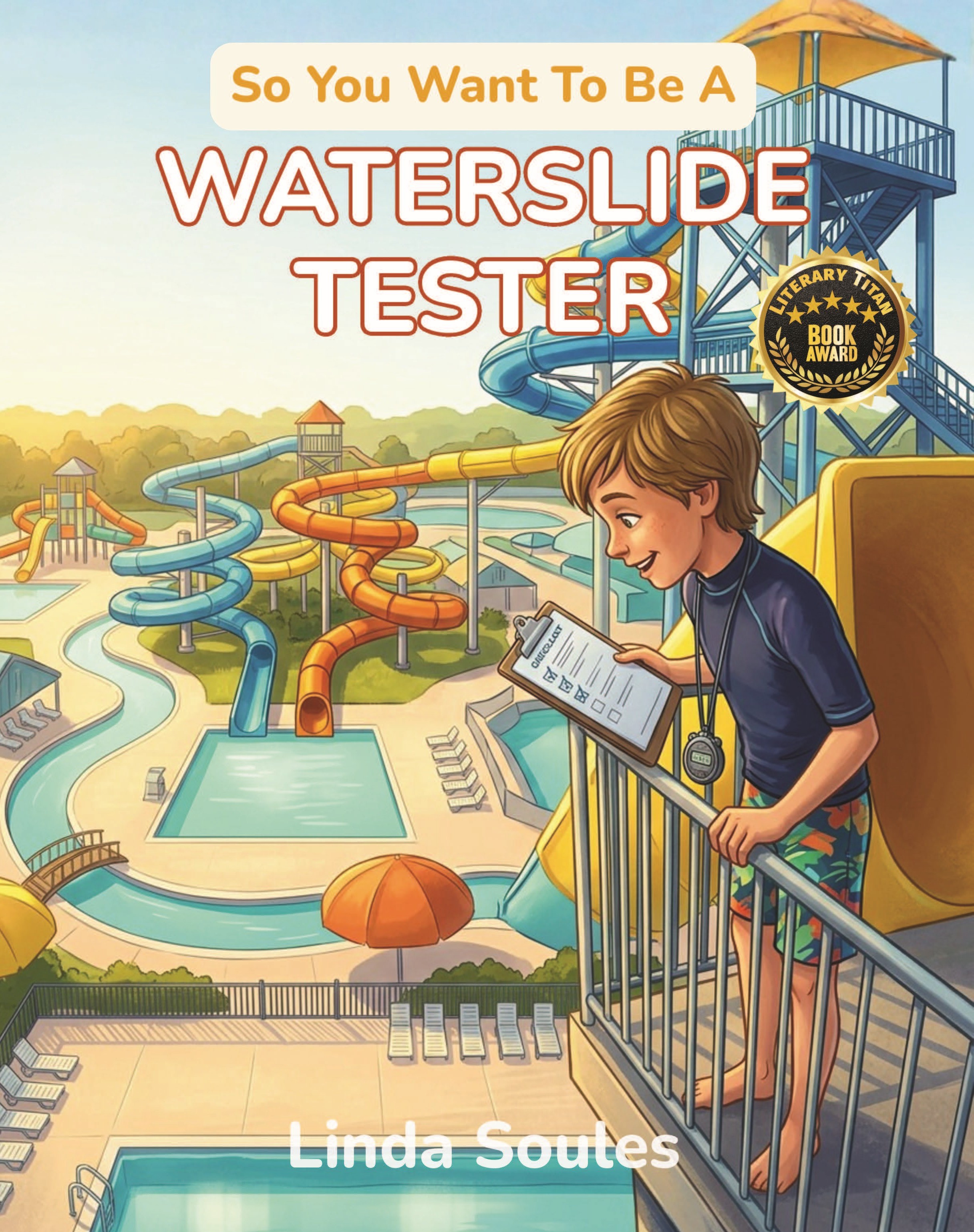
So You Want To Be A Waterslide Tester
by Linda Soules
Listen to this review
Linda Soules’s So You Want To Be a Waterslide Tester makes an appealing case for a career that might otherwise sound like a child’s fantasy. Its central insight is that testing a slide is not simply a chance to ride before the park opens: it is a form of safety work that combines engineering, attentive observation, and clear reporting. The book’s strongest passages keep that distinction in view, inviting young readers to enjoy the thrill while understanding the careful labor that makes it possible.
The writing is direct, energetic, and well suited to readers curious about how things work. Soules explains gravity, friction, water flow, and hydroplaning through concrete comparisons—a hockey puck gliding, a wet bar of soap shooting across a shower floor—before connecting those ideas to slide design. The discussion of flow rate is especially effective: too little water can make a ride rough, while too much can cause a rider to skim and lose control. Rather than leaving the science as abstract vocabulary, the book repeatedly asks readers to notice physical sensations: where speed builds, how a curve pushes the body, and where water coverage feels uneven.
That attention to the body gives the book a distinctive premise. The section on tools describes flow meters, pressure gauges, surface testers, instrumented suits, and weighted test dummies, but it also argues that a trained tester’s body is an essential instrument. The useful qualification that follows is that one tester’s experience cannot stand in for every rider. A lighter child and a heavier adult may experience different speeds and forces, so the tester who asks for more participants rather than overclaiming is doing more rigorous work. This is a thoughtful introduction to the limits of individual observation as well as to the profession itself.
The book is also strong on the unglamorous side of the job. Its account of the “thirty seconds” of riding set against hours of measuring, note-taking, paperwork, and repeated climbs helps correct the obvious misconception without draining the subject of its fun. The sample day, from a morning briefing to a report signed at the end of testing, gives the work a practical shape. So do the descriptions of collaboration with hydraulic engineers, safety teams, park operations, and compliance staff. In these sections, the career becomes less a solo adventure than a disciplined process of observation, adjustment, and retesting.
At its best, the book connects that process to a broader theme: preventive work matters even when its success is invisible. The author’s note compares testers with lifeguards, bridge inspectors, and food-safety inspectors, whose achievement is often an ordinary day without an emergency. The earlier image of a child laughing on a safe ride makes that idea tangible. The book’s recurring emphasis on being willing to say “not yet,” even when an opening date has been advertised, gives its celebration of the job an ethical backbone. Safety and enjoyment are presented not as competing aims but as conditions of one another.
The chapters and recurring questions make the book easy to navigate, while the glossary and suggested activities extend its usefulness beyond reading. Experiments with water on a tilted surface offer a modest, safe way to explore friction, and the invitation to observe safety features at a water park turns an ordinary visit into a lesson in design. The career-fit questions are accessible without reducing the job entirely to enthusiasm for rides: they also ask whether a reader can pay attention, evaluate carefully, and take fun seriously. The intended audience is clear, and the text generally treats young readers as capable of engaging with real technical ideas.
There are limits to the book’s authority as a career guide. It gives precise figures for flow rates, temperatures, ride speeds, and testing practices, and it names organizations, standards, manufacturers, and a historical tester, but the supplied text includes no citations or source notes for readers who want to verify or pursue those claims. The “day in the life” is presented as a vivid second-person schedule, yet the book does not clarify how much such routines vary among parks, manufacturers, and testing roles. That may leave readers with a more uniform picture of the profession than the book’s own emphasis on specialized slide types and team-based work would suggest. A short distinction between typical practice and illustrative example would strengthen the guidance.
The prose’s enthusiasm is often a strength, but it occasionally leans on repeated declarations about the job’s importance and joy. The “someone goes first” idea, for instance, appears in several formulations, and some passages move from explanation into lyrical affirmation before the practical detail has had time to settle. The result is warm and memorable, though readers seeking a compact, strictly factual career manual may find the encouragement somewhat overemphatic. The discussion of risks is similarly forceful: it makes safety central, but would benefit from clearer qualification around the circumstances in which particular hazards occur.
Overall, So You Want To Be a Waterslide Tester is an engaging introductory career book, especially successful at turning a playful premise into a lesson in applied physics, responsibility, and careful communication. Its technical explanations, practical activities, and respect for behind-the-scenes safety work are likely to appeal to curious readers who enjoy rides and want to know what makes them function. It is best read as an invitation to explore the field, rather than as a fully sourced or comprehensive account of its professional pathways. For middle-grade readers interested in engineering, amusement parks, or the hidden work behind everyday fun, it is a lively and thoughtful starting point.
Share-ready review images
Download square and vertical images for posts, stories, newsletters, and media kits.
For authors
Want a review page like this for your book?
Upload your manuscript, choose a review tier, and get a permanent public editorial review page you can share with readers.
Review My Book← Back to Reviews
