Children's Nonfiction
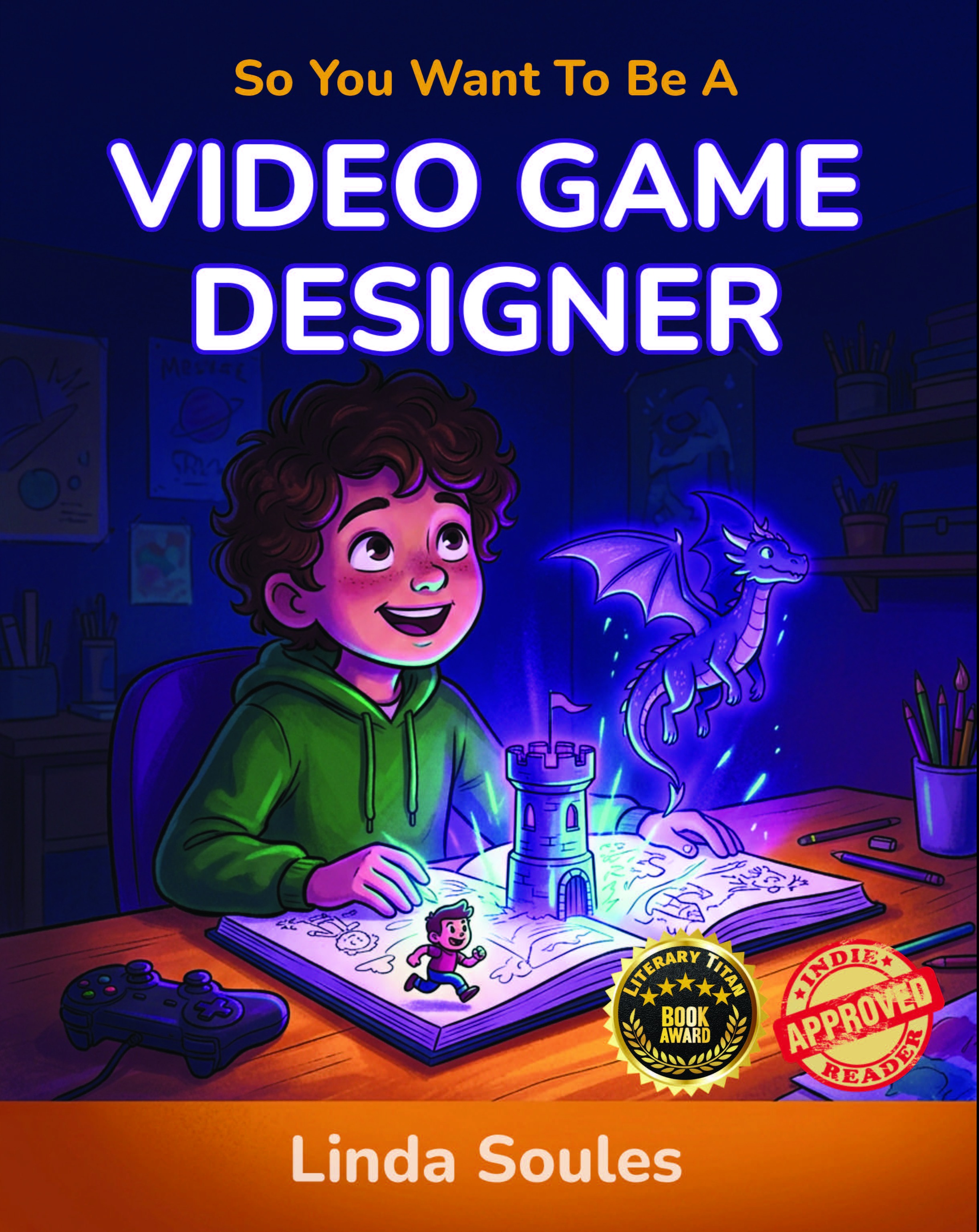
So You Want To Be A Video Game Designer
by Linda Soules
Listen to this review
Linda Soules’s So You Want to Be a Video Game Designer is a career introduction for young readers that treats game design as more than a pastime or a job title. Its central idea is that designers shape the player’s experience: they decide what a player can do, how challenges work, and whether a game feels satisfying. The book repeatedly returns to a useful question—“What if?”—and presents curiosity, testing, and revision as the foundations of the work. That framing gives the subject an inviting point of entry without reducing it to simply having good ideas.
The strongest sections make the craft tangible. In “What A Video Game Designer Actually Does,” the distinction between a game’s experience, its visual design, and its programming helps orient readers, while the account of documentation and iteration explains how ideas become playable systems. The description of a playtest is especially effective: designers observe where players become confused, bored, or excited, and use the difference between intention and experience to find problems. The sample workday extends that lesson, showing a designer taking notes during play, writing rules, and resisting the urge to explain a game to a first-time player.
Soules writes in a direct, energetic voice, using comic exaggeration to make technical and abstract ideas approachable. The imagined game in which a player saves a kingdom with “a spoon and a very brave hamster” captures the book’s playful spirit; the comparison of iteration to redrawing a picture offers a simpler explanation of a professional process. The prose also knows when to temper its enthusiasm. The “Hardest Parts” chapter acknowledges that early versions can be terrible, that finished games may contain work later cut, and that public criticism can be difficult to absorb. These admissions lend the encouragement more credibility than unqualified praise would.
The book’s account of design is most compelling when it attends to subtle player responses: a jump lasting three-tenths rather than four-tenths of a second, a challenge that feels fair, or the point when frustration turns into insight. Its treatment of accidental mechanics—such as the rocket jump in Quake—adds an appealing element of unpredictability, suggesting that designers sometimes learn from what a game does rather than only from what they intended it to do. The chapters on teamwork and player empathy also resist the lone-genius picture of creation, explaining how designers must communicate with programmers, artists, producers, and other collaborators.
As a practical guide, the book offers accessible exercises rather than vague exhortations. Readers are asked to devise a paper game, alter familiar rules, study games as designers, and watch someone play without offering hints. Suggestions to try Scratch or GameMaker, alongside the glossary’s explanations of terms such as “core loop,” “prototype,” and “UI,” give beginners a path from curiosity toward experimentation. The “Want To Learn More?” section adds books, websites, organizations, and a game-jam suggestion. Together, these resources make the book useful as a starting point for a child who wants to do something, not just read about a profession.
There are limits to the portrait. The account of workplaces—open-plan studios, creative spaces, and collaborative energy—is quite generalized, and the book says relatively little about less romantic aspects of employment, such as the varied routes into the industry or the practical pressures that can shape production. Its description of design roles is also necessarily simplified for its audience; readers may come away with only a broad sense of how responsibilities differ among game designers, level designers, narrative designers, and directors. The inspirational tone sometimes edges toward grand claims, particularly when games are described as the defining storytelling medium of a generation. Readers who want a measured industry overview will find more aspiration than qualification.
Some historical and industry anecdotes are presented without sources or much context. The book uses qualifying language for the Pac-Man pizza story, but claims about particular mechanics, influential designers, and the scale of the global games industry would be easier for curious readers to evaluate if the chapters identified references or offered a short bibliography. The recommended reading list is helpful, but it does not clearly document the factual material already in the book. This is a meaningful limitation in a guide that encourages readers to investigate the field, though it does not undermine its basic explanations.
The author’s note is notable for disclosing that the illustrations are AI-assisted and describing her approach to directing and refining them. That transparency is welcome; however, the supplied text does not allow an assessment of the images themselves, and the note’s reference to ethical frameworks remains broad rather than specific. The book’s appeal therefore rests most securely on its writing, structure, and practical advice. Its short, clearly titled sections and glossary suit independent browsing, while its conversational manner also lends itself to reading and discussion with an adult.
So You Want to Be a Video Game Designer is best suited to roughly middle-grade readers who love games and are beginning to wonder how they are made. It offers a lively, constructive introduction to design thinking and makes iteration, playtesting, and empathy feel like skills a young reader can begin practicing now. Those seeking detailed career logistics, heavily sourced history, or a more comprehensive picture of industry working conditions should look elsewhere for a supplement. For curious young readers ready to move from playing games to asking why they work, this is an engaging and useful first guide.
Share-ready review images
Download square and vertical images for posts, stories, newsletters, and media kits.
For authors
Want a review page like this for your book?
Upload your manuscript, choose a review tier, and get a permanent public editorial review page you can share with readers.
Review My Book← Back to Reviews
