Children's Nonfiction
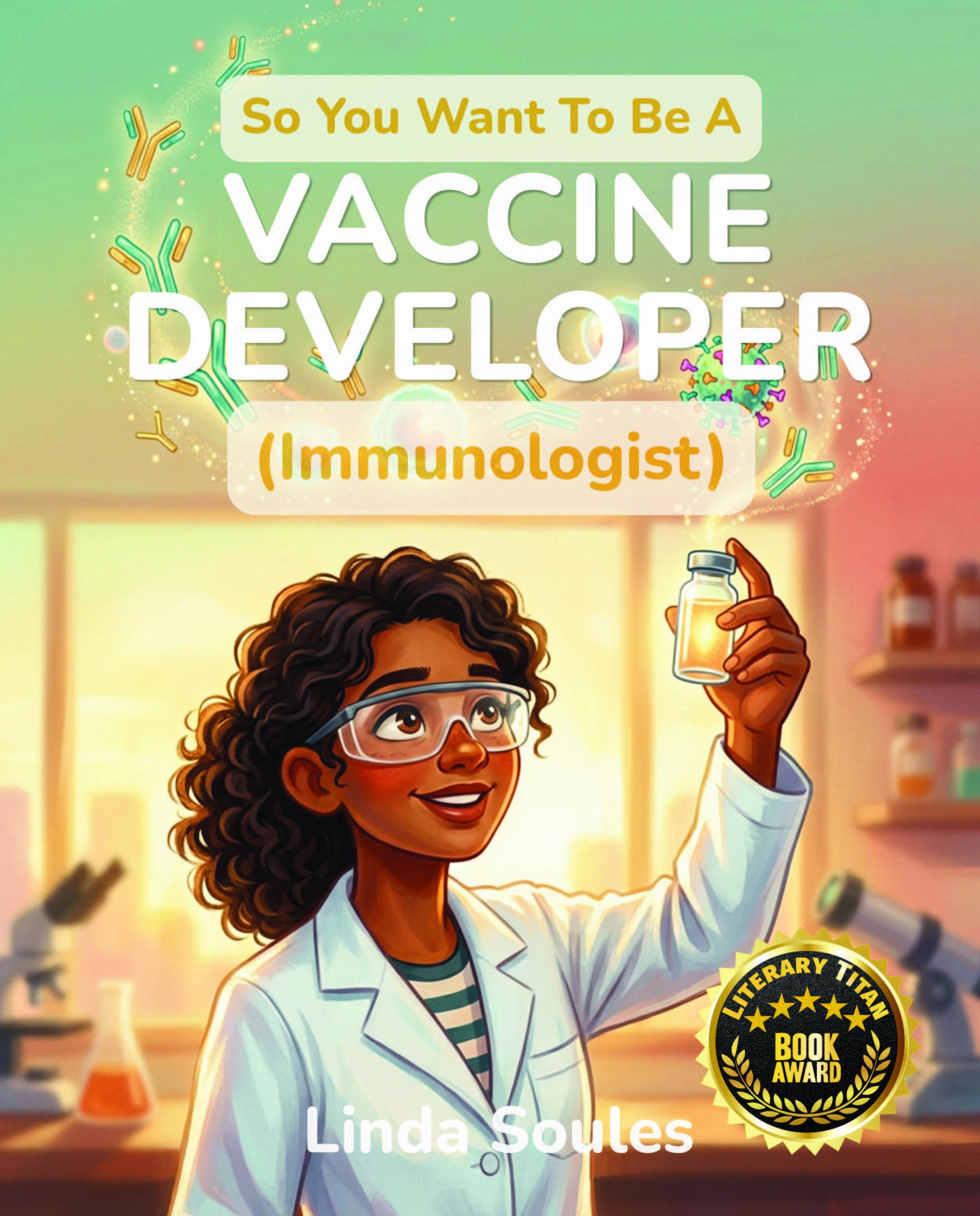
So You Want To Be A Vaccine Developer (Immunologist)
by Linda Soules
Listen to this review
So You Want To Be A Vaccine Developer (Immunologist) presents vaccine science as both a career and a way of thinking: a patient effort to teach the immune system what to recognize before disease arrives. Written for young readers exploring possible futures, Linda Soules’s book is strongest when it makes the work tangible without pretending it is simple. It offers a substantial introduction to the science, people, tools, and frustrations behind vaccine development, while repeatedly returning to a memorable central idea: prevention is powerful precisely because its successes are often invisible.
The book’s clearest explanatory device is its account of the immune system as a learner. Antigens become “wanted posters,” an mRNA vaccine a “recipe card,” and antibodies are likened to keys fitting locks. These comparisons give readers a foothold in unfamiliar terminology, and the glossary extends that support with concise entries on adaptive immunity, adjuvants, B cells, and correlates of protection. The metaphors generally serve the science rather than replacing it. The author also usefully explains that vaccine development is not simply “mixing chemicals in a lab”: it involves structural biology, statistics, regulation, manufacturing, and clinical research.
That breadth is one of the book’s notable strengths. The sections on cryo-electron microscopy, flow cytometry, ELISA, and neutralization tests show how researchers examine both the shape of a germ and the effectiveness of an immune response. The imagined “Day in the Life” makes a more modest but persuasive case for scientific discipline: checking cell cultures, discussing results, reading new papers, and recording an experiment that still needs repeating. Its line that “the data is the boss” captures a core principle without turning the work into a parade of breakthroughs. Likewise, the account of failed candidates, long timelines, and uneven responses across age and health gives the career guide welcome friction.
The historical portraits add human texture. Edward Jenner’s early vaccination experiment, Maurice Hilleman’s extensive contribution to routine vaccines, and Katalin Karikó’s persistence with mRNA research offer distinct stories about observation, sustained practical work, and basic research whose value was not immediately recognized. Karikó’s account is particularly effective as an illustration of the book’s argument that research may matter long before its applications are apparent. The discussion of clinical-trial volunteers and the communities vaccines are meant to reach also widens the frame beyond the scientist at a laboratory bench, bringing ethics and public benefit into the career description.
Soules writes in a direct, warm, conversational register, often addressing the reader as a prospective scientist. This suits the intended audience, identified elsewhere in the series as ages 10 to 14, and the “Could This Be Your Job?” questions invite reflection rather than simply prescribing a path. Practical suggestions—studying biology and chemistry, learning about trials, following an outbreak, and looking up one’s vaccination record—make the book useful beyond its explanations. Its further-reading and organization lists provide routes for readers who want to continue exploring.
The same enthusiasm sometimes makes the prose repetitive and overemphatic. The idea that vaccine development is “teaching” the immune system appears in several forms, as do descriptions of the field’s impact as extraordinary or nearly unmatched. The author’s note about disease prevented in the “negative space” of history is evocative, but the book has already made that point at length. A tighter edit could preserve the emotional force while giving the technical material more room. Some claims are also presented with considerable certainty without citations in the supplied text. The book names estimates for lives saved and disease burden, but a young reader seeking to verify those figures will need to pursue the listed resources independently.
Simplification is appropriate for an introductory guide, but a few formulations could use firmer qualifications. The book’s discussion of memory cells and lasting protection sometimes risks suggesting that a single vaccine dose generally provides lifelong defense; duration and booster needs vary. It does acknowledge that vaccines differ and that people respond differently, yet those caveats could be placed closer to the broad claims. Similarly, the account of Jenner’s test on a young boy is presented as a striking historical first without much discussion of the ethical standards that would govern research today. Given the book’s otherwise thoughtful attention to consent, that contrast would make a valuable teaching moment.
These limits do not erase the book’s strengths, but they define its best use: an inviting starting point, not a definitive technical reference. Readers who want a compact, encouraging introduction to immunology and the long, collaborative process of vaccine development are likely to find it rewarding, especially with a parent, teacher, or librarian available to follow questions into the recommended resources. Children who prefer a more concise treatment, or who want detailed sourcing and more precise qualifications for scientific claims, may find it less satisfying. For curious middle-grade readers drawn to biology, public health, or the puzzle of how prevention works, it offers a thoughtful and motivating place to begin.
Share-ready review images
Download square and vertical images for posts, stories, newsletters, and media kits.
For authors
Want a review page like this for your book?
Upload your manuscript, choose a review tier, and get a permanent public editorial review page you can share with readers.
Review My Book← Back to Reviews
