Children's Nonfiction
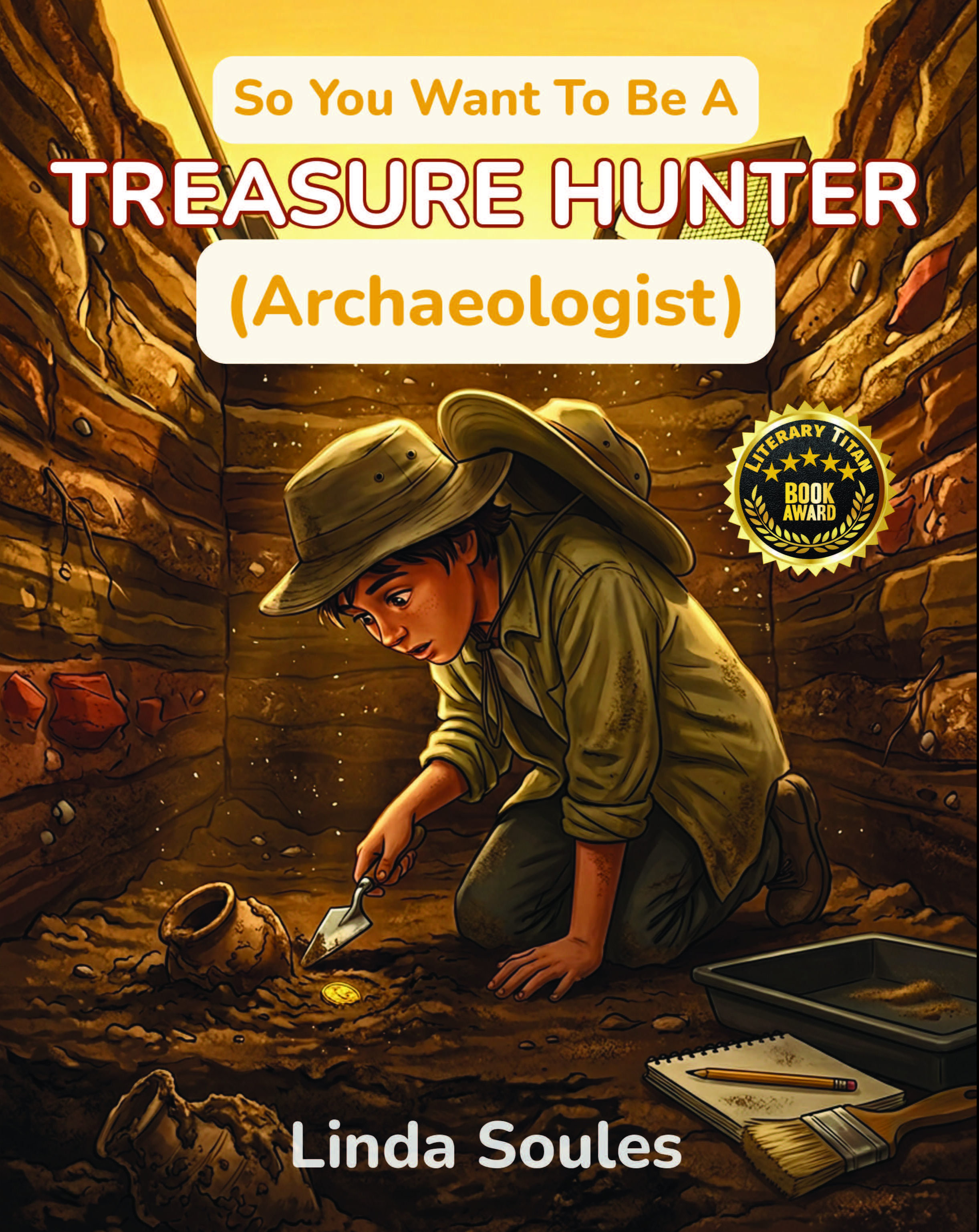
So You Want To Be A Treasure Hunter (Archaeologist)
by Linda Soules
Listen to this review
So You Want To Be a Treasure Hunter (Archaeologist) begins with a useful correction: archaeology is not a hunt for valuables but an effort to recover human stories from physical evidence. Linda Soules builds the book around that distinction, guiding young readers from stratigraphy and excavation tools to the ethical responsibilities of interpreting and preserving the past. The result is an inviting introduction with a clear point of view: the most meaningful discoveries are often ordinary objects, carefully documented, rather than spectacular treasures.
The writing is most effective when it makes archaeological methods tangible. The explanation of stratigraphy compares soil layers to papers accumulating on a desk, while the glossary defines “context” through the difference between a coin found by itself and one recorded beside a burned wall. These examples translate technical ideas without reducing them to mere vocabulary. The opening’s broken cooking pot, with charred lentil seeds still inside, is especially well chosen: it shows how artifacts and ecofacts together can suggest a family’s diet and connections. Throughout, the book returns to the idea that an object’s location is part of its meaning.
That emphasis gives the book a strong ethical and thematic center. Soules distinguishes the archaeologist from the looter not simply by profession but by purpose: one removes objects, the other records relationships and evidence. She also presents archaeology as a way to recover the lives of people often missing from written histories. The discussion of farmers, potters, children, and builders broadens the reader’s sense of whose past matters. The insistence that descendant communities should be partners in the work, rather than subjects of it, adds an important dimension to what might otherwise be a purely technical account.
The book is unusually willing to explain the costs and constraints of the work. Its sections on difficult field conditions, paperwork, and seasons with few dramatic finds counter the romance of discovery. More striking is the explanation that excavation is destructive: once a layer is removed, it cannot be restored, so the record must preserve what the site itself no longer can. The argument that archaeologists may responsibly leave much of a site untouched—so future researchers can use tools not yet available—complicates the usual image of progress as simply digging more. “The site is the inheritance” neatly captures this conservation-minded perspective.
Structure supports the intended young audience. Short, clearly titled sections move from what archaeologists do to where they work, whom they work with, and how readers might try related activities. The simulated excavation, stratigraphy jar, and household-object exercise turn abstract method into practical play. A sample day, from the morning briefing through section drawing and field notes, gives the reader a sequence of tasks rather than another generalized description. The profiles of Howard Carter, Mary Leakey, and Tatiana Proskouriakoff provide historical examples of discovery and interpretation, while the resource list points toward further reading and activities.
Soules’s style is accessible but often deliberately lyrical. Images such as a trench wall becoming a calendar, or the ground as a layer cake of human history, help convey the wonder that motivates the book. The prose also aims for emotional connection: archaeological objects are presented as evidence of actual lives, not just relics. At times, however, the elevated language is repeated so often that it blunts its effect. The “past in your hand,” the story in the soil, and the dignity of forgotten lives recur across several sections. The repetition reinforces the book’s values, but sometimes makes passages feel more like variations on a central address than steps toward new information.
There is also a gap between the book’s career-guide framing and the practical detail it provides. Readers learn about patience, teamwork, careful recording, and the range of specialists on a dig, but receive little concrete guidance about education, training, employment, or the day-to-day realities of entering the profession. The “Could This Be Your Job?” section is primarily a short invitation to consider one’s interests and patience. That makes the book stronger as an introduction to archaeological thinking than as a guide to making a career plan. Some vivid scenes, including the imagined first day on a dig, convey the emotional appeal of fieldwork but cannot stand in for the varied experiences of actual archaeological projects.
The book’s broad claims about archaeology’s power to restore identity and correct historical accounts are compelling, but the discussion remains introductory; it does not explore in much detail the difficult disagreements that can arise around excavation, interpretation, or the return of finds. The emphasis on respectful collaboration is valuable, though readers seeking a more complex account of those issues will need further resources. The author’s note also discloses that the illustrations are AI-assisted; because the supplied text does not include the images themselves, their visual quality cannot be assessed here.
For curious readers, especially those around the series’ stated ages of 10 to 14, this is a lively and thoughtful starting point. Its best lessons are not merely about what archaeologists discover, but about how they learn to look: slowly, skeptically, and with respect for the people whose traces remain. It will be most valuable to young readers drawn to history, puzzles, and hands-on investigation, and to adults looking for a conversation-starting introduction. Readers who want detailed career logistics or a deeper account of contested archaeological practice should pair it with more specialized material.
Share-ready review images
Download square and vertical images for posts, stories, newsletters, and media kits.
For authors
Want a review page like this for your book?
Upload your manuscript, choose a review tier, and get a permanent public editorial review page you can share with readers.
Review My Book← Back to Reviews
