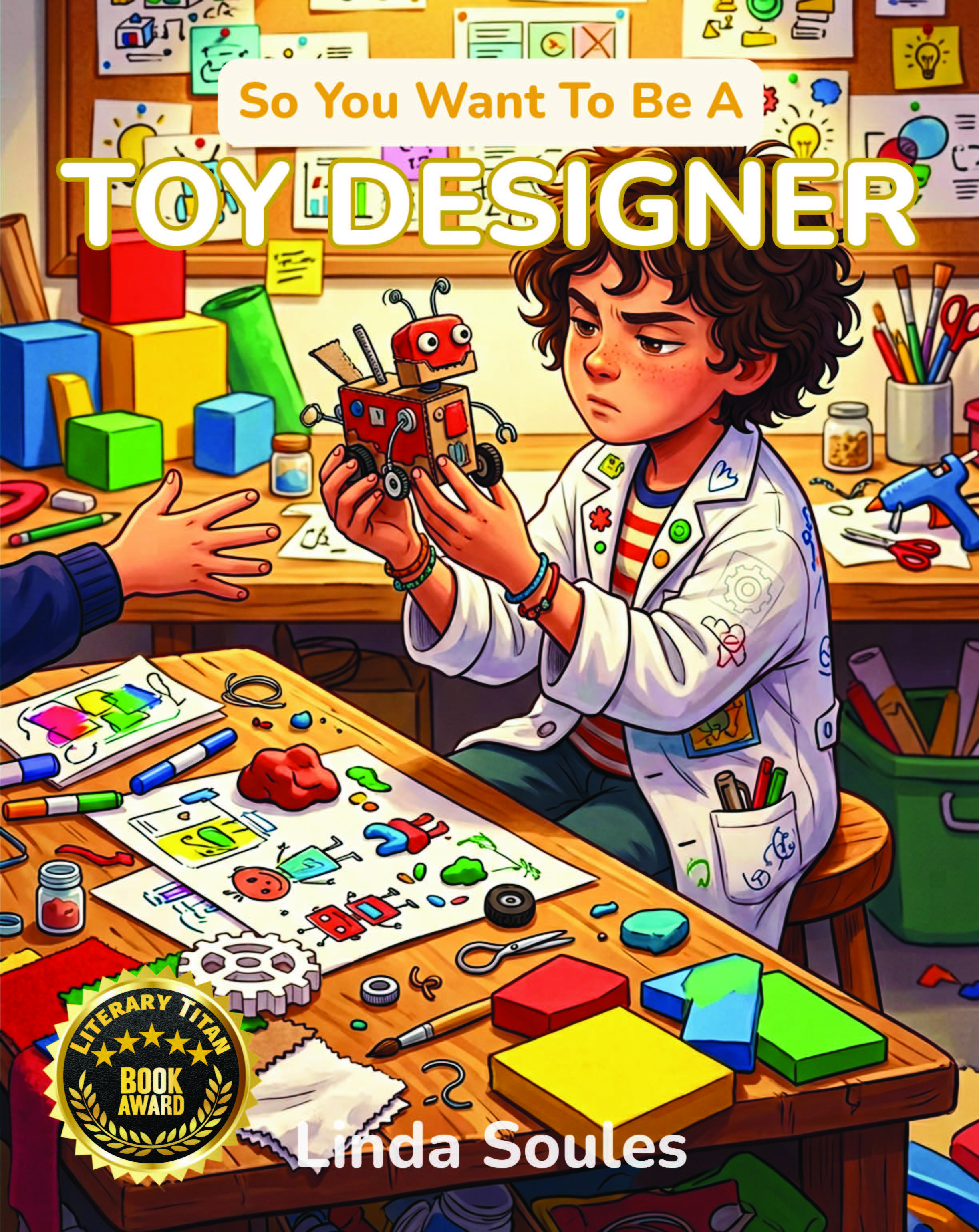
Children's Nonfiction
So You Want To Be A Toy Designer
by Linda Soules
Listen to this review
So You Want To Be A Toy Designer treats play not as a reward after learning but as a way of learning in its own right. Its central idea—that a toy should give a child something to imagine with, rather than prescribe every move—shapes the book’s account of the profession, from rapid sketching and rough prototypes to safety review and playtesting. The result is an inviting introduction to toy design that takes both childhood and the practical demands of making products seriously.
The book is most persuasive when it makes design a process of observation. A prototype, it explains, is not a miniature finished product but a question put to a child. The example of magnetic wooden animals makes that point concrete: children who were expected to practice assembly began combining the pieces into new creatures and inventing stories. The designers’ lesson—that children may reveal a toy’s real possibilities—gives the book a useful humility. Similarly, the proposed day in the life, with sketches, testing, engineering meetings, and safety review, presents the work as collaborative and iterative rather than as a solitary burst of inspiration.
Its prose is direct, warm, and deliberately memorable. Short formulations such as “The prototype is the designer’s question” and “The child’s play is the answer” give young readers sturdy ideas to carry through the chapters. The recurring contrast between feature-heavy toys and open-ended ones also gives the book thematic coherence. Blocks, dolls, balls, clay, and crayons recur as examples of objects whose simplicity leaves room for invention. The book’s strongest emotional passages extend that argument: a well-loved toy may last across generations, while a toy’s representation of different bodies and cultures can tell a child who belongs. The author’s closing insistence that designers should make toys for “every child” gives the career a social purpose without losing sight of play itself.
The practical sections make the introduction especially useful. Readers are encouraged to sketch ten concepts, build a rough prototype from household materials, test it without giving instructions, and record what happens. The glossary defines terms such as “affordance,” “age grading,” and “tooling” in accessible language, while the suggested activities—guessing a toy’s age range or looking up a patent—turn career curiosity into things to do. The catalogue of careers is also broad enough to show that toy design draws on engineering, art, child development, manufacturing, and research. These details help counter the assumption that designing toys means simply having fun and drawing clever ideas.
The chapters on the harder parts are an important strength. Children may ignore a prototype; safety requirements may force a redesign; a promising mechanism may prove too costly or difficult to manufacture. The book gives these disappointments meaningful space, and its attention to safety makes clear that delight cannot outrank a child’s wellbeing. The discussion of production constraints is particularly valuable because it shows that commercial design involves negotiation: designers must decide which parts of an idea are essential and which can be surrendered. This gives the book a more realistic texture than a career guide focused only on imaginative freedom.
There are, however, limits to its account. The prose often returns to the same lesson—that children are the best judges, and open-ended toys invite deeper play—sometimes with little added to the argument. The repetition reinforces the theme, but it can make sections feel more like variations on a motivational refrain than a widening exploration of the field. Some descriptions also turn a useful principle into an overly neat rule. A child putting a toy down quickly may signal a design problem, as the book suggests, but the text gives little attention to how testing conditions, a child’s age or interests, or the sample of children might affect what designers observe. The emphasis on child response is valuable; a fuller account of how designers interpret different responses would make it more precise.
The book also offers few sources alongside its factual and historical claims. The accounts of Ruth Handler, Shintaro Tsuji, and Eddy Goldfarb are engaging, and the facts about LEGO precision, the Slinky, and toy safety add variety. Yet the unnamed magnetic-animal designer and the broader industry claims—such as the typical two-to-four-year development cycle—are not accompanied by citations or a way for readers to distinguish illustrative examples from general findings. The “Want To Learn More?” section points readers toward books, organizations, websites, and activities, which helps, but it does not fully address that gap within the main text.
For curious readers, especially children drawn to making, drawing, puzzles, or observing how others play, So You Want To Be A Toy Designer is an encouraging and practical starting point. Parents and teachers may find it a useful prompt for conversations about creativity, safety, and inclusion. Readers seeking a detailed account of toy-industry economics, a tightly sourced history, or a nuanced guide to research methods may need additional material. Its best recommendation is modest but meaningful: build something, let a child play with it, and pay attention to what happens next.
Share-ready review images
Download square and vertical images for posts, stories, newsletters, and media kits.
For authors
Want a review page like this for your book?
Upload your manuscript, choose a review tier, and get a permanent public editorial review page you can share with readers.
Review My Book← Back to Reviews
