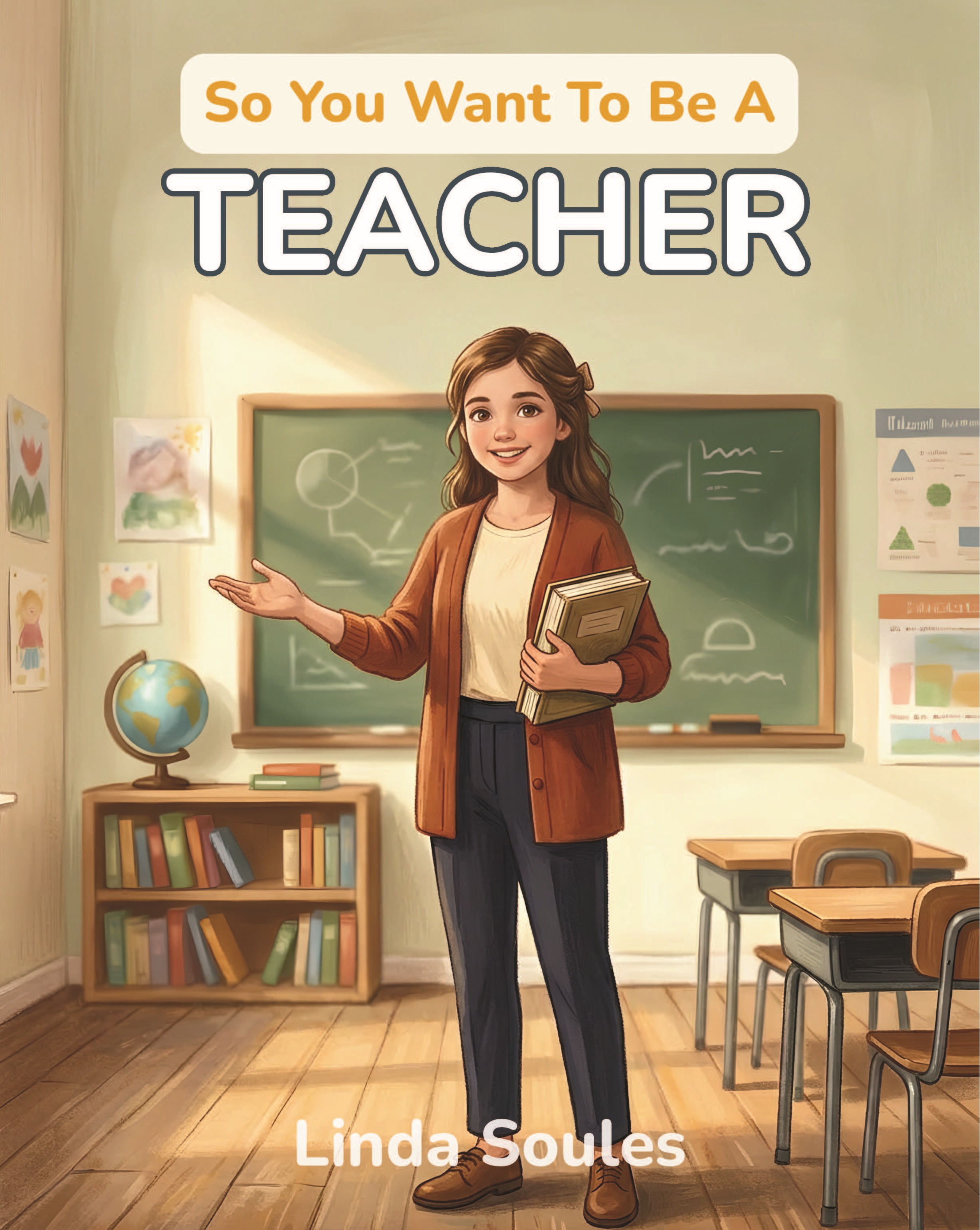
Children's Nonfiction
So You Want To Be A Teacher
by Linda Soules
Listen to this review
So You Want to Be a Teacher is a career introduction for young readers that treats teaching not as a tidy list of classroom tasks but as a relationship-based craft. Its central claim—that learning depends on trust as much as on lesson content—gives the book a coherent point of view. The opening image of a teacher guiding students toward ideas, rather than “pouring knowledge into empty heads,” sets up an argument the chapters return to through practical examples, career advice, and profiles of educators in history.
The strongest passages make the work visible in its daily particulars. “What a Teacher Actually Does” explains lesson planning, assessment, and the skill of “reading the room,” while noting that grading, family communication, and adjustments to future lessons often happen beyond students’ view. The account of a day at school gives this invisible labor a concrete shape: the teacher arrives before the students, welcomes them, adapts a math lesson to different needs, then grades papers and answers emails after dismissal. Details such as lunch being “twenty minutes” spent answering messages and eating cold food keep the portrait from becoming purely inspirational.
The book is especially effective when it explains educational ideas in language a young reader can use. Its glossary clarifies terms including scaffolding, differentiation, assessment, and pedagogy; the chapter on classroom tools makes the useful distinction that manipulatives are “not toys” but ways to make abstract ideas tangible. The advice to teach someone a skill, tutor a younger student, observe teachers, and reflect on one’s own learning turns career curiosity into manageable experiments. These sections make the book more than an invitation to admire teachers: they help readers test whether they enjoy the work’s central activities.
Its style is warm, direct, and often lively. The kindergarten classroom compared to herding cats, the “perfect flight” of a paper airplane, and the loose tooth appearing during a math lesson offer humor without making children seem like obstacles. The book also handles emotional difficulty with unusual frankness for a career guide. Teachers may encounter students’ hardship without being able to fix it, and may keep wondering about a child they could not reach. The recognition that educators need to hold a boundary while still “showing up fully” is a valuable counterweight to the more celebratory passages.
The historical profiles broaden the book’s sense of what teaching can look like. Anne Sullivan’s patient work with Helen Keller, Jaime Escalante’s expectations for his calculus students, Maria Montessori’s observations of children, and Confucius’s question-led instruction illustrate different methods and contexts. The examples support the book’s recurring emphasis on curiosity, persistence, and respect for learners. However, they are brief sketches rather than full biographies, and the account of each figure is shaped toward the chapter’s argument. Readers seeking deeper historical context will need to follow the suggested reading elsewhere.
A significant limitation is that the book’s lyrical confidence sometimes outruns its evidence. Statements that the teacher is “again and again” the biggest factor in student learning, that a great teacher’s economic value reaches millions of dollars, or that teachers make around 1,500 decisions a day are presented without nearby citations or explanations of how the figures were established. The “Want to Learn More?” section offers useful books, websites, and organizations, but it does not clearly document these particular claims. Since the book invites children to think critically about education, indicating which claims are estimates and where they come from would strengthen its credibility.
The account also leans toward the emotional rewards of teaching. Its discussion of modest pay, personal spending on supplies, fatigue, and work outside school hours is welcome, but the recurring emphasis on life-changing moments and lasting gratitude can still make the career feel more consistently affirming than the preceding difficulties suggest. The book says that many teachers cannot reach every student, yet it gives little space to institutional pressures beyond workload and pay. A fuller treatment of class size, limited resources, or differing school conditions might help readers understand that a teacher’s daily experience varies considerably. The route to qualification is sensibly qualified with phrases such as “in most places,” though readers would benefit from a clearer reminder to check local requirements.
Overall, this is a thoughtful, accessible introduction for children who are curious about teaching, particularly readers around the series’ stated ages of 10 to 14 and adults discussing careers with them. Its best contribution is the combination of practical preparation with an honest account of the patience, attention, and emotional steadiness the work demands. Readers looking for a detailed or rigorously sourced guide to teacher training will need additional resources; those wanting a humane first portrait of the profession are more likely to value it.
Share-ready review images
Download square and vertical images for posts, stories, newsletters, and media kits.
For authors
Want a review page like this for your book?
Upload your manuscript, choose a review tier, and get a permanent public editorial review page you can share with readers.
Review My Book← Back to Reviews
