Children's Nonfiction
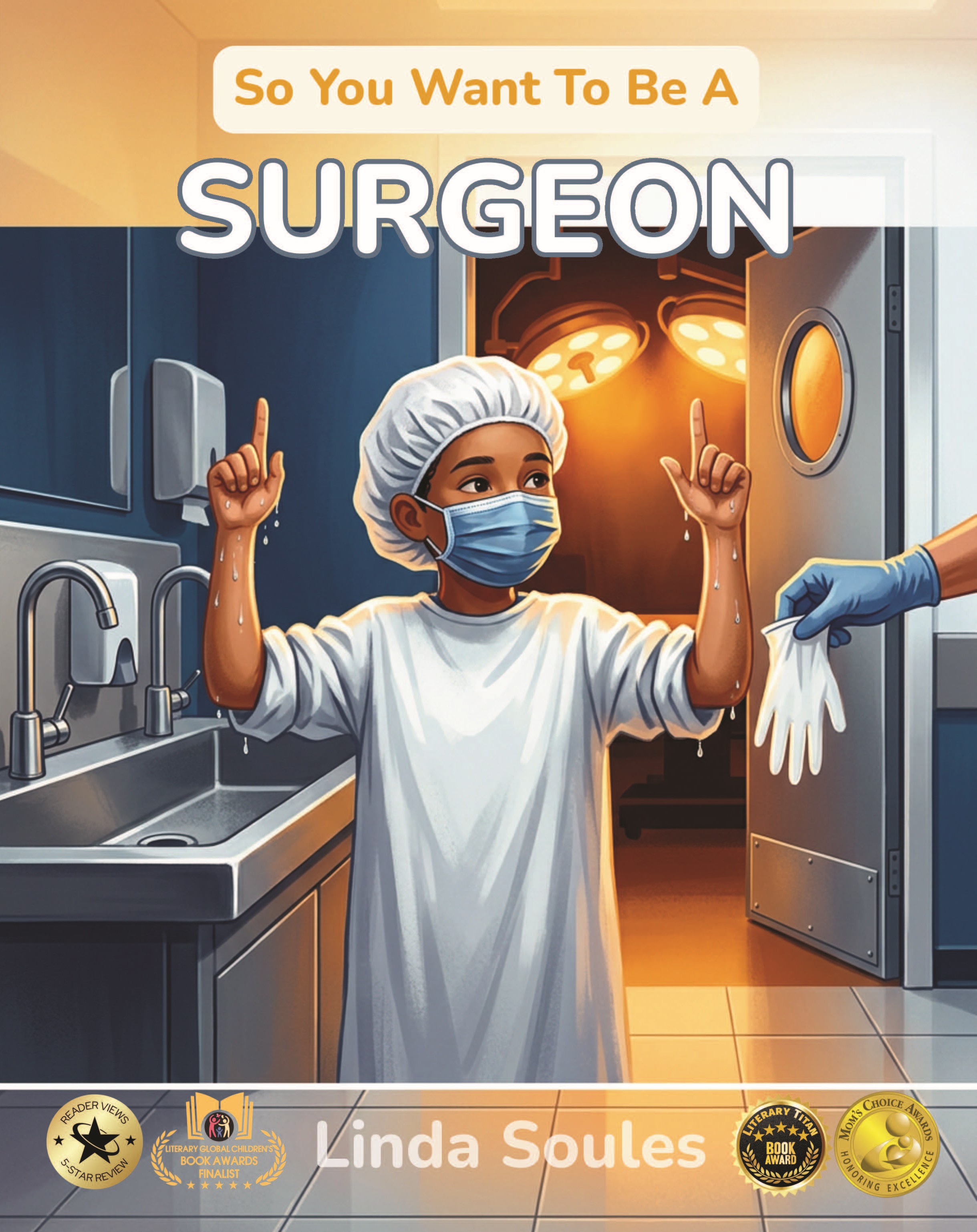
So You Want To Be A Surgeon
by Linda Soules
Listen to this review
So You Want To Be A Surgeon treats a career guide as an invitation into a demanding vocation, not merely a catalogue of instruments and procedures. Linda Soules begins in the operating room, with its bright lights, cold air and concentrated team, then widens the view to include diagnosis, preparation, communication and recovery. The central corrective—that “the actual cutting” is only a fraction of the work—gives the book a useful organizing idea: surgery depends as much on judgment and care as on technical skill.
The writing is direct, vivid and often deliberately lyrical. The image of the surgeon’s hands, trained “knot by knot, stitch by stitch,” gives young readers a concrete way to imagine expertise as something earned through repetition. The chapters on the sterile field, laparoscopic instruments and surgical loupes offer accessible explanations without lingering over procedural detail. The account of a frozen section, in which a pathologist examines tissue during an operation and the surgeon waits for an answer, is especially effective: it makes clear that surgery involves collaboration and adjustment, not simply following a fixed plan.
The book’s strongest thematic choice is its refusal to equate courage with fearlessness. In “The Hardest Parts of the Job,” it describes anatomical surprises, complications and the emotional weight of poor outcomes. The discussion of Morbidity and Mortality Conference introduces accountability as part of professional practice, while the closing author’s note adds a more subtle measure of judgment: knowing when not to operate. That distinction gives the portrait ethical depth. The surgeon’s responsibility is not presented as a simple mandate to intervene, but as a duty to weigh possible benefit against suffering.
Soules also works to make the profession human rather than solitary. The “People You Work With” chapter gives roles to anesthesiologists, nurses, scrub technicians, assistants and residents, and the operating-room time-out illustrates how routine checks can protect patients. The day-in-the-life schedule is another helpful device, particularly its contrast between hours of preparation and the brief conversation with a waiting family. These details may help readers see that technical achievement happens within a network of relationships and communication.
The historical profiles extend the book’s account of who has contributed to surgery. Nina Starr Braunwald’s work as a heart surgeon and valve designer, Vivien Thomas’s technical innovation despite being denied the status and recognition afforded to physicians, and Daniel Hale Williams’s career and institution-building all offer examples of skill shaped by barriers as well as ambition. Thomas’s delayed recognition is especially pertinent to a book for young readers: it complicates the otherwise uplifting message that effort alone determines success. The profiles are concise, but they open paths toward further reading and discussion.
The practical sections are among the book’s most engaging features. Suggestions such as practicing knots with string, sewing a line of stitches on fabric with an adult’s help, building small models and learning basic anatomy turn curiosity into manageable activities. The glossary reinforces unfamiliar terms, and the resource pages offer books, organizations and activities rather than leaving readers with inspiration alone. The stated training route—college, medical school, residency and possibly further specialization—also makes the length of the commitment plain.
There are, however, limits to the book’s approach. Its second-person address and recurring declarations about “steady hands,” trust and calling can become insistent. The prose sometimes elevates ordinary professional responsibilities into near-sacred language, which may inspire some readers but feel overstated to others. Several claims are presented with confidence but little sourcing in the supplied text, including the statement that checklists may have saved more lives than any other modern surgical innovation and that studies show improved performance with self-chosen music. For a book that encourages scientific curiosity, brief references or a source note for such claims would strengthen its authority.
The portrait is also more emotionally and vocationally persuasive than practically comprehensive. It explains training duration and qualities such as concentration, endurance and communication, but gives little sense of the costs, selection pressures or varied working conditions that shape access to the profession. The historical examples acknowledge exclusion, yet the career pathway itself is presented as broadly open to anyone willing to begin. That optimism suits an introductory book, though readers seeking a fuller account of the realities of medical training will need other sources. The text refers to illustrations and describes their creation as AI-assisted, but the supplied material does not include the images, so their quality cannot be assessed here.
Overall, So You Want To Be A Surgeon is a thoughtful, accessible introduction that combines career information with an unusually strong emphasis on humility, teamwork and patient-centered judgment. Its most memorable message is that competence means more than knowing how to act: it also means preparing carefully, admitting limits and recognizing when action may do harm. The book is best suited to curious readers around ages 10 to 14, especially those drawn to biology or hands-on problem-solving, and to parents or teachers looking for a springboard for conversations about medicine. Readers wanting detailed, sourced career guidance should pair it with more practical resources, but as an invitation to explore the profession, it has substance as well as enthusiasm.
Share-ready review images
Download square and vertical images for posts, stories, newsletters, and media kits.
For authors
Want a review page like this for your book?
Upload your manuscript, choose a review tier, and get a permanent public editorial review page you can share with readers.
Review My Book← Back to Reviews
