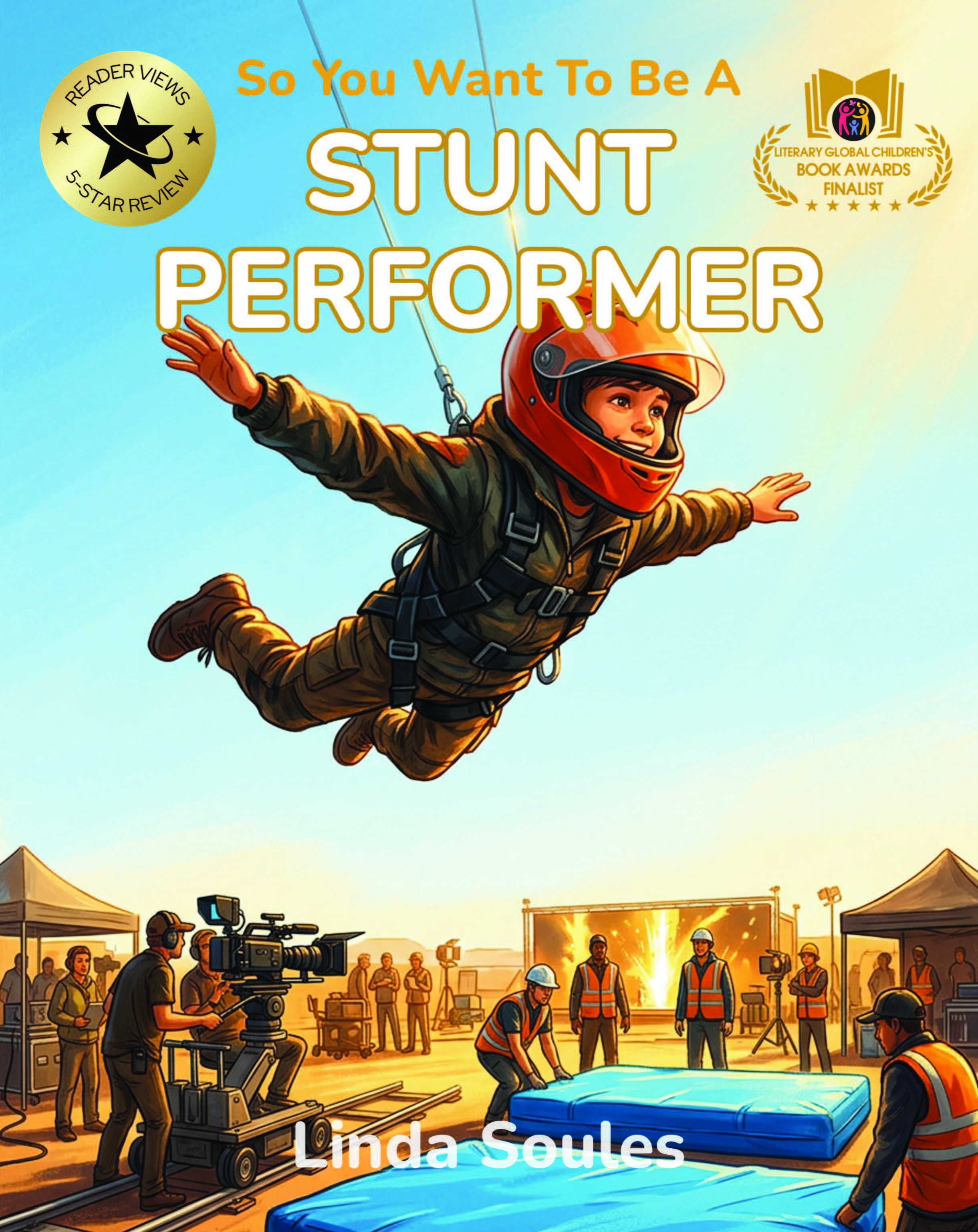
Children's Nonfiction
So You Want To Be A Stunt Performer
by Linda Soules
Listen to this review
So You Want to Be a Stunt Performer makes its central distinction clear from the opening pages: stunt work is not about courting danger but about making danger appear convincing while controlling it. Linda Soules builds the book around that productive paradox. A high fall may last only seconds on screen, she explains, but requires careful calculation, rehearsal, equipment checks, and backup systems. This emphasis gives the career a more thoughtful shape than its spectacular image suggests, and makes the book as much an introduction to planning and teamwork as to physical performance.
The strongest sections are those that turn this principle into concrete detail. “What A Stunt Performer Actually Does” lays out the stunt breakdown, from identifying an action in the script to calculating forces, rehearsing progressively, and checking safety before filming. The discussion of crash pads, airbags, wire rigs, fire protection, and breakaway materials similarly helps readers understand how movie effects are engineered. The book is especially effective when it contrasts what the camera shows with what the crew has prepared: a fight becomes choreography, a fall a sequence of marks, and apparent spontaneity the result of precision.
Soules’s prose is direct, energetic, and designed to speak to a young reader without making the subject sound simple. Short declarative lines—“The body is irreplaceable”—give the book a memorable cadence, while repeated formulations such as “Plan the action. Engineer the safety. Land it” reinforce its core message. The recurring attention to saying “no” is a notable strength. Safety is not treated as a minor technical concern or a responsibility belonging only to coordinators; the performer’s judgment and willingness to refuse inadequate preparation are presented as essential professional skills.
The book also broadens the portrait of the job beyond athletic ability. Its discussion of emotional control, proprioception, acting, physics, and communication gives readers a useful sense of the diverse demands involved. The sample day—with a safety meeting, rehearsal adjustments, wardrobe matching, a vehicle extraction, and a debrief—helps puncture the fantasy that the work consists mainly of dramatic action. Likewise, the account of doubling an actor stresses an often-invisible craft: matching not only build but posture and movement, so that the audience accepts the illusion.
Historical profiles add welcome human scale. Dar Robinson’s record-setting falls and invention of the decelerator illustrate technical ingenuity, while the account of his death on a routine motorcycle ride underscores the book’s warning that familiar or apparently easy tasks deserve care too. Zoë Bell’s path from gymnastics and doubling to stunt coordination gives the section a contemporary example of skill developing into leadership. Jackie Chan’s training in Beijing opera offers a different tradition of physical storytelling. These brief profiles are vivid, though they are snapshots rather than deeply developed biographies.
The book’s most valuable reader impact may be its effort to redirect youthful fascination with risk toward observation and preparation. Suggestions to watch fight choreography, look for stunt credits, and compare what appears on screen with what happened behind the scenes encourage active viewing. The glossary is practical, and the further-reading and organization lists provide routes for continued exploration. Together, these features make the book useful as a conversation starter for families and classrooms, not merely a sequence of career facts.
There are limits to its approach. The repeated safety message is persuasive, but the highly assured language can sometimes make complex practices sound more uniform or guaranteed than the book itself acknowledges. It admits that preparation cannot eliminate injury and describes the cumulative wear of a career, yet its brisk explanations may leave young readers with an incomplete sense of how much conditions differ between productions and jurisdictions. The book offers no citations alongside its many specific technical and historical claims in the supplied text; for readers pursuing the subject further, it would be helpful to distinguish more clearly between general principles and details that depend on a particular stunt or production.
One recommendation deserves particular care: the “prepare right now” section invites children to practice a backward fall on a soft surface with a parent’s supervision. The passage does include a safety-minded setting and basic instructions, but a brief exercise cannot substitute for qualified instruction, and the advice sits uneasily beside the book’s insistence that stunts require planned, verified conditions. A stronger warning not to attempt falls or other stunts without trained supervision would better support the book’s own central ethic. The suggested low-step jump and floor roll also merit the same caution.
The book’s repeated summaries and emphatic slogans make its message easy to retain, though readers seeking a more nuanced account of career entry, employment uncertainty, or the day-to-day economics of the profession may want a more detailed companion. The appended series catalogue and author’s note provide context, but also extend a focused career guide into promotional and series-wide material. Still, the core chapters remain coherent and accessible. So You Want to Be a Stunt Performer is best suited to curious readers roughly in the middle-grade range who are drawn to action filmmaking and ready to learn that discipline matters more than bravado. It offers an engaging introduction, provided adults reinforce its safety principles and steer practical experimentation toward qualified instruction.
Share-ready review images
Download square and vertical images for posts, stories, newsletters, and media kits.
For authors
Want a review page like this for your book?
Upload your manuscript, choose a review tier, and get a permanent public editorial review page you can share with readers.
Review My Book← Back to Reviews
