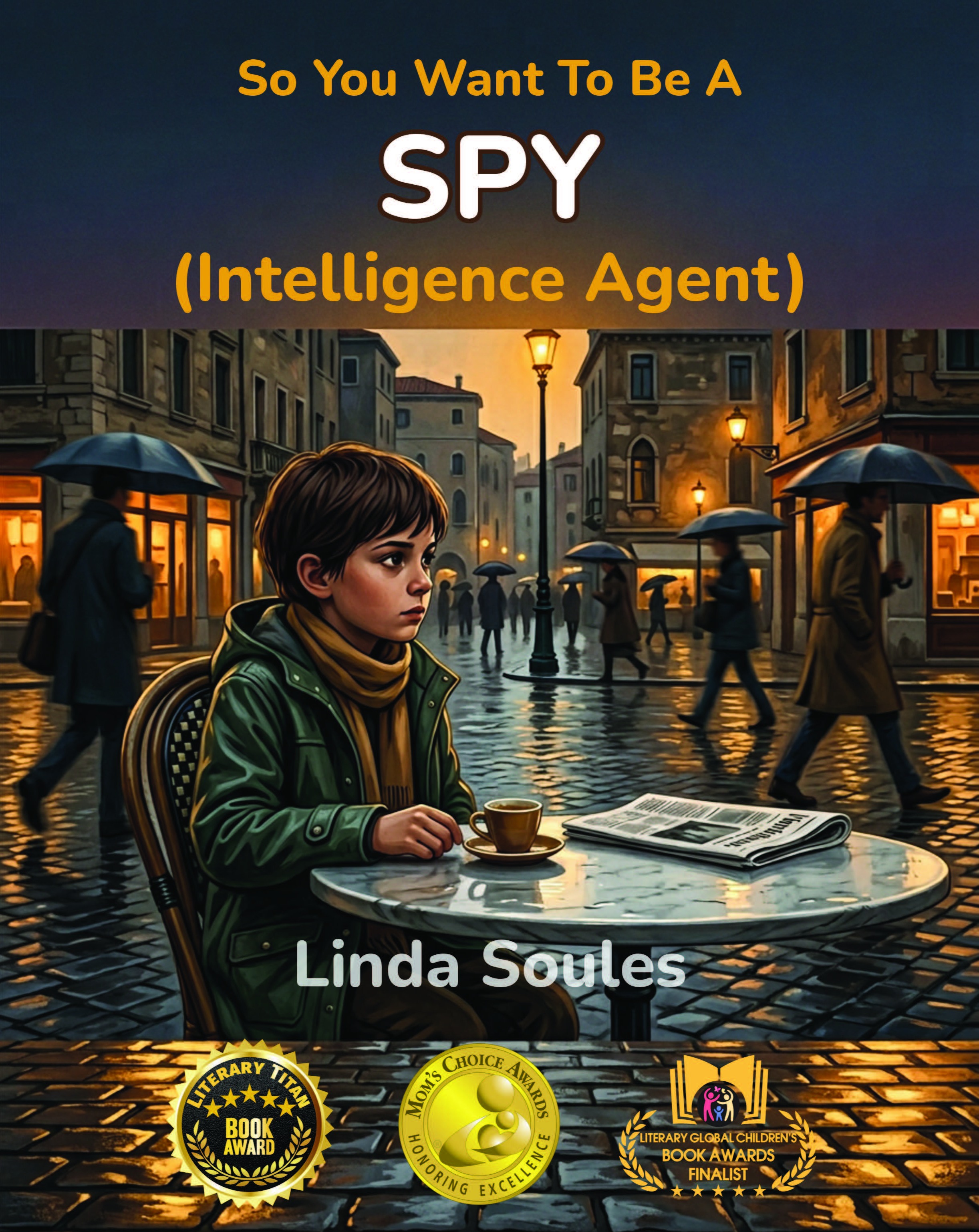
Children's Nonfiction
So You Want To Be A Spy (Intelligence Agent)
by Linda Soules
Listen to this review
So You Want To Be a Spy (Intelligence Agent) is less a guide to glamorous espionage than an argument for careful thinking. Its central image is the intelligence puzzle: scattered reports, photographs, conversations, and records must be assembled without pretending that the missing pieces are available. That framing gives the book a useful corrective to the familiar action-movie version of spy work. Across chapters such as “What An Intelligence Agent Actually Does” and “The Best Parts of the Job,” Linda Soules emphasizes research, analysis, patience, and responsible judgment over gadgets and danger.
The book’s strongest theme is intellectual honesty. Analysts are urged to distinguish evidence from assumption, search for explanations that challenge their own conclusions, and say “I don’t know” when the information does not support certainty. The discussion of confirmation bias is especially effective: the question “what would change my mind?” turns an abstract concept into a practical test of open-mindedness. “The Hardest Parts of the Job” extends this ethical focus to reporting unwelcome findings to powerful decision-makers. In these passages, the book offers young readers more than career information; it makes a persuasive case for accuracy, skepticism, and courage in everyday life.
Soules’s prose is direct, conversational, and rich in memorable comparisons. The analyst’s work becomes a puzzle, a pattern hidden in noise, and a process that ends by identifying what remains unknown. Short sections, explanatory asides, and a glossary make specialized terms such as “dead drop,” “asset,” and “open source intelligence” approachable. The scheduled outline in “A Day in the Life” gives the account a concrete rhythm, moving from morning reports to team analysis, report writing, language study, and a final briefing. Its closing thought—that the day ends by clarifying what the analyst still does not understand—nicely captures the book’s emphasis on inquiry rather than certainty.
The historical sketches also help broaden the young reader’s idea of who can contribute to intelligence work. Virginia Hall’s missions with a prosthetic leg, Noor Inayat Khan’s work as a radio operator, Harriet Tubman’s Civil War intelligence gathering, and Juan Pujol García’s deception of Nazi Germany supply vivid examples of resourcefulness in very different circumstances. The book pairs these profiles with practical activities: checking sources, keeping a bias journal, making a pattern map, and arguing the opposing side of a friend’s position. That link between history and practice is one of its most engaging structural choices.
Yet the book’s breadth sometimes comes at the expense of precision. Its title promises a book about a “spy,” while much of the text describes intelligence analysts, researchers, technical officers, linguists, and field officers as parts of a large institution. The distinction is acknowledged, particularly when the book notes that field officers make up only a small fraction of the workforce, but the terminology still shifts. Readers drawn specifically to undercover operations may find that the most sustained attention goes instead to analysis and writing. That shift is valuable, but a clearer explanation of how the different roles relate—and which ones the book means by “spy”—would make the career picture more exact.
Some generalizations also risk turning useful guidance into rules that sound more certain than they are. The glossary says, “One source is a rumor. Two are interesting. Three are the beginning of a fact,” while the preparation chapter similarly presents three sources as a threshold for fact. The surrounding advice correctly stresses source evaluation and independent confirmation, but the numerical shorthand may suggest that quantity alone establishes reliability. Likewise, the claim that the “vast majority” of useful intelligence comes from public sources is delivered emphatically without much qualification. The book would be stronger if it consistently applied its own lesson that confidence should match the evidence.
The account of intelligence service is also strongly idealized. It stresses protection, public service, and the quiet satisfaction of preventing harm, while acknowledging secrecy, pressure, and the burden of withholding information from loved ones. It gives less attention to the risks of institutional error, the limits of intelligence, or the ethical and political questions raised by covert activity. The brief warning that a good service must keep asking whether its actions are right is important, but it is not developed as fully as the book’s celebration of service. For readers ready to consider the subject’s moral complexity, this is a notable omission; for younger readers beginning with a career overview, it may be a starting point for discussion with an adult.
The tone is enthusiastic, and several passages repeat the same praise of patience, observation, and unseen service. Still, the repetition reinforces the book’s central message, and the practical exercises give its encouragement substance. The closing sections—including “Could This Be Your Job?” and “Want To Learn More?”—extend the invitation with reading suggestions, activities, and organizational resources. As a result, this is most likely to appeal to curious readers around the series’ stated middle-grade audience who enjoy puzzles, history, languages, and questions about how we know what we know. It is less suited to readers seeking a comprehensive or sharply critical account of espionage. For its intended audience, it offers an engaging introduction to intelligence work, especially when paired with conversation about the ethical complexities it leaves largely unexplored.
Share-ready review images
Download square and vertical images for posts, stories, newsletters, and media kits.
For authors
Want a review page like this for your book?
Upload your manuscript, choose a review tier, and get a permanent public editorial review page you can share with readers.
Review My Book← Back to Reviews
