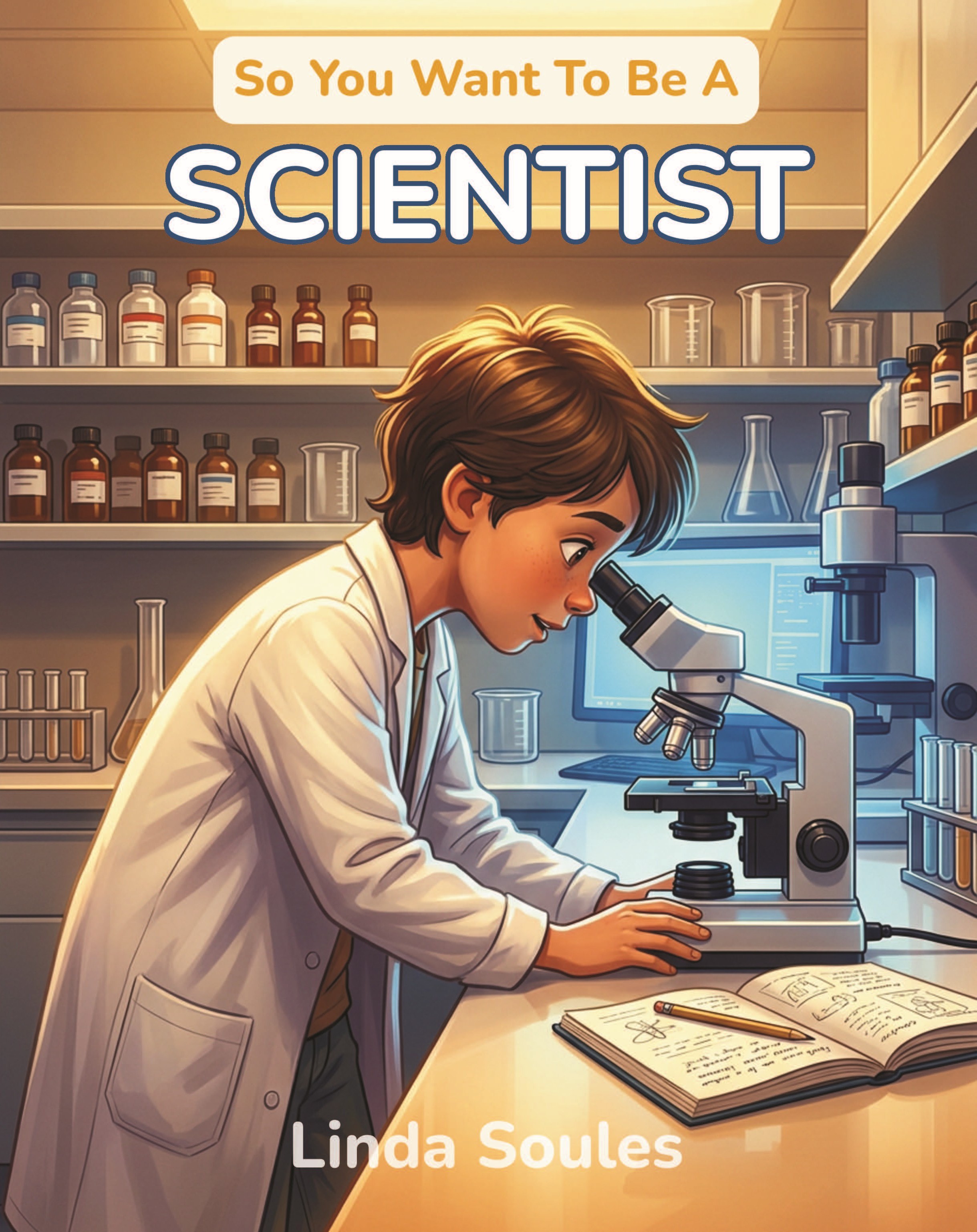
Children's Nonfiction
So You Want To Be A Scientist
by Linda Soules
Listen to this review
So You Want To Be A Scientist by Linda Soules approaches career guidance as an invitation to think, rather than a catalogue of qualifications. Its opening claim—“you already are” a scientist if you notice, wonder, and investigate—sets a generous tone for a book aimed at young readers. The idea is effective: science becomes a habit of attention accessible to children now, not a distant profession reserved for people in lab coats. Soules sustains that welcome through direct address, concrete examples, and a clear interest in the excitement as well as the less glamorous work of research.
The book’s strongest feature is its account of how science actually proceeds. “What A Scientist Actually Does” shifts from familiar discovery stories to the ordinary routines of reading, designing experiments, checking results, and writing them up. Later, “A Day in the Life” turns those routines into a practical schedule: a scientist repeats an experiment after one unusual number rather than treating it as a revelation, and struggles to explain a finding clearly enough to understand it. These details usefully counter the notion that research consists mainly of sudden flashes of genius. The sections on grant applications, collaboration, and peer review extend that realism, showing that scientific work depends on institutions and colleagues as well as curiosity.
Soules is also good at making abstract habits tangible. In “The Tools of the Trade,” the hypothesis is presented as a tool that shapes the experiment before any equipment is used; the glossary then gives readers accessible definitions of terms such as “falsifiability,” “null result,” and “replication.” The book’s repeated emphasis on recording observations, testing predictions, and asking what might disprove an idea gives its practical advice a coherent backbone. Suggestions such as starting a notebook, joining citizen-science projects, and comparing a prediction with an experiment’s outcome offer children ways to act on that advice without waiting for formal training.
The prose is energetic and often memorable. Short sentences, questions, and vivid comparisons suit the subject and likely read well aloud. The account of Suzanne Simard’s forest research, with trees connected by fungal threads, gives a sense of discovery beneath an apparently familiar landscape. The discussion of Stephanie Kwolek’s cloudy polymer solution becoming Kevlar supports the book’s broader point that an unexpected result deserves investigation. Elsewhere, the “pale blue dot” and the image of science as a slow relay race widen the emotional scope without losing sight of the work involved. The result is a book that wants readers to feel both wonder and intellectual responsibility.
That responsibility comes into sharper focus in the author’s note. Soules acknowledges that scientific knowledge can be used for harm as well as help, and argues that ethical judgment belongs to scientists themselves. This is a valuable qualification to the book’s otherwise strong faith in science. Its examples of Marie Curie, Carl Sagan, and Tu Youyou also offer different models of scientific work: persistence under constraint, communication beyond the laboratory, and research informed by historical texts. The selection helps make the field feel broader than a single image of a solitary laboratory researcher.
There are, however, places where the book’s enthusiasm outruns its precision. Some explanations and anecdotes are delivered as settled, uncomplicated facts, even when the text gives readers no sources with which to assess them. The account of tree networks, for instance, moves from a dye appearing in nearby trees to broad claims about sharing food, water, and warnings; the narrative offers little indication of what the experiment establishes or where interpretation begins. Likewise, the claim that a seed’s starch grains effectively determine which way its root and shoot grow is a striking simplification. For an introductory book, simplification is necessary, but the confident presentation can make complex or qualified findings seem more straightforward than they are.
Several generalizations also deserve more care. “Every discovery in human history” is said to have been made using the scientific method, and the book suggests that currently unanswered questions “will” receive answers. Such lines convey optimism, but they blur the distinction between scientific inquiry and other ways humans develop knowledge, and promise certainty where the book’s own account of failure and revision counsels humility. The description of science as a crowd that “gets a right” slowly is vivid, though less exact than the surrounding explanations. A little more qualification, or a short reading list tied to particular claims, would strengthen the book’s admirable commitment to evidence.
The structure is accessible and modular, moving from the nature of the job through its routines, rewards, difficulties, qualities, and preparation, before closing with resources and a personal appeal. At times, the repeated affirmations of curiosity and persistence make the chapters feel less distinct than their headings suggest. The conclusion, in particular, turns toward motivational language that may feel familiar to readers who prefer a more restrained career guide. The supplied text also gives no view of the illustrations, so their contribution to the book cannot be assessed here.
Overall, So You Want To Be A Scientist is most valuable as an encouraging introduction for curious readers, especially children around the series’ stated ages of 10 to 14, and for parents or teachers seeking a springboard for conversation. Its frank treatment of failed experiments, writing, teamwork, and ethics gives it substance beyond inspiration. Readers seeking closely sourced explanations or a detailed account of different scientific careers may want additional material alongside it, but young question-askers are likely to find both practical ideas and a persuasive reason to keep asking why.
Share-ready review images
Download square and vertical images for posts, stories, newsletters, and media kits.

For authors
Want a review page like this for your book?
Upload your manuscript, choose a review tier, and get a permanent public editorial review page you can share with readers.
Review My Book← Back to Reviews
