Children's Nonfiction
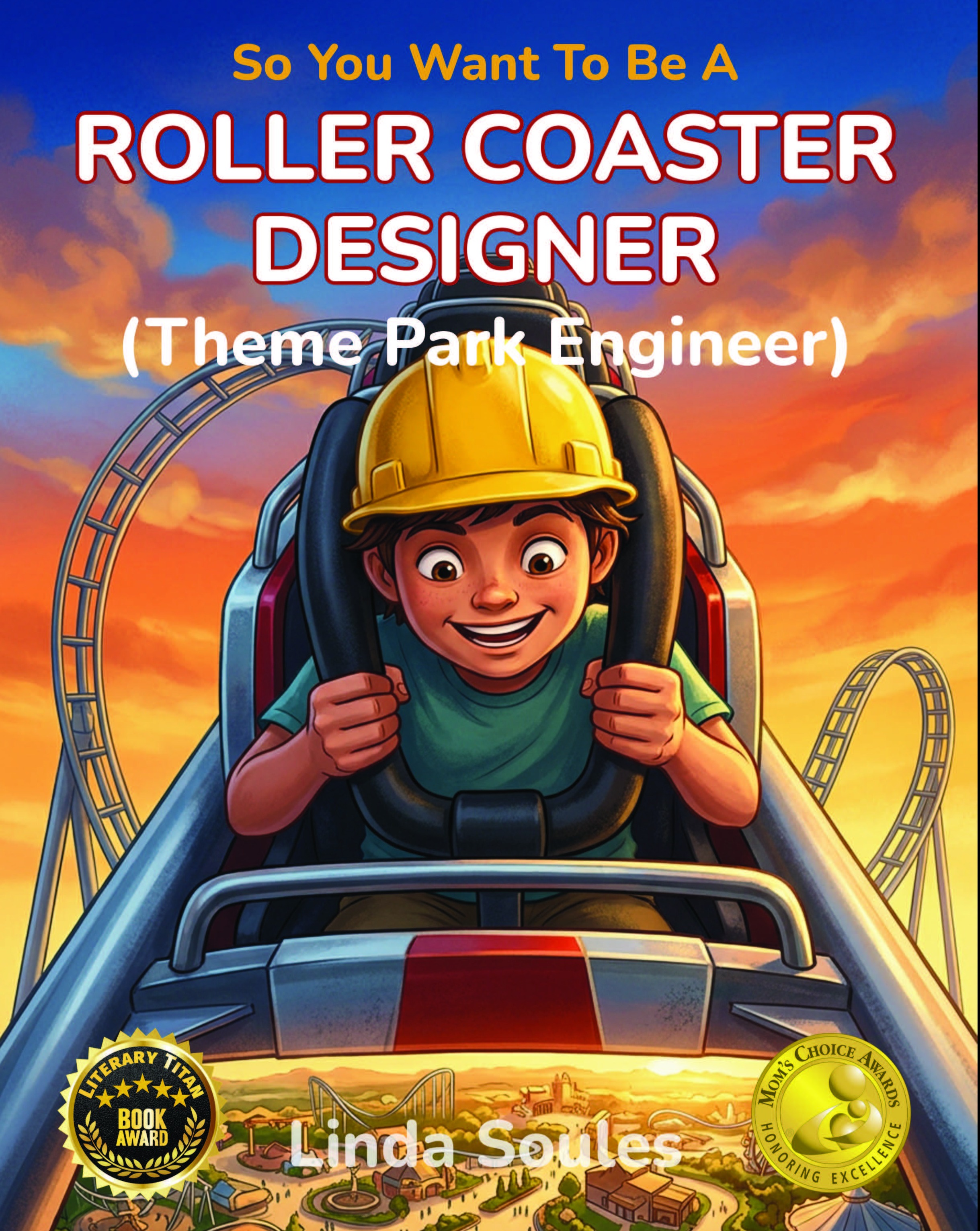
So You Want To Be A Roller Coaster Designer (Theme Park Engineer)
by Linda Soules
Listen to this review
In So You Want to Be a Roller Coaster Designer, Linda Soules makes an appealing case that engineering can be both rigorous and joyful. The book’s central idea is that a coaster designer does not simply calculate speed or draw track: the designer shapes what riders feel, moment by moment. Its most effective passages connect physics to sensation, explaining how height stores energy, how a drop turns it into speed, and how curves produce the pushes and weightlessness riders experience. For young readers who love rides but have not yet thought about the science behind them, that connection offers a lively way into engineering.
The writing is energetic and conversational, often addressing the reader directly: “So. You want to be a roller coaster designer.” That invitation establishes a friendly tone without making the subject seem trivial. Soules uses vivid comparisons to make technical ideas accessible, likening stored energy to a stretched rubber band and a ride’s sequence of thrills to music or film editing. The account of a designer balancing “the precision of the numbers and the joy of the experience” gives the book its strongest thematic thread. Engineering is presented not as a constraint on creativity, but as the means by which a particular sensation can be safely created.
The organization is practical and well suited to a career-exploration book. Chapters move from what the job involves and where designers work to tools, challenges, collaborators, and preparation. The “A Day in the Life” section makes abstract work concrete: a designer adjusts a loop after software flags excessive sideways forces, discusses a support post with structural engineers, studies ride footage for pacing, and reviews harness safety documents. The sequence communicates that the work combines calculation, discussion, observation, and painstaking review—not just sketching spectacular track layouts.
Several details are especially memorable. The explanation that modern loops are teardrop-shaped rather than circular gives readers a tangible example of geometry serving both comfort and safety. The book also makes pacing part of the design problem: too many major thrills in succession can dull their effect, while long gaps can drain anticipation. The practical activities extend that idea beyond the page. Building a marble run, drawing a track profile, and keeping a “ride book” invite readers to observe motion and consider how a sequence feels. These exercises are among the book’s strongest features because they turn enthusiasm into experiments a child can try.
The discussion of safety is also an important strength. Rather than treating restraints, testing, and inspections as dull obstacles, Soules presents them as central responsibilities. The repeated question in the sample workday—what could go wrong, and what prevents it?—underscores the trust riders place in the people who design and maintain attractions. The book also acknowledges less glamorous realities: testing takes time, physical construction can differ from plans, and a finished design may need revision. This helps keep the profession from appearing to be nothing but amusement-park thrills.
At times, however, the prose pushes its inspirational argument so hard that it becomes repetitive. The book returns frequently to the equation of physics with joy, and to the idea that a designer engineers a feeling of danger while ensuring safety. The repetition reinforces the theme, but some later sections—especially “How You Help People,” “Could This Be Your Job?” and the author’s concluding note—restate ideas already developed earlier. Readers looking for a brisk reference guide may find the lyrical language and recurring affirmations slow the pace.
The career picture is more evocative than comprehensive. Readers learn about software, accelerometers, scale models, safety reviews, and the roles of structural, mechanical, and testing engineers. They also encounter three named designers—Werner Stengel, Denise Dinn Larrick, and John Wardley—whose short profiles suggest different routes into the field and different creative emphases. But the book offers little practical detail about educational requirements, early-career jobs, or how someone might move from school into this specialized work. The “What You Can Do” activities and resource list provide useful starting points, yet older readers seeking a concrete career plan will need information beyond this volume.
Some explanations are simplified to suit the intended audience, and the confident tone can make those simplifications sound more absolute than they are. Statements such as “the train can never go higher than where it started” are presented as a basic rule for coasters that rely on the initial lift, while the discussion of safety sometimes frames zero harm as the defining goal without explaining how engineers assess and manage risk in practice. Likewise, the brief profiles make sweeping claims about individual designers’ importance without much context. These choices keep the book accessible, but a curious reader may benefit from a teacher or adult helping distinguish introductory models from the full complexity of engineering and industry history.
Overall, Soules offers an engaging introduction to the imaginative and technical sides of coaster design. The book is strongest when it explains a physical principle through a rider’s experience and then gives readers a way to investigate that principle themselves. It will be most valuable to children roughly in the middle-grade range who are already fascinated by amusement rides, enjoy hands-on projects, or are beginning to explore engineering careers. Readers seeking detailed training pathways or a technically rigorous account of coaster design may find it a starting point rather than a complete guide.
Share-ready review images
Download square and vertical images for posts, stories, newsletters, and media kits.
For authors
Want a review page like this for your book?
Upload your manuscript, choose a review tier, and get a permanent public editorial review page you can share with readers.
Review My Book← Back to Reviews
