Children's Nonfiction
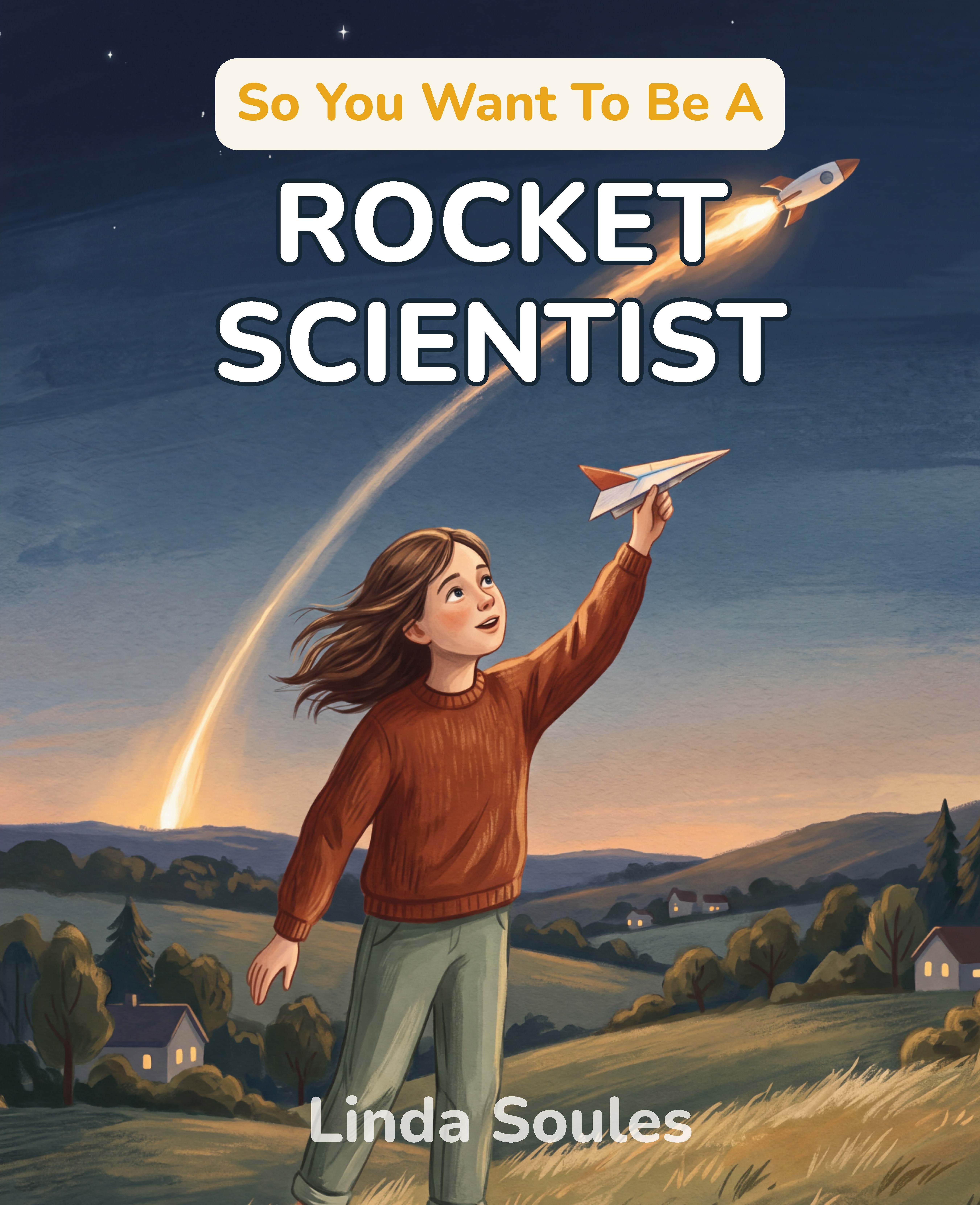
So You Want To Be A Rocket Scientist
by Linda Soules
Listen to this review
Linda Soules’s So You Want to Be a Rocket Scientist treats its subject less as a glamorous title than as a demanding form of collaborative engineering. Its central correction is useful for young readers: “rocket scientist” is often shorthand for genius, but the work described here depends just as much on patience, careful checking, and knowing when to stop a countdown. That practical emphasis gives the book a stronger foundation than a simple celebration of big machines and spectacular launches.
The opening explanation of the “battle against weight” efficiently establishes the engineering challenge. The comparison to carrying snacks on a marathon makes the fuel problem concrete, while the discussion of Newton’s third law, thrust, and the balloon example turns basic physics into something a child can picture. Elsewhere, the explanations remain similarly accessible without reducing the field to magic: the sections on liquid oxygen and engine cooling, staged rockets, orbital motion, and gravity assists build a workable vocabulary for understanding how rockets function. The glossary reinforces that learning, though some readers may find it more useful as a reference than as a narrative read-through.
The book’s organization is one of its chief strengths. It moves from the rocket’s parts and specialist roles to workplaces, tools, working conditions, and preparation, then broadens into history, public benefit, and career reflection. The labeled descriptions of fairings, payloads, stages, and engines help readers orient themselves before the text moves into the less visible labor behind a launch: simulations, static fires, telemetry, inspections, and post-flight analysis. “A Day in the Life” is especially effective at showing that work. Its test engineer faces an engine shutdown after a temperature spike, then studies the data and finds a fixable valve-timing problem. The armadillo interruption adds humor, but the episode’s larger point is serious: a test that ends early can still teach the team something essential.
Soules writes in a conversational, lively register, using analogies and small jokes to keep technical material inviting. The “Talk Like a Rocket Scientist” section translates terms such as “nominal,” “anomaly,” and “Max Q,” while “Secrets of the Launch Pad” offers vivid curiosities, from the woodpecker-damaged shuttle tank to the frog photographed beside a Virginia launch. These moments are likely to hold the attention of readers who might resist a more formal introduction to aerospace. The tone does sometimes lean heavily on punchlines and exclamatory phrasing, and the steady stream of facts can make the book feel more like an energetic reference guide than a sustained story. That is a matter of fit, not a failure of purpose: readers seeking a continuous narrative or extended technical depth may want another book alongside it.
The human and ethical dimensions prevent the career portrait from becoming uncomplicated boosterism. The account of Yvonne Brill and Annie Easley gives meaningful space to women who faced barriers and made consequential technical contributions; Ritu Karidhal’s work on India’s Mars Orbiter Mission widens the geographical frame. Most striking is “A Hard Chapter in Rocket History,” which does not detach Wernher von Braun’s achievements from his role in Nazi Germany’s V-2 program or the forced labor used to build those weapons. The chapter ends by asking who engineering work helps and whom it may harm. That question gives moral weight to the book’s portrait of technical ambition, and the author’s closing reflection on the importance of being able to call a “hold” extends the safety theme into classrooms and families.
There are limits to the book’s scope. Its examples range internationally, but much of the career guidance centers on U.S. institutions, employers, education, and programs, so readers elsewhere may need to translate some of the practical advice. The discussion is also weighted toward engineering and launch operations; it mentions technicians, welders, software developers, and weather officers, but gives less sustained attention to the different training routes or day-to-day experiences of those roles. The book does note that not every team member needs a four-year degree, a helpful qualification that could have been developed further. In addition, pay, employment, launch-record, and mission claims are presented with dates but without citations beside the relevant passages. The “Want to Learn More?” list offers a starting point, yet readers checking particular statistics or very recent events will need to follow those sources themselves.
As a career introduction, the book succeeds by presenting both the excitement of launch day and its less cinematic counterpart: repeated testing, strict safety procedures, budget uncertainty, failed hardware, and work that often goes unseen. Its strongest audience is curious readers roughly in the middle-grade range who enjoy science, practical problem-solving, and lively factual books, especially those considering aerospace careers. It should also prompt useful conversations between children and adults about teamwork, failure, and responsibility. Readers looking for a comprehensive engineering textbook or a deeply sourced history will need more, but as an engaging, candid invitation into rocket science, it is a worthwhile place to begin.
Share-ready review images
Download square and vertical images for posts, stories, newsletters, and media kits.


For authors
Want a review page like this for your book?
Upload your manuscript, choose a review tier, and get a permanent public editorial review page you can share with readers.
Review My Book← Back to Reviews
