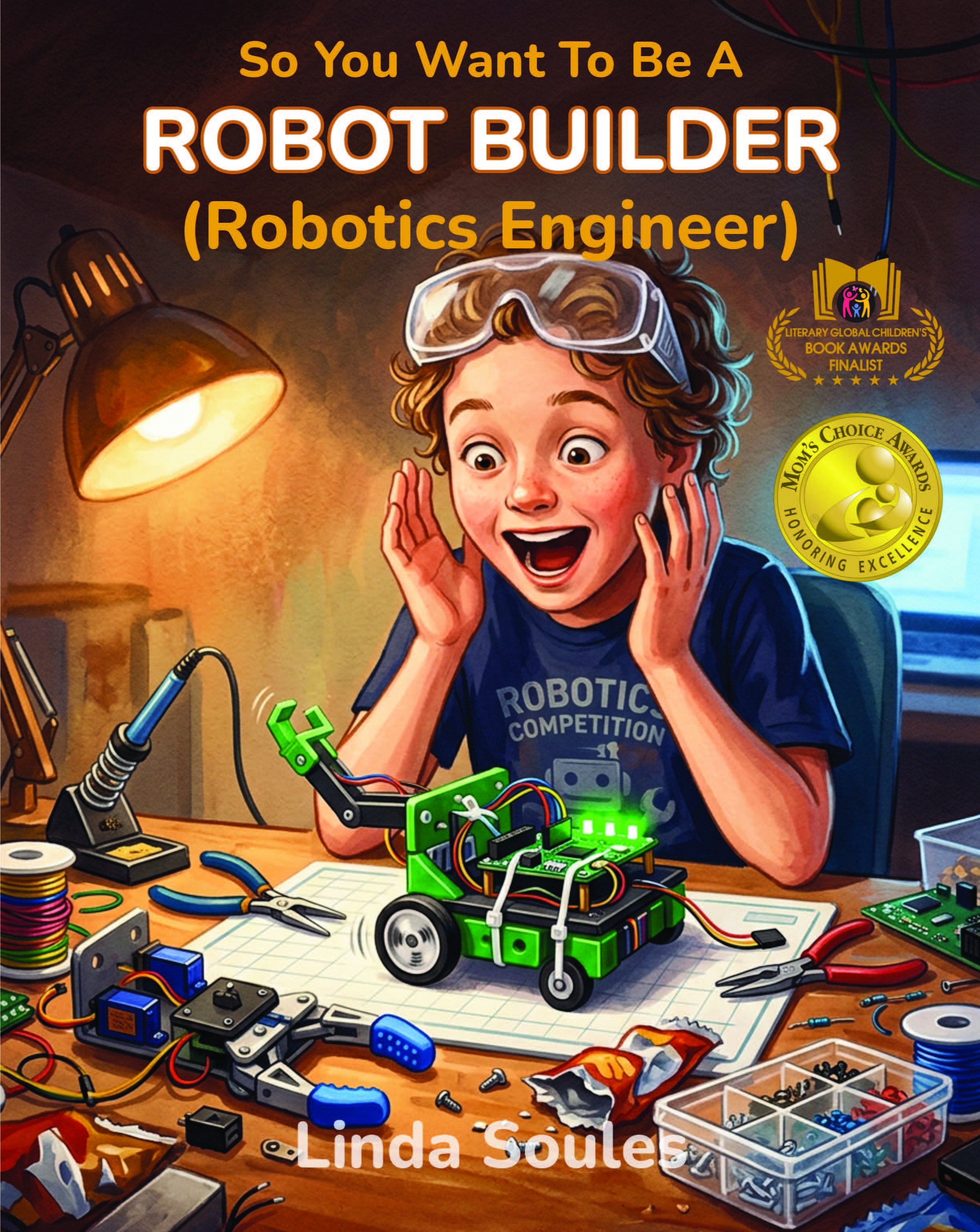
Children's Nonfiction
So You Want To Be A Robot Builder (Robotics Engineer)
by Linda Soules
Listen to this review
Linda Soules’s So You Want To Be A Robot Builder (Robotics Engineer) treats robotics less as a parade of futuristic machines than as a practical, human, and often frustrating form of engineering. Aimed at young readers exploring careers, it introduces the field through a recurring framework: a robot must “sense, think, act.” That simple sequence gives the book a clear conceptual anchor, while its strongest passages show how difficult it is to make those three capacities work together in the real world.
The opening definition is particularly effective for beginners. By contrasting a robot with a toaster, which heats without perceiving or deciding, Soules establishes an accessible distinction without relying on familiar movie images of humanoids. She then maps the robot onto a body, nervous system, and brain: mechanical engineering, electronics, and software. The analogy is memorable, and the book consistently returns to the idea that robotics is a system-wide discipline. Its explanation of how software demands can force mechanical redesign conveys something important about the work: engineering is not a tidy sequence of separate tasks but an iterative conversation between parts.
That emphasis on iteration gives the career portrait welcome substance. The sections on the best and hardest parts of the job resist portraying robot building as effortless invention. A first movement may be a lurching arm whose gripper opens at the wrong time; a supposedly successful machine may fail outside controlled conditions. The account of debugging is concrete and useful, especially its reminder that faults can arise in hardware, software, their interaction, or the environment. The proposed “Day in the Life,” with an engineer studying twenty failures before spotting a slow response to a sideways tilt, makes patience and careful observation feel like central skills rather than afterthoughts.
The prose is direct, energetic, and tuned to a young audience. Short sentences and recurring contrasts—what the engineer intended versus what the robot was told—make technical ideas approachable. The practical suggestions are among the book’s most useful elements: building with cardboard and tape, taking apart old toys, trying Scratch, joining a robotics club, and keeping a log of what a machine was meant to do and what it actually did. These activities connect the career overview to things a reader can try now. The glossary also gives newcomers a concise introduction to terms such as “actuator,” “degrees of freedom,” and “feedback loop.”
Soules broadens the book beyond mechanics and code by asking who robots help, who may bear the costs of their use, and what choices are built into a machine’s behavior. The discussion of surgical assistance alongside factory-worker displacement is notably more thoughtful than a simple claim that technology improves lives. The author’s note develops this ethical thread, arguing that robots carry their builders’ decisions into workplaces, rescue sites, and homes. This gives the career a moral dimension without losing sight of its technical demands. The profiles of Rodney Brooks, Cynthia Breazeal, and Denis Hong further suggest that the field contains different approaches, from insect-inspired behavior to social robotics and machines designed to assist people with disabilities.
There are limits to the book’s otherwise engaging confidence. Many statements are presented as settled or universal without qualifications: “the robot is always right,” “every cause has a fix,” and the claim that a robot’s error is the engineer’s. These are effective teaching slogans for encouraging responsibility, but they simplify the realities of complex systems, where failures can involve unpredictable conditions, incomplete information, or factors beyond one engineer’s control. The book’s enthusiasm sometimes outruns its precision in other ways, too. Claims about what robots can or cannot do are stated broadly, while the supplied text offers no citations or source notes for readers who want to investigate them. The “Famous Robotics Engineers” sketches are lively but brief, and could leave readers wanting more detail about the people’s work and the evidence for the book’s summaries.
The imagined workday is vivid, but its neat progression—from finding a problem to improving performance—may suggest a more orderly routine than the earlier discussion of setbacks warrants. It is best read as an illustration of possible tasks, not a complete account of a typical day. Likewise, the repeated “sense, think, act” language helps build coherence, but the book returns to its central ideas often enough that some readers may find the later sections repetitive. The ethical questions are important, yet they are raised more than developed; readers seeking sustained discussion of automation’s social effects will need additional material.
As a career introduction, this is a warm, practical invitation rather than a technical manual. Its best contribution is the combination of accessible explanations, honest attention to failure, and encouragement to make things before deciding whether the field is appealing. The hands-on advice and clear vocabulary make it especially suitable for curious readers around ages 10 to 14, as well as parents or teachers looking for a starting point for discussion. Readers seeking rigorous technical instruction, extensive sourcing, or a deeper treatment of robotics’ social consequences may find it too introductory. For young people drawn to building, testing, and figuring out why a machine does not behave as intended, it offers a convincing first look at the work.
Share-ready review images
Download square and vertical images for posts, stories, newsletters, and media kits.
For authors
Want a review page like this for your book?
Upload your manuscript, choose a review tier, and get a permanent public editorial review page you can share with readers.
Review My Book← Back to Reviews
