Children's Nonfiction
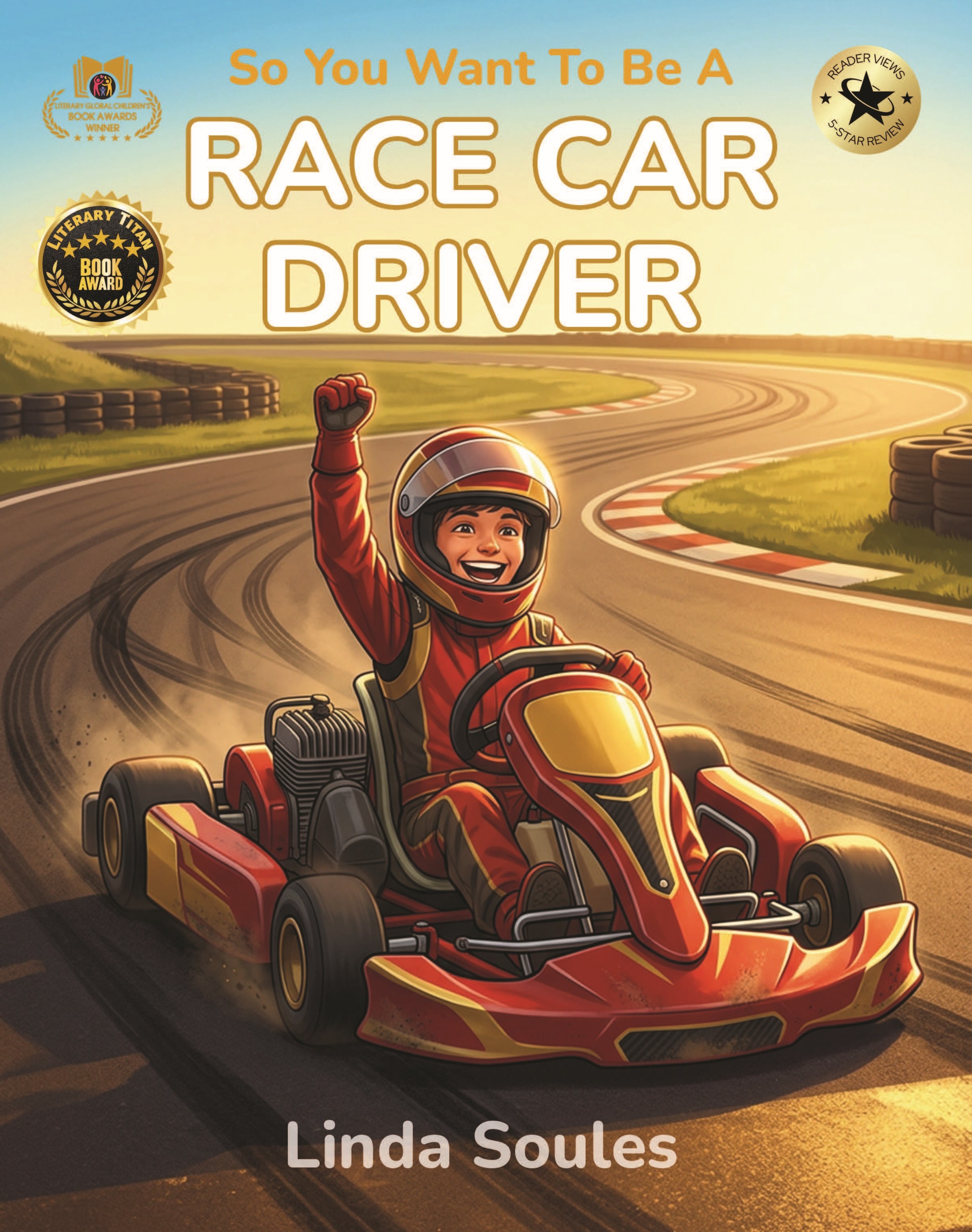
So You Want To Be A Race Car Driver
by Linda Soules
Listen to this review
Linda Soules’s So You Want to Be a Race Car Driver makes a useful distinction at its outset: racing is not simply about speed, but about controlling speed through corners. From that premise, the book builds a lively introduction to driving as a combination of precision, physical endurance, technical understanding, and teamwork. Its strongest quality is its willingness to replace the familiar image of the fearless daredevil with a more interesting one: a calm problem-solver who listens to a machine, interprets information, and makes decisions under pressure.
The opening section explains the principle “smooth is fast” through concrete examples of braking, steering, and acceleration. The image of driving as a conversation between driver and car gives young readers an accessible way to understand a demanding skill. Later explanations of the steering wheel as an instrument that communicates tire grip and handling extend that idea effectively. The book also makes racing’s intellectual work visible. In “A Day in the Life,” a driver compares lap data with a teammate’s, identifies time lost in turn seven, tests an adjustment, and returns to the engineers with further feedback. That sequence translates abstract claims about concentration into a recognizable cycle of observation, experiment, and revision.
The structure is well suited to browsing as well as continuous reading. Sections on the tools of the trade, the pleasures and difficulties of the work, colleagues, preparation, and racing vocabulary give the subject a practical shape. The glossary defines terms such as “apex,” “downforce,” “telemetry,” and “understeer and oversteer,” while suggested activities invite readers to try finding a racing line on a bicycle course, keep a race notebook, or explore karting and sim racing. These details help make the career feel approachable without implying that a child needs a professional car to begin learning its underlying ideas. The prose is direct, energetic, and generally effective at explaining specialized concepts without assuming prior knowledge.
The account is also commendably frank about costs and risks. The chapters on the hardest parts describe crashes, fear, heat, physical strain, and the disappointment of mechanical failure or a poor strategy call. The book does not equate courage with fearlessness; instead, it presents calculated courage as the ability to assess danger and remain composed. This is a more responsible model for young readers than romanticizing reckless behavior. Its insistence that a driver depends on engineers, mechanics, strategists, and pit crews likewise counters the lone-hero version of the sport. The histories of Ayrton Senna, Danica Patrick, and Lewis Hamilton add examples of different paths and barriers, including the importance of representation in a sport the book describes as historically lacking inclusion.
There are, however, limits to the book’s breadth and precision. Although “race car driver” covers many disciplines, the most sustained descriptions center on Formula One. NASCAR ovals and drag racing receive brief introductory contrasts, but most equipment, working routines, and statistics refer to F1. Readers drawn to other forms of racing may therefore find the promised career broader than the material actually delivered. The book’s occasional shifts among team roles also blur distinctions: it identifies a crew chief as a central partner, then describes a race engineer as the person analyzing sensor data and communicating feedback. A clearer explanation of how responsibilities vary by series would strengthen the career picture.
Some explanations are presented with more certainty than their scope seems to warrant. The claim that “the answer to every performance question is always in the data” sits uneasily beside the book’s persuasive account of a driver’s tactile judgment and experiential feedback. Likewise, broad statements about racing’s role in developing road-car technologies, and precise figures about heat, weight loss, heart rate, and pit-stop performance, would benefit from qualification or attribution. In an educational book for children, numerical specificity can be compelling, but it also carries an expectation of careful context. The text’s repeated superlatives and motivational refrains—especially the recurring “smooth is fast” and the closing invitation to pursue the checkered flag—sometimes make the prose feel more emphatic than reflective.
The tone is friendly, though its sustained second-person address can become formulaic, and some sections repeat ideas already established: focus, smoothness, teamwork, and learning from data recur across the main chapters, preparation advice, and author’s note. The result is encouraging but occasionally less concise than it might be. The series note states that illustrations are AI-assisted and describes the author’s approach to directing and editing them. That transparency is welcome; the supplied text does not include the illustrations themselves, so their quality or contribution to the book’s explanations cannot be assessed here.
Overall, this is a thoughtful and engaging introduction for readers curious about motorsport and the skills behind the spectacle. Its best pages show that racing involves sustained attention, mechanical curiosity, communication, and calculated risk—not merely bravery and speed. The book is a stronger fit for children who enjoy technical detail and practical activities than for readers seeking a comprehensive account of every racing discipline. For that audience, it offers an inviting first map of the profession, with a useful reminder that learning to observe, test, and improve can begin long before a reader reaches a racetrack.
Share-ready review images
Download square and vertical images for posts, stories, newsletters, and media kits.


For authors
Want a review page like this for your book?
Upload your manuscript, choose a review tier, and get a permanent public editorial review page you can share with readers.
Review My Book← Back to Reviews
