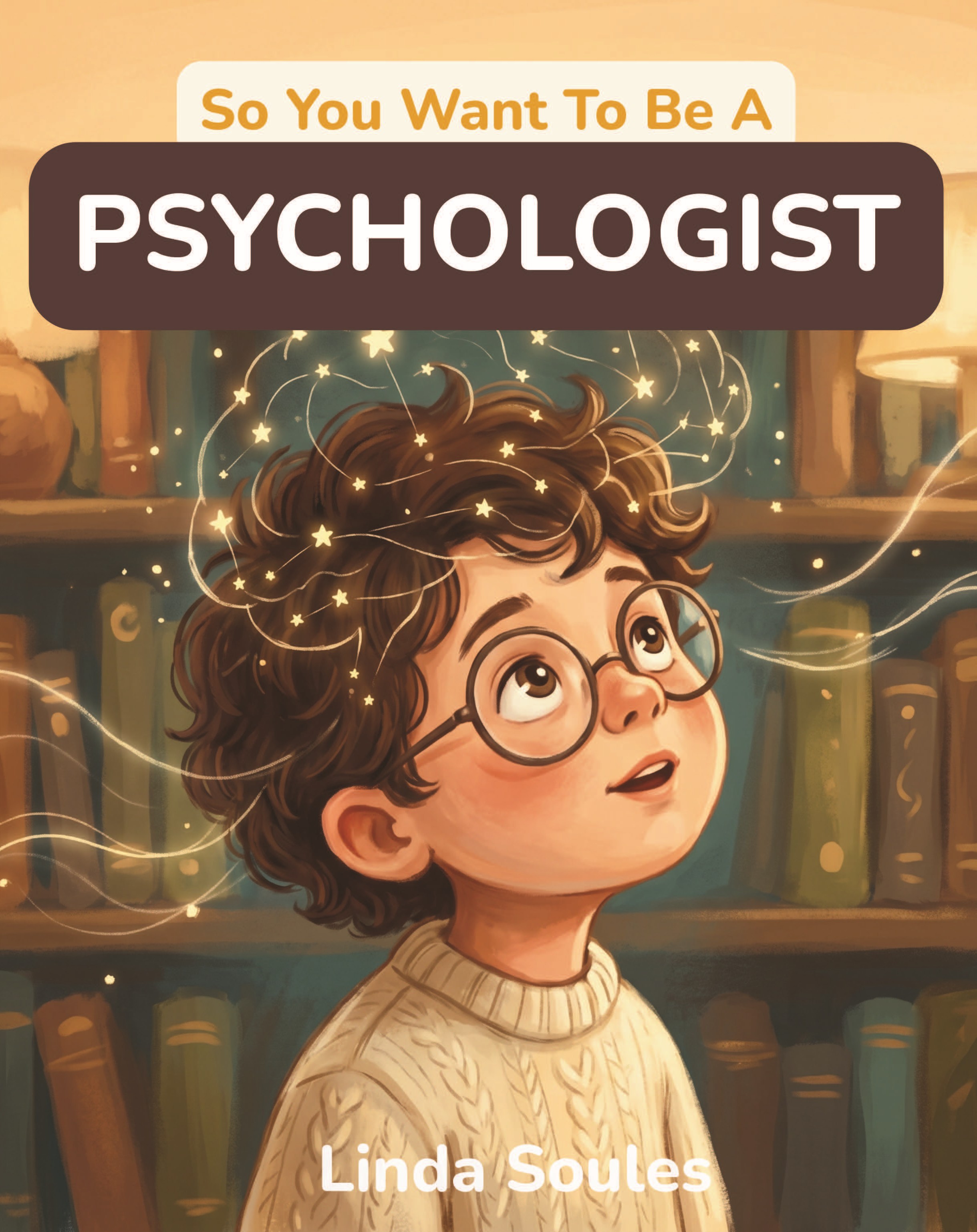
Children's Nonfiction
So You Want To Be A Psychologist
by Linda Soules
Listen to this review
So You Want to Be a Psychologist makes a lively case for psychology as a science of evidence, not simply a profession of listening in a quiet office. Its central question—why do people do what they do, and how could we find out?—gives the book a clear organizing principle. For young readers curious about minds and behavior, that emphasis is both inviting and useful: it presents psychology as a way of asking better questions, rather than a collection of clever guesses.
The writing is direct, energetic, and well suited to its intended audience. Short sections, concrete examples, and occasional jokes keep complex ideas approachable without making the subject feel trivial. The invitation to try tickling yourself, for instance, introduces the brain’s expectations in an immediate way, while the “Color Trap” and “Floating Finger” activities let readers experience perceptual effects rather than merely read about them. The book’s most effective teaching move is to return repeatedly to the distinction between an explanation that feels obvious and one supported by evidence.
That theme is reinforced through memorable examples. The story of Clever Hans shows how an apparent feat of arithmetic could be explained by the horse responding to people’s subtle cues. Pavlov’s dogs illustrate how an ordinary observation can become a research question. Later, the basketball-and-gorilla experiment dramatizes inattentional blindness, and the discussion of memory as reconstruction connects psychological research to everyday recollection and courtroom testimony. These examples give abstract ideas a human scale and help explain why careful observation, experiments, and statistics matter.
The book also broadens its picture of the profession effectively. Psychology appears in schools, hospitals, courts, sports, laboratories, and the design of alarms and dashboards—not just in therapy. The “A Day in the Life” section makes this breadth tangible by following an assessment of a nine-year-old who struggles with reading alongside research on how children learn words. It also draws attention to less glamorous work, including scoring tests, writing reports, examining data, and explaining findings clearly. The portrait is strongest when it shows that helping people can mean both understanding one person and producing knowledge that may benefit many.
Its humane emphasis is another strength. Assessment is described as a way to give a family a “map,” not to put a child in a box, and the book insists that people being studied are partners whose trust must be protected. Informed consent, privacy, and the responsibility to communicate difficult findings with care are presented as integral to the work. The historical profiles add welcome depth: the Clarks’ research on segregation connects psychology to justice, while Martha Bernal’s story highlights exclusion within the field itself. These chapters suggest that the discipline’s history is not only a story of discoveries, but also of who gets to make them and whose experiences are taken seriously.
The book is candid, too, about the slow and uncertain parts of research. Studies can take years; promising ideas can fail; peer review can expose mistakes. Its account of a psychologist preferring correction to remaining wrong is a strong explanation of scientific humility. That realism helps balance the more enthusiastic passages about discovery and impact, and makes the career seem demanding as well as fascinating.
Some of the explanations, however, are simplified to the point that young readers could mistake an introductory model for a universal rule. The description of an experiment as changing one thing while keeping everything else the same is a useful starting point, but it leaves out the varied designs psychologists actually use. Likewise, the claim that a good test “means the same thing for everyone” smooths over the difficult questions of fairness, culture, and interpretation that the book elsewhere encourages readers to examine. These ideas could be framed as first approximations rather than settled descriptions.
The career guidance also needs more qualification. The book says that psychologists share a doctorate and that most do not provide therapy, but these claims are presented broadly, without clearly limiting them to a particular country or distinguishing among professional roles and licensing rules. The references to U.S. institutions make the intended context apparent, yet readers elsewhere may need guidance that qualifications and job titles vary. The book gives a useful overview of study and training, but offers little practical detail about costs, alternative routes, or how careers differ across settings. Some scientific anecdotes, including the marshmallow study and claims about animal laughter, would also benefit from a brief note that research findings can be debated or reinterpreted.
At times, the prose leans heavily on repetition: curiosity, evidence, patience, and willingness to be wrong recur across many sections. The repetition supports the book’s message, but occasionally makes the later chapters feel more like reinforcement than new discovery. A little more space for contrasting branches of psychology—or for the limits and disagreements within the field—could have added texture.
Still, the book succeeds as an enthusiastic, thoughtfully framed introduction. Its strongest readers will be curious children and young teens who enjoy puzzles, questions about human behavior, and the idea that science can improve how people are understood and treated. It is less suited as a complete guide to training or career planning, but as a first invitation to explore psychology, it is engaging, humane, and likely to leave readers noticing the questions hidden in ordinary moments.
Share-ready review images
Download square and vertical images for posts, stories, newsletters, and media kits.
For authors
Want a review page like this for your book?
Upload your manuscript, choose a review tier, and get a permanent public editorial review page you can share with readers.
Review My Book← Back to Reviews
