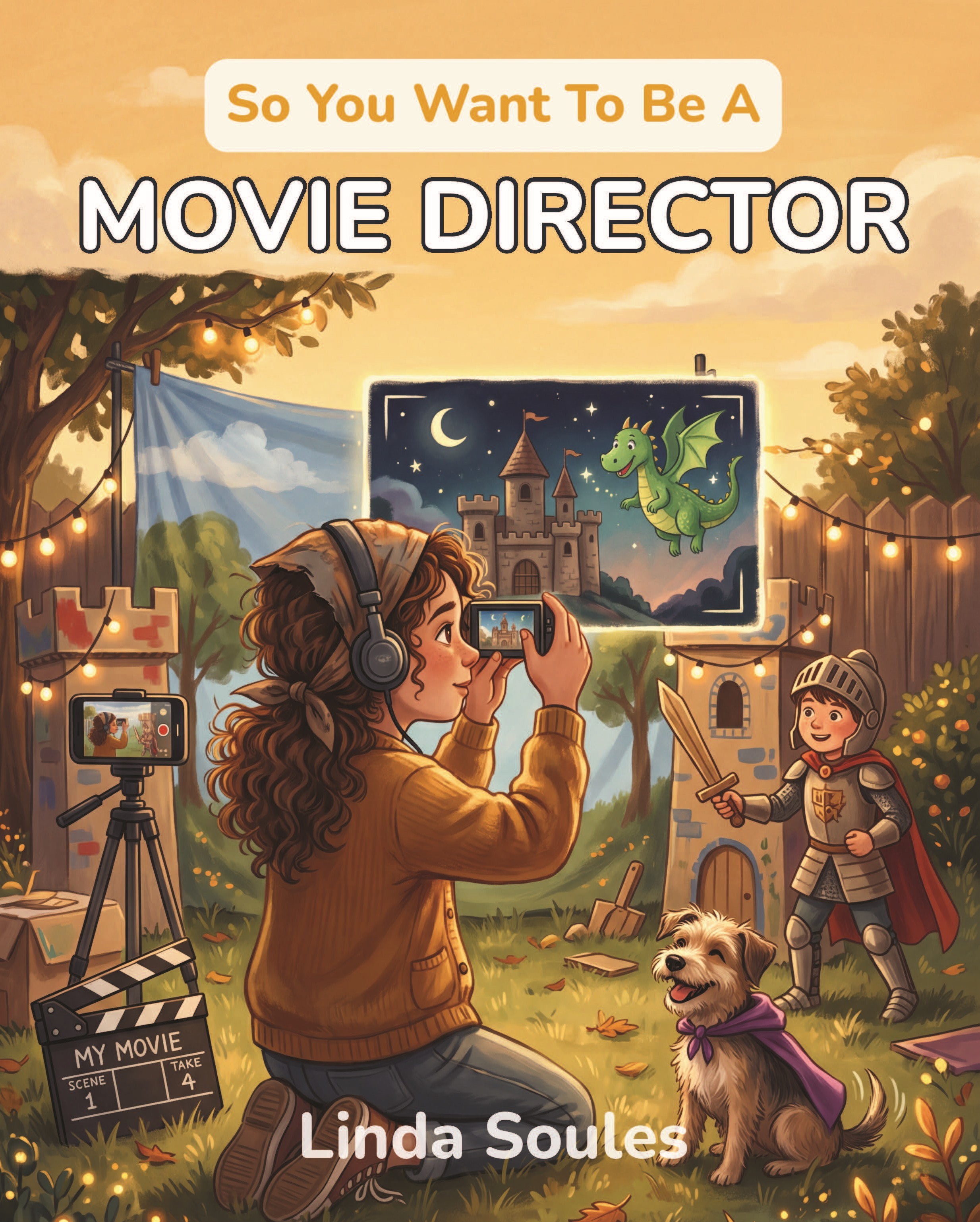
Children's Nonfiction
So You Want To Be A Movie Director
by Linda Soules
Listen to this review
So You Want To Be a Movie Director makes filmmaking feel less like a distant, glamorous mystery than a complicated form of collaborative problem-solving. Linda Soules introduces the director as the person who holds a vision of the whole movie, but she repeatedly complicates the idea of solitary authorship: actors, editors, designers, camera crews, and many others shape the finished work. That emphasis gives the book a useful central argument. Directing is not simply having ideas; it is communicating them, making decisions under pressure, and helping a large team do its best work.
The strongest passages make technical ideas tangible. The explanation of pre-production, filming, and post-production gives readers a clear map of the process, while definitions of “blocking,” “coverage,” “takes,” and “dailies” are folded into practical descriptions rather than left as jargon. The chapter on tools is similarly effective: storyboards become “a comic book of the movie,” and the slate’s clap is explained as a way to match sound with picture. These details give young readers a vocabulary for watching films more attentively, as well as an introductory sense of how the work is done.
Soules is especially good at illustrating how small choices affect an audience. The Kuleshov experiment, in which viewers read different emotions into the same calm face depending on the image shown beside it, is a concise lesson in editing and interpretation. The book then turns that idea into a phone-based experiment readers can try themselves. Other stories serve the same purpose: the malfunctioning mechanical shark in Jaws led Spielberg to show less of the creature, while Georges Méliès’s camera trick made objects appear and vanish. Rather than presenting mishaps as mere trivia, the book uses them to show how constraints and accidents can generate creative solutions.
The practical material is one of the book’s clearest strengths. Its imagined “Day in the Life” follows a director through a shoot, from reading the call sheet to losing time when a goat eats part of a prop map. That comic disruption also makes the less glamorous demands of the job visible: the director must cut a beloved scene when daylight runs short. Later, “What You Can Do to Prepare Right Now” offers accessible exercises—muting a scene, drawing storyboards, making a one-minute film, and learning to edit—without implying that expensive equipment or formal training is a prerequisite. The result is an inviting bridge from reading to doing.
The book also resists a purely celebratory portrait of the profession. It discusses long shooting days, time away from home, budget pressure, projects that fail, and directors who may be replaced when studios disagree with them. Its account of gender and racial inequity in big-studio directing gives the career discussion a necessary social dimension, and the examples of Alice Guy-Blaché, Jennifer Yuh Nelson, and Ava DuVernay widen a roster that might otherwise have centered almost entirely on familiar male Hollywood figures. The chapter on how movies can connect audiences, preserve languages, and help viewers name feelings extends the book’s interest beyond the mechanics of production.
Still, the book’s treatment of the career is more encouraging than analytical. It explains that there is no single path into directing and mentions film school, short films, festivals, and entry-level set work, but it gives comparatively little attention to the uncertain, lengthy process of building a career through smaller jobs. The discussion of pay acknowledges a wide range, yet the practical implications of that instability remain brief. Young readers get a vivid picture of what directors do, but less guidance about the financial and professional trade-offs involved in trying to do it for a living.
The tone is warm and conversational, and the frequent direct address, playful examples, and short sections should make the material approachable for middle-grade readers. At times, however, the book’s earnestness becomes repetitive. The importance of teamwork, imagination, and connecting with audiences is reiterated across the chapters, and the closing author’s note shifts from career guidance toward a broad reflection on growing up. That passage may comfort some readers, but its inspirational language is less specific than the book’s strongest explanatory sections. The wealth of facts and sidebars can also make the pacing feel stop-and-start, especially for readers seeking a sustained narrative rather than a browseable guide.
There are small editorial blemishes in the supplied text, including the contents-page split in “Mov ie” and a mistyped time in the sample schedule. More consequentially for a nonfiction guide, some statistics and historical claims are presented without detailed source notes in the text provided. The recommended websites and organizations offer useful next steps, but readers who want to check particular figures may need more direct citations. The book’s closing series note also says its illustrations are AI-assisted; because no illustrations are included in the material supplied for review, their quality cannot be assessed here.
As a whole, this is a lively and useful introduction that treats young readers as capable of understanding both the creative and logistical sides of filmmaking. Its best feature is the way it turns abstract craft into observable choices and doable experiments. Readers looking for a detailed guide to breaking into the industry, or a continuous biography of one director, may find its broad survey too introductory. For curious readers roughly in the middle-grade range who enjoy movies and want to understand how scenes are planned, filmed, and edited—and for adults looking for hands-on activities to share—it is a worthwhile starting point.
Share-ready review images
Download square and vertical images for posts, stories, newsletters, and media kits.
For authors
Want a review page like this for your book?
Upload your manuscript, choose a review tier, and get a permanent public editorial review page you can share with readers.
Review My Book← Back to Reviews
