Children's Nonfiction
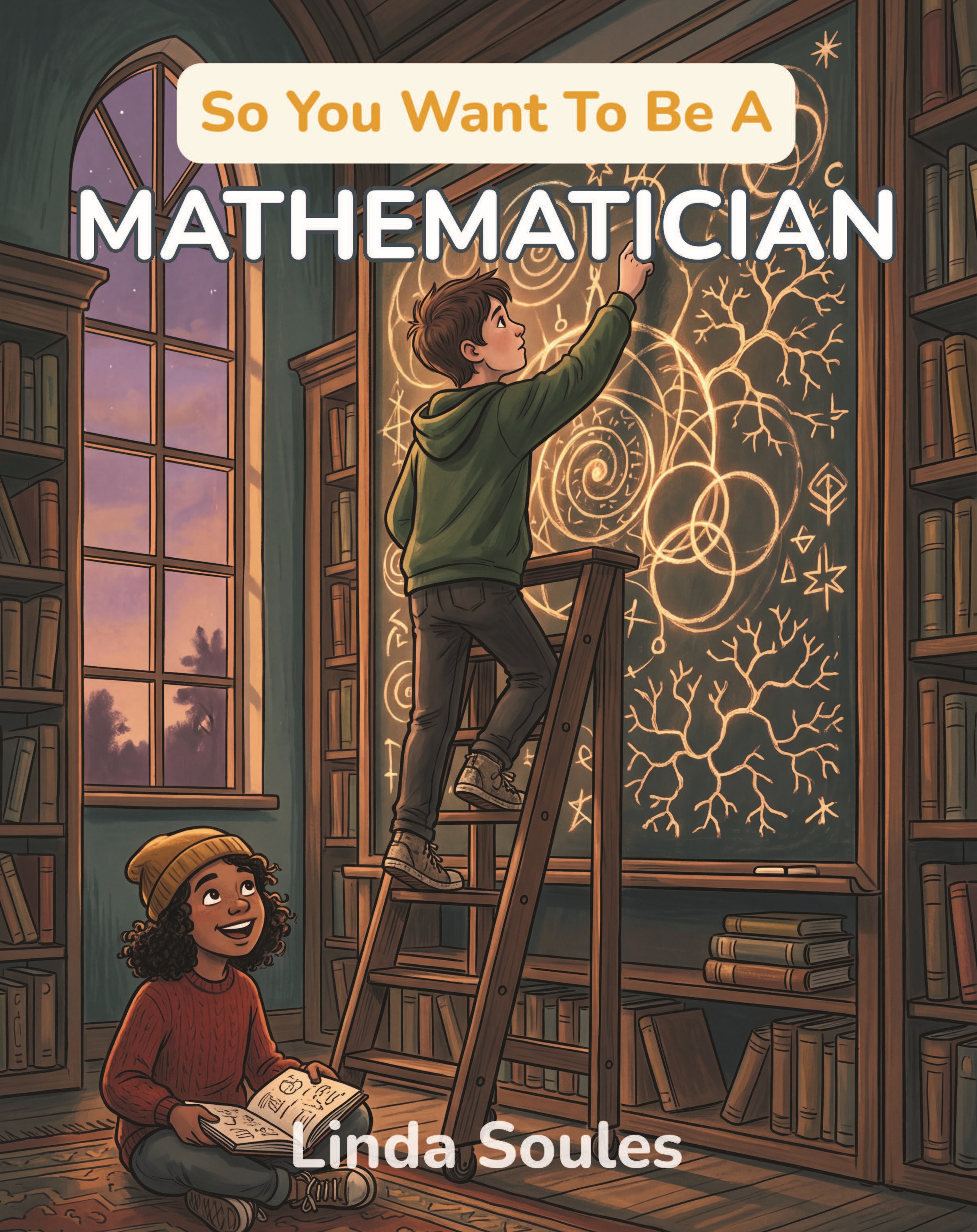
So You Want To Be A Mathematician
by Linda Soules
Listen to this review
Linda Soules’s So You Want to Be a Mathematician makes an appealing case that mathematics is not mainly a matter of quick calculation or memorizing formulas, but of noticing patterns, asking questions and proving what must be true. Its opening example—the pigeonhole principle applied to the number of hairs on New Yorkers’ heads—sets the book’s method: begin with a playful puzzle, make the reasoning visible, then invite readers to try the idea themselves. The result is a lively introduction to both mathematical thinking and a possible career.
The strongest feature is the writing’s knack for turning abstract ideas into concrete scenes. Euclid’s proof that primes never end becomes a list that fails when you multiply its entries and add one. The circle-and-chords puzzle lets readers predict how many regions six points create, then discover why a pattern that seemed reliable gives the wrong answer. The hairy ball theorem arrives as an impossible-sounding challenge to comb a tennis ball flat. These explanations are vivid without treating young readers as incapable of following a real argument. Activities such as making a Möbius strip, exploring the Collatz conjecture and playing Sprouts extend that approach beyond the page.
The book also presents mathematics as a human and collaborative enterprise. Its portraits range from Emmy Noether, who taught without pay under a male colleague’s name, to Katherine Johnson, whose hand calculations John Glenn insisted on checking before his flight. The accounts of Ramanujan, Maryam Mirzakhani and June Huh complicate the idea that mathematicians are uniformly gifted students who follow a smooth academic path. Stories about the Scottish Café’s problem notebook, Paul Erdős’s many collaborators and mathematicians working with Disney animators or rescue services further counter the image of solitary calculation. This variety gives the career discussion welcome social texture.
Structurally, the book moves effectively from “What a Mathematician Actually Does” through kinds of mathematics, training, tools, daily work and career possibilities, before offering a glossary and further resources. The “day in the life” section is especially useful because it includes teaching, collaboration, failed approaches and family life, rather than presenting research as an unbroken stream of breakthroughs. The practical advice is specific: take proof-writing classes, learn to code, consider summer programs and recognize that a mathematics degree can lead to work under titles such as statistician, actuary or data scientist. The distinction between pure and applied mathematics is clear, while the book also shows how ideas pursued for curiosity can acquire uses generations later.
Soules’s conversational voice is consistently inviting, and its humor usually serves the explanation. The joke about a topologist unable to distinguish a doughnut from a coffee mug, and the “Wobbly Table Theorem,” make mathematical ideas memorable without reducing the whole subject to gimmicks. The author’s note, explaining that her career began in law and that her father-in-law was the mathematician George Soules, adds a personal dimension to the book’s argument that mathematical reasoning belongs to anyone willing to follow it.
There are limits to the book’s approach. Its energetic succession of anecdotes and facts can make the chapters feel more like a collection of curiosities than a sustained account of how mathematical research develops. Readers get examples of proofs and open problems, but relatively little extended experience of working through a difficult problem from uncertainty to a finished argument. The career portrait is broad, yet the routes described—especially the PhD path for research mathematicians—remain necessarily compressed, and the discussion gives limited attention to the everyday realities of particular jobs beyond selected examples.
Some explanations also simplify complex ideas in ways that could use more qualification. The book is generally careful to flag uncertainty—for example, when discussing the Fibonacci pattern in nature or the unproved Goldbach and Collatz conjectures—but a few claims are presented with little context. The brain-scan finding about mathematical beauty, the salary figures and the account of a newly announced AI solution to a major problem would benefit from fuller sourcing or explanation, particularly in a nonfiction book that teaches readers to ask what supports a claim. There is also a conspicuous duplicated phrase in the passage about Proofs from The Book, a copyediting lapse in an otherwise polished text. The time-sensitive AI item, explicitly described as awaiting verification, may also date quickly.
These weaknesses do not undo the book’s central achievement: it makes mathematical curiosity feel accessible, consequential and open to people whose school experiences may have told them otherwise. Its best audience is curious readers around ages 10 to 14, especially those who enjoy puzzles, patterns and stories about how ideas are discovered; parents and teachers may also find it a useful springboard for discussion and activities. Readers seeking a rigorous textbook or a deeply detailed guide to mathematics careers will need something more specialized, but young readers wondering whether they could belong in the subject will find a thoughtful and engaging invitation.
Share-ready review images
Download square and vertical images for posts, stories, newsletters, and media kits.
For authors
Want a review page like this for your book?
Upload your manuscript, choose a review tier, and get a permanent public editorial review page you can share with readers.
Review My Book← Back to Reviews
