Children's Nonfiction
So You Want To Be A Marine Biologist
by Linda Soules
Listen to this review
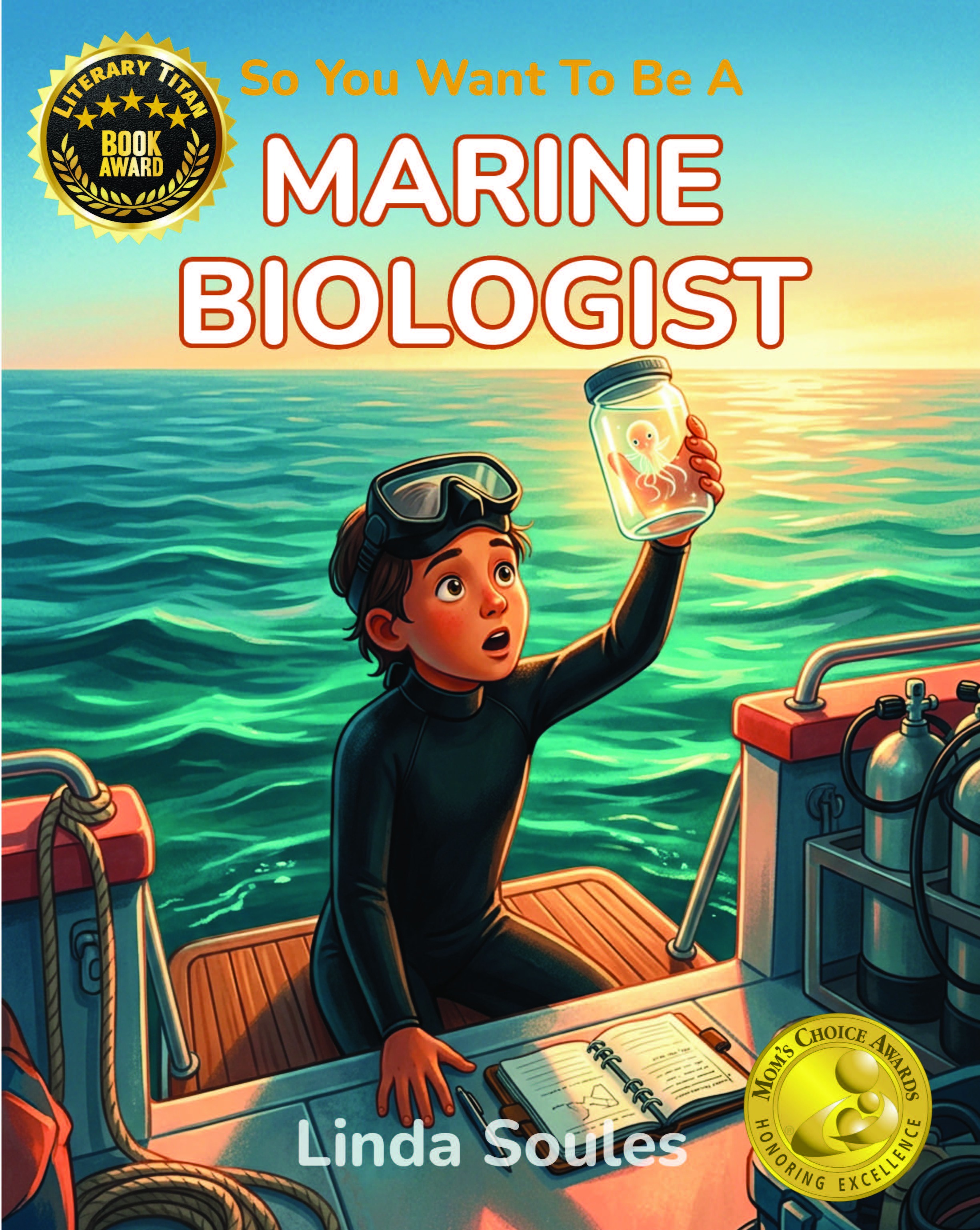
Linda Soules’s So You Want to Be a Marine Biologist is a career introduction built around a productive tension: marine biology offers extraordinary encounters with life little known to humans, but pursuing those discoveries also means patience, record-keeping, rough conditions, and competition for research funding. Aimed at young readers, the book makes the work feel both wondrous and consequential. Its strongest feature is its lively sense of address: it speaks directly to an aspiring scientist without reducing the subject to a list of facts or a glossy adventure fantasy.
The opening establishes the book’s governing appeal through scale and mystery. The ocean is described as a planetary life-support system, while the claim that only a tiny fraction of the deep-sea floor has been seen gives the career a vivid purpose: there is still much to discover. Soules sustains that sense of possibility in sections on ROVs, plankton nets, and the “whale pump,” and in the account of deep-sea sounds that overturn the idea of a silent ocean. These details are memorable because they connect unfamiliar science to images a young reader can grasp. The whale-poop explanation, in particular, turns an amusing fact into an account of ecological relationships and carbon cycling.
The prose is energetic and often sensory. Descriptions of underwater light, shifting temperatures, and animal sounds help convey why fieldwork can matter beyond the data it produces. The book also has a useful recurring contrast between wonder and method: in the sample day, a diver is absorbed by a reef’s beauty while counting fish along transect lines and photographing bleaching. That juxtaposition captures a central truth of scientific observation—the ability to admire a place and document it systematically at once. The schedule makes research feel tangible, though it is best understood as an illustrative scenario rather than a universal day in the profession.
Structurally, the book is easy to navigate. Its sequence moves from what marine biologists do and where they work to tools, benefits and difficulties, workplace relationships, preparation, and a glossary. The practical suggestions—keeping a dated field notebook, visiting nearby water, learning to identify local animals, and contributing observations through citizen-science projects—give readers ways to begin without living near the coast. The resource list extends that invitation through books, organizations, and live research footage. Profiles of Sylvia Earle, Jacques Cousteau, and Eugenie Clark add historical examples, with Clark’s work especially useful in showing how sustained study can challenge public fear of sharks.
Soules is also careful to include less glamorous realities. Seasickness, cold water, long boat rides, and the cost of expeditions complicate the adventure imagery. The section on grant proposals is a particularly valuable corrective: research depends not only on curiosity and field skill but also on years of applications, waiting, and possible disappointment. Likewise, the chapters on data discipline and equipment troubleshooting make clear that scientific work includes maintenance and organization, not just discovery. This balance is among the book’s more responsible choices, though its eventual invitation to pursue the career remains strongly affirmative.
That enthusiasm can sometimes crowd out nuance. The book repeatedly returns to the ocean as a mystery awaiting discovery and to marine biologists as its advocates. The repetition lends coherence, but also makes some passages feel more like a motivational speech than an inquiry into the many forms the work can take. The discussion of career preparation is correspondingly broad: readers learn about scuba gear, observation, interdisciplinary thinking, and field notebooks, but receive little detail about educational routes, the range of non-diving marine biology jobs, or how research careers differ across institutions. Since the book itself notes that not every marine biologist is in the water, more attention to laboratory, data, policy, and other pathways would make the career picture more complete.
Some statements are presented with a confidence that may invite further context. The “Could This Be Your Job?” questionnaire emphasizes love of the ocean, patience, comfort with difficult conditions, and a sense of responsibility, but offers little counterweight for readers who are interested in marine science yet uneasy about diving or extended shipboard work. The book does mention ROVs and lab technicians, which complicates the physical ideal it sets up, but it could make clearer that field conditions and job duties vary by specialty. Its lively superlatives and sweeping claims are engaging for children, although readers seeking a more qualified scientific account may want an additional source alongside it.
The book’s intended audience is clear: curious children, especially those ready to imagine a future career, and adults reading with them. Its direct questions, glossary, concrete examples, and immediate activities make it accessible without being condescending. Older readers looking for detailed career planning may find it introductory, while younger readers may benefit from the text being shared with an adult. Within those limits, Soules offers a generous, engaging portrait of marine biology that treats both the ocean’s wonder and the work required to understand it seriously. It is most worth recommending to young readers drawn to marine life who want an inspiring first look at the field, rather than a comprehensive guide to entering the profession.
Share-ready review images
Download square and vertical images for posts, stories, newsletters, and media kits.
For authors
Want a review page like this for your book?
Upload your manuscript, choose a review tier, and get a permanent public editorial review page you can share with readers.
Review My Book← Back to Reviews
