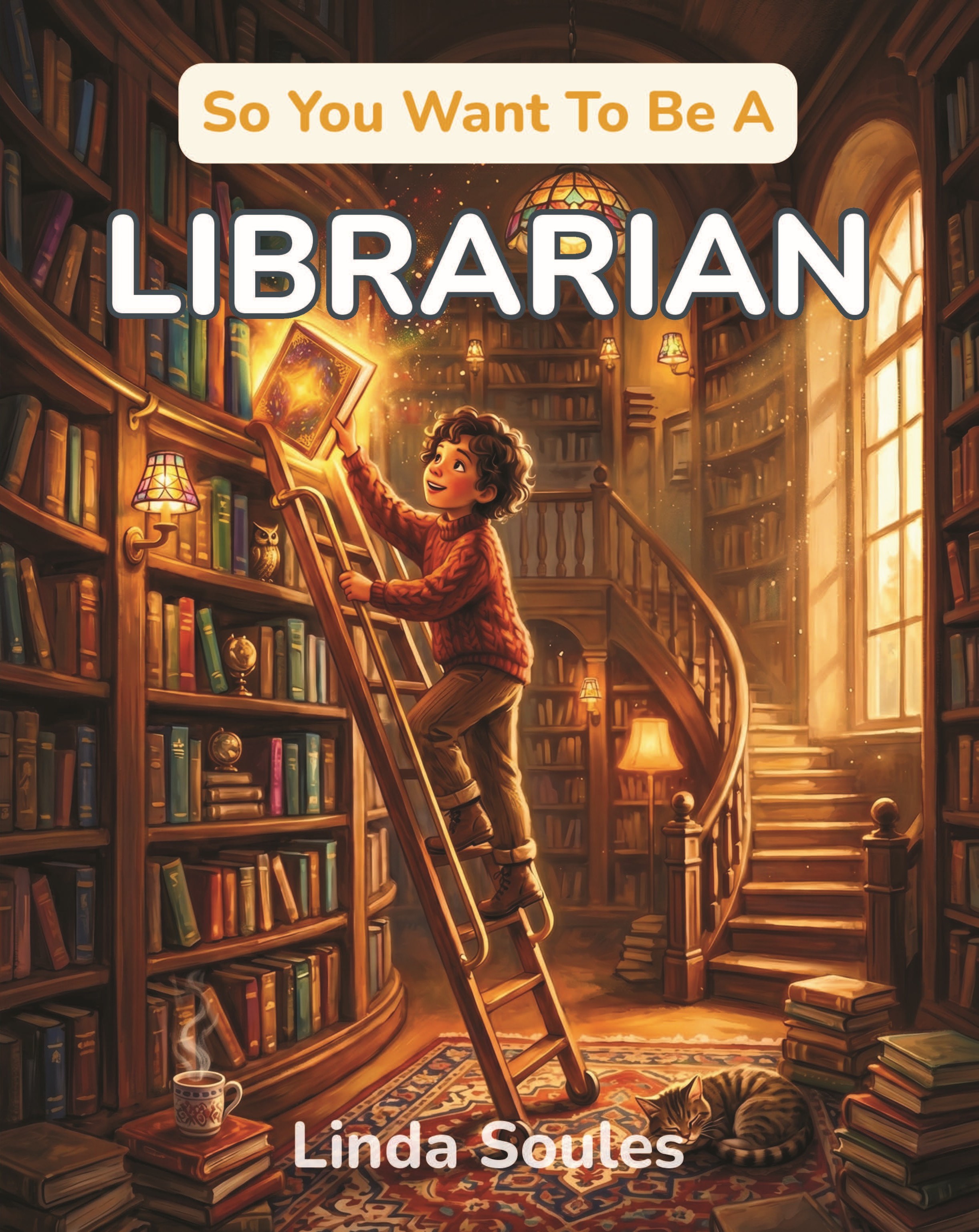
Children's Nonfiction
So You Want To Be A Librarian
by Linda Soules
Listen to this review
So You Want to Be a Librarian is less a conventional career manual than an affectionate argument for what libraries make possible. Linda Soules presents librarianship as the work of connecting people with books, information, and one another, and returns repeatedly to a central ideal: that knowledge and welcome should be available without regard to a visitor’s money or background. The book’s strongest achievement is making that ideal feel concrete. A librarian is not merely “the keeper of books,” but the person who helps a job-seeker navigate an online form, finds a story for a reluctant reader, or guides a patron toward reliable medical information without judgment.
The writing is direct, warm, and deliberately conversational, with an appealing knack for turning professional concepts into images a young reader can grasp. The catalog becomes “a promise that nothing is lost”; a reference question is “detective work”; Dewey Decimal numbers are explained as a way of bringing related subjects together on the shelves. Humorous asides, such as the ancient “scariest overdue notice ever written,” keep the historical material from feeling like a lesson. The recurring second-person address also makes the book feel like a conversation with a prospective librarian rather than a distant overview of an occupation.
Its account of the work is notably broader than the familiar picture of quiet shelves and book recommendations. The sections on school, academic, law, medical, corporate, and prison librarians, as well as archivists and bookmobiles, establish the range of settings. The explanation of information literacy is especially timely: librarians teach people to examine who is behind a claim and whether its evidence holds up. Similarly, the discussion of privacy, access, and intellectual freedom shows that the profession involves ethical commitments, not simply service skills. The book makes a persuasive case that a librarian’s care for readers includes respecting their choices, even when those choices differ from the librarian’s own.
Soules is also willing to describe pressures that a more promotional account might skip. “The Hardest Parts of the Job” acknowledges that libraries often become de facto sources of warmth, internet access, and support for people in crisis, while librarians may lack the training and resources to meet every need. The account of budget cuts, public challenges to books, and the emotional labor of staying calm and kind gives the career guide useful ballast. The fictionalized day-in-the-life schedule reinforces that balance: story hour and reader help sit alongside cataloging, budget-conscious selection, email, desk work, and an after-school rush. It is an effective way to make visible the less glamorous work that keeps a library functioning.
The historical portraits give the book some of its most memorable particulars. Pura Belpré’s response to the absence of Spanish-language books—telling Puerto Rican folktales with puppets and helping bring those stories into print—shows how representation can shape a collection. The Pack Horse Librarians, carrying books through the mountains of eastern Kentucky, embody the book’s idea of access as active work rather than a passive promise. S. R. Ranganathan’s five laws provide a compact framework for the profession, especially the idea of a library as a “growing organism.” These examples make the book’s values more persuasive than abstract praise alone could.
There is, however, a cost to the manuscript’s lyrical insistence. The language often circles back to the same formulations: the library belongs to everyone, the librarian connects people to what they need, and the door must remain open. These are worthwhile themes, but they are restated so frequently that some passages feel more like variations on a tribute than new information. The author’s note intensifies this tendency, describing librarianship as “one of the kindest, most important callings there is.” Readers looking for a crisp, practical guide may wish for more concrete detail about day-to-day differences between specialties and what training or entry-level work entails. The graduate degree is mentioned, but career pathways are not developed much further.
As nonfiction for prospective young readers, the book would also benefit from clearer sourcing. It offers a lively range of historical and contemporary claims, including statements about the influence of librarians on internet search and the effects of reading-to-dogs programs, but the supplied text does not attach citations to those assertions. The “Want to Learn More?” section provides books, websites, and activities, which is a useful invitation to continue exploring, though it is not a substitute for traceable sources in the main text. The guidance also focuses largely on the United States, a limitation worth noting for readers seeking a picture of librarianship across different countries and systems. In addition, “librarian” is often referred to as “she,” even though the book otherwise describes a broad profession; more consistent inclusive language would better match that breadth.
Overall, So You Want to Be a Librarian is an engaging, values-led introduction that takes young readers seriously and makes an overlooked profession feel consequential. Its strongest material joins practical explanation to human stories, particularly in the accounts of Belpré and the Pack Horse Librarians; its weaker moments arise when enthusiasm becomes repetition or substitutes for practical and sourced detail. It is best suited to readers around the stated middle-grade age range who are curious about libraries, enjoy reflective nonfiction, or want to explore service-oriented careers. For them, it offers not just a picture of a possible job, but a thoughtful invitation to ask what kind of welcome and access a community should provide.
Share-ready review images
Download square and vertical images for posts, stories, newsletters, and media kits.
For authors
Want a review page like this for your book?
Upload your manuscript, choose a review tier, and get a permanent public editorial review page you can share with readers.
Review My Book← Back to Reviews
