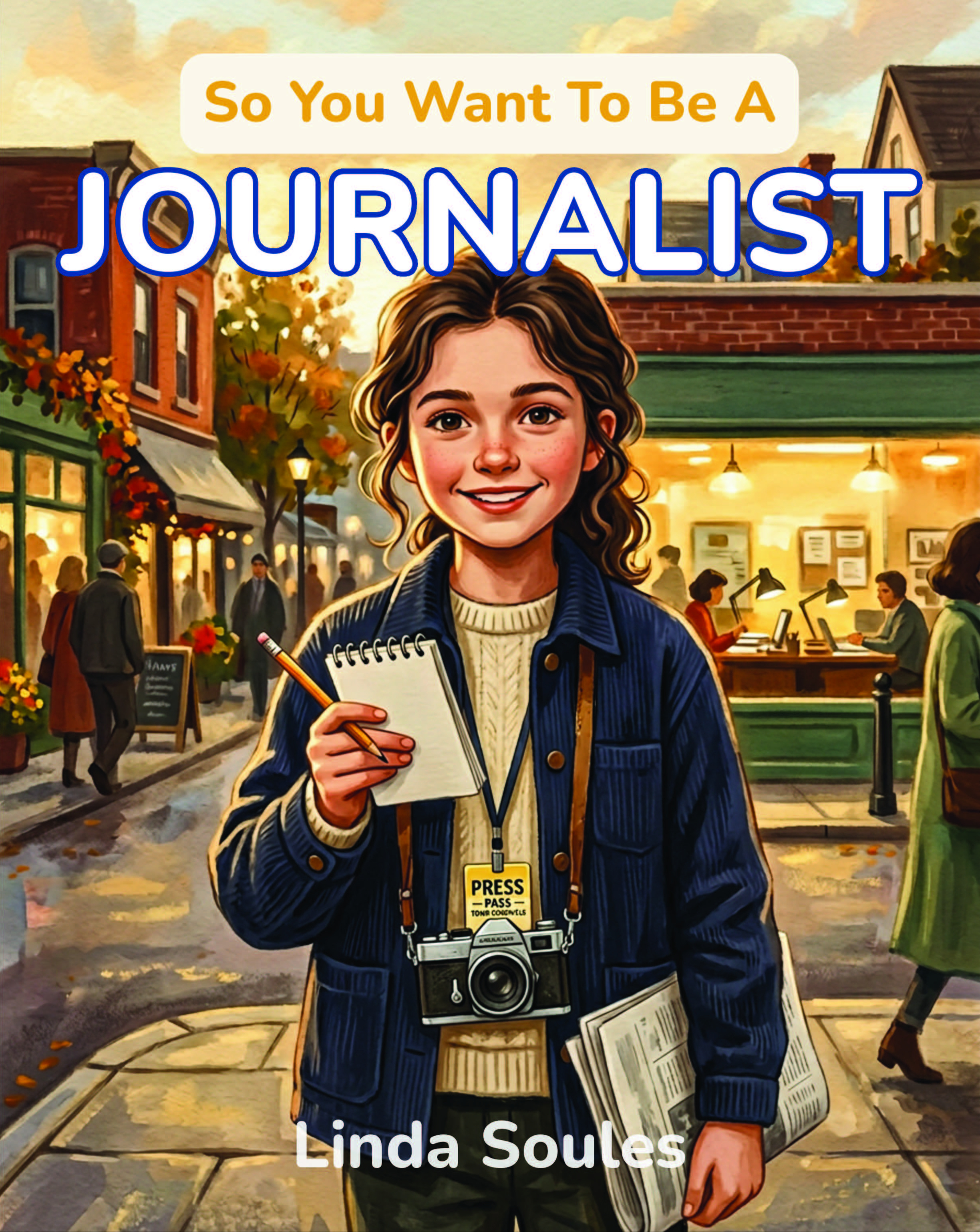
Children's Nonfiction
So You Want To Be A Journalist
by Linda Soules
Listen to this review
So You Want to Be a Journalist is a career introduction for young readers that treats journalism less as a glamorous route to a byline than as a public responsibility built from questions, documents, patience and verification. Its central argument is clear: a reporter’s essential task is to find out what can be established and explain it so others can understand. That emphasis gives the book a stronger purpose than a simple catalogue of job duties, and helps it present both the appeal and the burdens of the work.
The writing is direct, energetic and frequently shaped around memorable contrasts. “The writing is the last step. The reporting is the job” neatly shifts attention from the visible product to the labor behind it. The notebook, phone, recorder and public records are explained through practical examples, while the repeated image of the reporter reading a dull document or making one more call makes the work tangible. The book’s plain-spoken voice is well suited to its intended audience without being consistently cute or condescending. Its comparison of a questionable claim to “a guess wearing a costume” is a vivid way to make skepticism understandable to a young reader.
The strongest sections explain not just what journalists do, but why the habits matter. In “The Tools of the Trade,” the account of using a recorder to confirm quotations also shows how recording can help a reporter listen more closely. “The People You Work With” usefully broadens the picture beyond the lone investigator, describing editors, copy editors, fact-checkers, photographers and other newsroom colleagues. The sample “Day in the Life,” from scanning police logs and court filings to confirming every quote and number with an editor, is especially effective at making routine work feel concrete. Its beagle-paced interview is a welcome touch of humor amid the procedural detail.
The book’s civic argument is its organizing strength. Sections on how journalism helps people connect reporting to budgets, school-board decisions, public safety and accountability. The idea of the press as a watchdog is made accessible through small examples, such as a neglected pothole being repaired after a reporter asks questions. The historical profiles reinforce this theme without all presenting the same model of reporting: Ida B. Wells documents racial violence at personal risk; Nellie Bly reports from inside an asylum; Edward R. Murrow uses broadcast reporting to challenge Joseph McCarthy; and Gordon Parks communicates through photographs. Parks’s inclusion is particularly valuable in showing that journalism’s “sentence” need not be written in words.
The practical advice is among the book’s most useful material. Readers are encouraged to compare news sources, interview someone, check claims independently, learn basic statistics and cover a real event. These exercises translate the book’s principles into actions a young reader can attempt now. The glossary clarifies terms such as “lede,” “beat,” “source” and “off the record,” while the further-reading list and named organizations provide routes for continued exploration. Together, these features make the book a workable starting point for a school-paper reporter or a curious reader trying to understand how news is made.
Its account of journalism is not wholly celebratory. The chapters on pressure, dwindling resources, online attacks and the emotional cost of covering disasters acknowledge that the job can be precarious and personally difficult. The flood reporter’s lingering reaction to the smell of wet drywall is a precise, affecting detail; so is the admission that courage does not mean being fearless. This candor gives the book credibility and helps balance its invitation to readers with a sense of the demands involved.
There are, however, limitations to the presentation. The book sometimes states broad civic claims with more certainty than the supplied text supports. Assertions that democracy cannot remain a democracy without journalism, or that communities without local reporters repeatedly experience particular civic outcomes, would benefit from qualification and references. The constitutional discussion also risks making the press’s special protection sound like a simple ranking of occupations; the underlying point about its importance is clear, but the explanation could be more carefully framed. The further-reading section is useful, yet the main text does not provide citations for many historical and contemporary claims. For a book whose core lesson is to verify, showing young readers where such claims come from would model that lesson especially well.
The book’s moral framing is persuasive, but at times its view of the profession is more unified than the reality it describes. It presents a recognizable ethical ideal—independence, accuracy, fairness and accountability—without much discussion of how reporters and news organizations may disagree about methods or face conflicts between competing responsibilities. Its focus is also distinctly American, particularly in the constitutional and local-news discussion; readers elsewhere may need an adult or another resource to place those institutions in their own context. The author’s note says she is a reader rather than a journalist. That candid disclosure is welcome, though it also underscores the value of expert sourcing and citations in a book that offers career guidance with confidence.
Overall, So You Want to Be a Journalist is an engaging, thoughtful introduction whose clearest achievement is making patient, often unglamorous reporting seem consequential. Its practical exercises, accessible explanations and profiles of Wells, Bly, Murrow and Parks give young readers both a picture of the work and a way to begin practicing its habits. It will be most valuable to readers around ages 10–14 who are curious about news, writing or public life, and to teachers and families looking for a starting point for conversations about evidence and media. Readers seeking a fully sourced, nuanced account of journalism’s institutions and current challenges will need to supplement it, but as an invitation to ask better questions and check the answers, it is purposeful and appealing.
Share-ready review images
Download square and vertical images for posts, stories, newsletters, and media kits.
For authors
Want a review page like this for your book?
Upload your manuscript, choose a review tier, and get a permanent public editorial review page you can share with readers.
Review My Book← Back to Reviews
