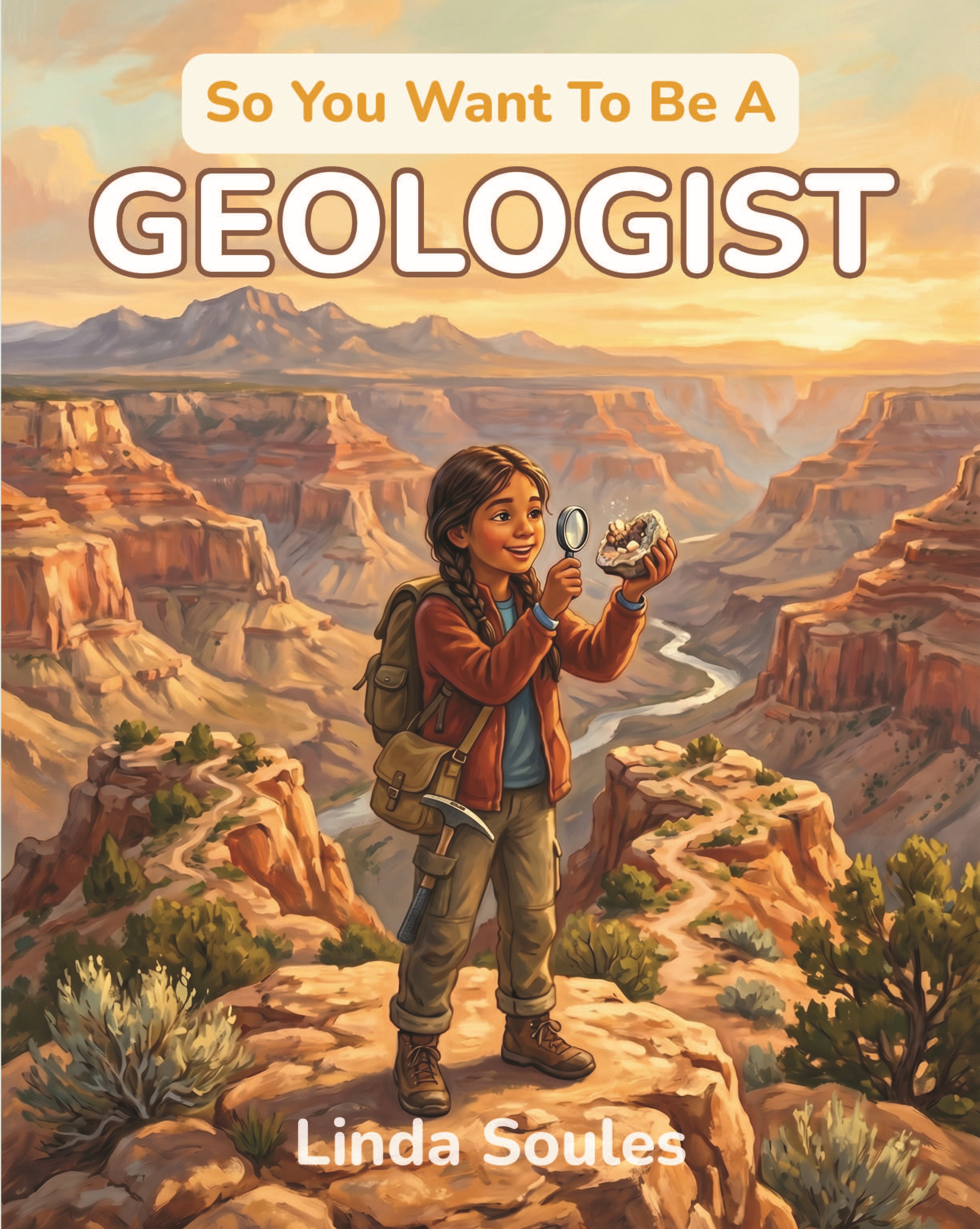
Children's Nonfiction
So You Want To Be A Geologist
by Linda Soules
Listen to this review
So You Want to Be a Geologist makes its central case through a deceptively simple invitation: pick up a stone and ask where it came from. From there, Linda Soules presents geology as both a science of evidence and a way of seeing—the practice of reading Earth’s history in rocks, while using that knowledge to understand hazards and find resources. The book is aimed at young readers considering a career, but its strongest achievement is broader: it makes an immense, slow-moving subject feel immediate and legible.
The writing is lively, direct, and rich in images that help make scale graspable. The comparison of Earth’s history to a calendar year, with human history squeezed into the final minutes of December 31, gives “deep time” a memorable shape. So does the book’s recurring metaphor of rocks as a diary: a cliff becomes a record, a geologist a reader, and fieldwork a kind of investigation. These images recur often, sometimes to the point of repetition, but they give the book a coherent voice and help connect its many topics.
That voice is notably conversational without treating its readers as incapable of seriousness. The rock-cycle siblings—igneous the dramatic one, sedimentary the patient one, metamorphic the one who has “been through a lot”—make a basic classification approachable, while the humor about licking rocks, naming hammers, and carrying too many samples gives the subject texture. The jokes generally serve the explanations rather than replacing them. The chapter on tools, for example, moves from hammer and hand lens to maps, microscopes, and radioactive dating, showing how field observations are tested in the lab. Its compact formulation, “The field finds the story. The lab proves it,” is effective, even if actual scientific work is less neatly divided.
The structure is well suited to curious readers who may dip in and out. After explaining what geologists do, the book surveys specialties, workplaces, tools, rocks, and Earth’s interior, then turns to the pleasures and difficulties of the job. A sample field day follows, with lab and office days to complicate the picture. Later sections consider teamwork, public safety, useful personal qualities, historical figures, and ways to prepare. The progression from wonder to practical advice gives the book an accessible framework, and the glossary reinforces essential terms without overwhelming the main narrative.
Its most valuable thematic thread is the insistence that good geology depends on intellectual humility. The discussion of missing pages in the rock record acknowledges that evidence is incomplete; the description of revising a field interpretation when an outcrop does not fit models a useful scientific habit. The book also resists presenting geology as mere adventure. Its account of the 1991 eruption of Mount Pinatubo connects observation and public warning to lives saved, while sections on groundwater, construction, energy, and climate show why work on rocks has human consequences. The stories of James Hutton, Mary Anning, and Inge Lehmann give those themes historical form, particularly Anning’s account of expertise achieved without formal schooling and recognition withheld for much of her life.
The balance is not perfect. The prose is consistently enthusiastic, and its repeated claims that geology is adventurous, beautiful, and important can make the book feel more like an invitation than a neutral career guide. Soules does address physical strain, uncertainty, slow progress, and responsibility, but the appealing image of fieldwork in spectacular places remains dominant. Readers who dislike hiking, remote settings, or extended scientific work may need a clearer sense that many geologists spend substantial time in laboratories and offices; those alternatives are present, though less vividly dramatized.
For readers seeking concrete career planning, the treatment is also limited. The book explains dispositions and school subjects that may help, but offers little detail on degree routes, qualifications, employment prospects, or how different specialties translate into day-to-day careers. Its “Could This Be Your Job?” checklist is encouraging, but a child making practical decisions will need additional guidance. Some explanations likewise simplify for accessibility: the glossary says sedimentary strata have the oldest layers at the bottom without noting that this applies to an undisturbed sequence. Such qualifications would sharpen the science without burdening young readers.
The book’s closing advice—to collect rocks, keep a notebook, visit museums and parks, and learn to read maps—successfully turns interest into action. Its resource list further points readers toward books, organizations, and public science resources. The supplied text also refers to illustrations and the series’ AI-assisted art, but those images cannot be assessed from the manuscript provided; the review’s judgment is therefore of the writing and organization rather than the visual presentation.
Overall, So You Want to Be a Geologist is an engaging introduction that succeeds as a spark for curiosity more than as a comprehensive career manual. Its clearest audience is middle-grade readers, especially those who already collect rocks or wonder how landscapes formed, along with parents and teachers looking for a discussion-rich science book. Readers wanting detailed professional pathways or a more restrained account of the work should use it as a starting point, not a final guide.
Share-ready review images
Download square and vertical images for posts, stories, newsletters, and media kits.
For authors
Want a review page like this for your book?
Upload your manuscript, choose a review tier, and get a permanent public editorial review page you can share with readers.
Review My Book← Back to Reviews
