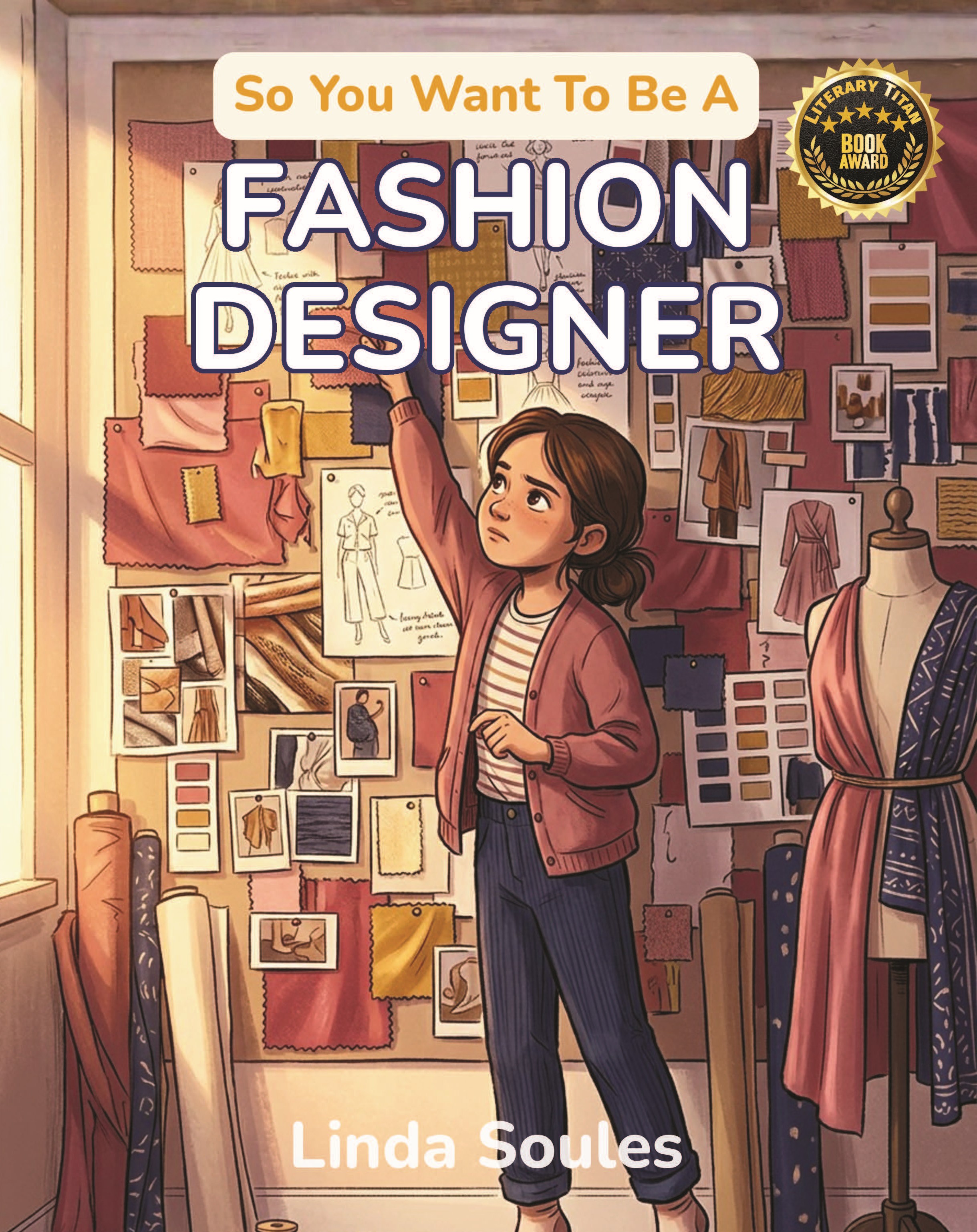
Children's Nonfiction
So You Want To Be A Fashion Designer
by Linda Soules
Listen to this review
So You Want to Be a Fashion Designer treats clothing not as a glamorous surface but as a designed object, a form of communication, and a chain of decisions involving materials, bodies, workers, and the planet. Its strongest idea is that fashion design is both expressive and practical: a garment must carry an aesthetic vision while allowing someone to breathe, bend, and feel at home in their body. That combination gives the book a more thoughtful foundation than a simple tour of sketches and runway shows.
The opening chapter makes this case vividly by asking readers to look at what they are wearing and consider the choices behind it: fabric, neckline, sleeve, hem, pattern, and construction. The explanation that fabric has its own “character”—cotton wrinkles, silk stains, denim records wear—translates material knowledge into language an adolescent reader can grasp. The book also explains design through useful concrete details, from darts and gussets to toiles and dress forms. Its account of a quarter-inch affecting fit is especially effective in conveying that precision matters as much as inspiration.
The prose is energetic and frequently memorable. The studio, with its fabric bolts, chalk-dusted cutting table, and unfinished garments, feels like a working place rather than a fantasy setting. The “Day in the Life” section gives the career a helpful rhythm: sourcing fabric, fitting a toile, editing a collection, negotiating with production, and marking changes on photographs. This sequence also shows that the work is collaborative. Pattern makers, sample sewers, fit models, suppliers, and buyers all contribute to turning a sketch into something wearable, countering the familiar image of the solitary designer.
The book’s most compelling ethical thread is its insistence that clothes are made for people, not idealized figures. Its discussion of adaptive clothing, including a jacket designed to sit properly when its wearer is seated in a wheelchair, makes inclusion a practical design problem rather than an abstract virtue. The fitting-room passage, in which a well-fitting garment can help someone feel recognized, is emotionally direct and central to the book’s argument. It is also balanced by reminders that fashion affects garment workers and the environment. “Helping people,” the book argues, includes both the people who wear clothes and those who make them.
Historical and contemporary examples broaden that perspective. Coco Chanel is presented through her challenge to restrictive women’s clothing; Virgil Abloh’s account connects his work to opening doors for young Black designers; and Issey Miyake’s story links innovation in fabric to survival and renewal. These brief portraits are accessible and well chosen for illustrating different paths into design. The activities—studying seams, starting a sketchbook, draping a scarf, sewing a button, and repairing clothes—are among the book’s most useful features. They turn career curiosity into small experiments a reader can actually try.
There are limits to the book’s explanatory approach. Its confident, compressed style can make complex claims sound more settled than the text demonstrates. Statements about how many collections designers produce, the industry’s environmental impact, or trend forecasting are presented broadly, without much discussion of variation, uncertainty, or the differences between kinds of design work. The Digital Lavender example offers an appealing story of prediction, but “It really works” is a sweeping conclusion for a brief anecdote. Likewise, the claim that getting the fabric right means a garment “nearly designs itself” is vivid, but risks understating the continuing work of fit, construction, cost, and revision that the book elsewhere explains well.
The inspirational voice is another mixed element. Repeated assurances that every body is a design challenge with a solution reinforce the book’s humane outlook, but can make inclusion sound simpler than it is. The industry’s narrow ideals and wasteful practices are acknowledged, yet the discussion moves quickly toward the responsibility and potential of thoughtful designers. Readers looking for a detailed account of fashion’s economics, labor conditions, or the barriers to making responsible clothing may want a more sustained treatment. The book’s closing reflections sometimes return to the same message about clothing as language and the importance of helping people feel seen; the repetition strengthens its emotional emphasis but also limits space for complication.
As a career introduction, the book is clearly organized, moving from daily tasks and tools through challenges, skills, history, preparation, and further resources. The glossary supports its technical vocabulary, while the suggested books, museums, organizations, and activities offer useful next steps. The additional series material at the end is less essential to the fashion discussion and interrupts the momentum, though it identifies the book as part of a larger career-exploration project.
So You Want to Be a Fashion Designer will be most valuable to readers roughly in the middle-grade and early-teen years who are curious about clothing and want an encouraging, hands-on first look at the profession. Its particular strength is connecting creativity to fit, craftsmanship, collaboration, and care for people. Readers seeking rigorous industry analysis or a highly critical account of fashion’s systemic problems may find it too simplified and reassuring, but as an accessible invitation to explore the craft—and to start examining how clothes are made—it is thoughtful and practical.
Share-ready review images
Download square and vertical images for posts, stories, newsletters, and media kits.
For authors
Want a review page like this for your book?
Upload your manuscript, choose a review tier, and get a permanent public editorial review page you can share with readers.
Review My Book← Back to Reviews
