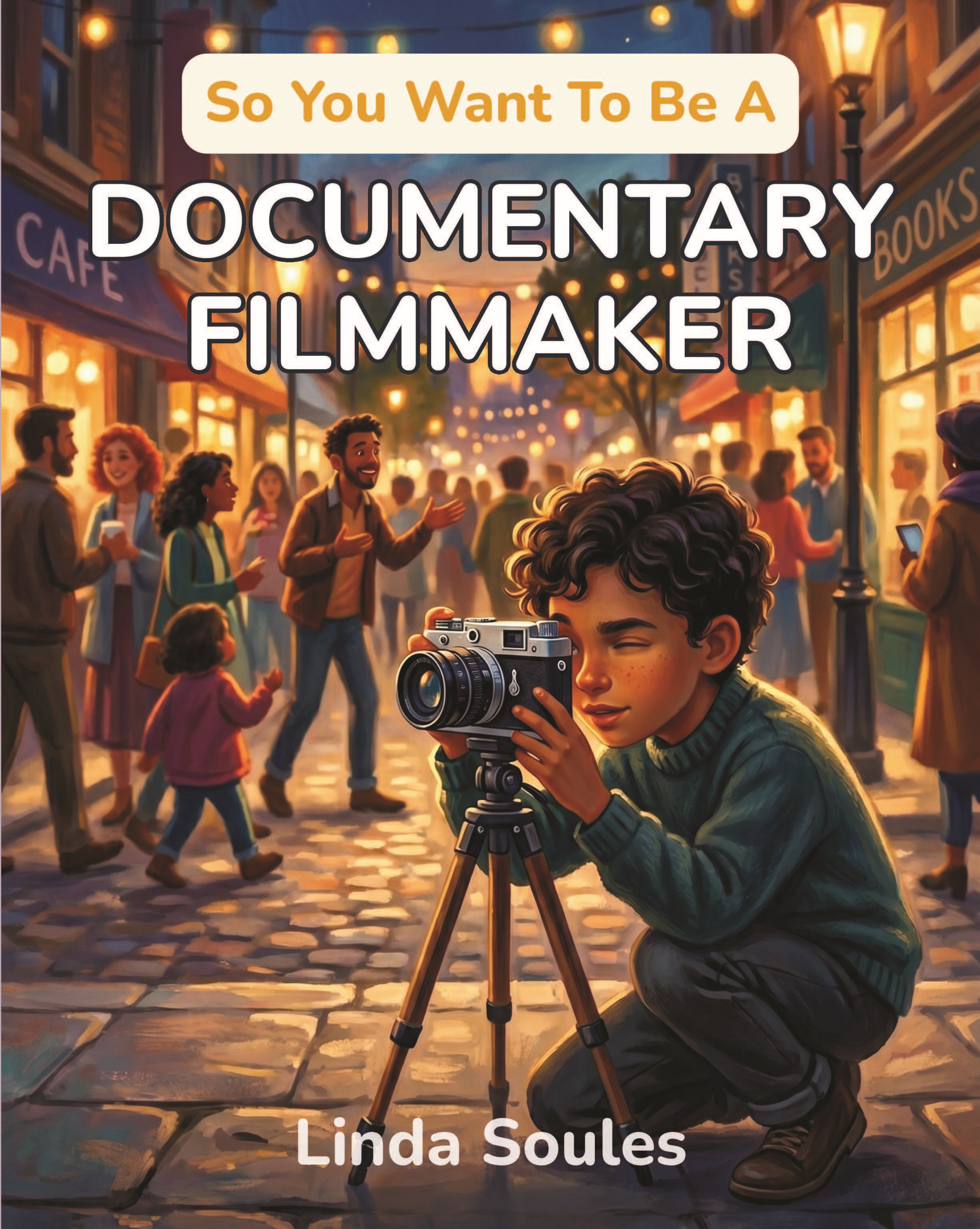
Children's Nonfiction
So You Want To Be A Documentary Filmmaker
by Linda Soules
Listen to this review
So You Want to Be a Documentary Filmmaker is a lively introduction to a career built around attention: noticing people and places others overlook, listening patiently, and shaping what is recorded into a film. Written for young readers exploring possible futures, Linda Soules’s book makes the work appealing without pretending it is all travel and dramatic encounters. Its most useful idea is also its ethical center: documentary filmmaking involves creative choices, but those choices carry responsibility because the people on screen are real.
The book’s conversational second-person voice invites readers into the job rather than presenting a detached list of requirements. Its opening image of a filmmaker noticing “the man who feeds pigeons” sets up a warm, accessible account of curiosity as a professional skill. That approach continues through specific, memorable details: the crew waiting for a family to get used to the camera, the sound recordist capturing “room tone,” and the filmmaker trying not to laugh when interview headphones pick up a gurgling stomach. These moments make the work feel tangible and human, particularly for readers who may have little experience with film production.
Practical explanations are among the book’s strongest features. The sections on cameras, sound and editing clarify that expensive equipment is less important than judgment and preparation. The explanation of shooting ratios gives a useful sense of how much material may be discarded, while the editing discussion shows how a story emerges through choices rather than simply being “captured.” The glossary reinforces this vocabulary, and the suggested exercises—such as making two edits of the same blank expression—turn abstract ideas about editing into something a young reader can try. The book also includes clear entry points into the field, from school video clubs and production-assistant work to grants and self-made short films.
Its treatment of ethics gives the career guide unusual substance. Soules stresses that filmmakers should not invent dialogue, stage events as if they happened spontaneously, or edit a person’s words to alter their meaning. The book’s historical examples make that principle more than a slogan. Robert Flaherty’s staged scenes in Nanook of the North introduce the long-running dispute over where shaping ends and deception begins; Alanis Obomsawin’s work, especially Kanehsatake: 270 Years of Resistance, offers a contrasting example of a filmmaker documenting a community from within. Barbara Kopple’s experience filming a miners’ strike and the discussion of Blackfish further show how documentaries can affect subjects and audiences beyond the screen.
The range of examples is another strength. The book moves from the Lumière brothers to contemporary Indian filmmakers Rintu Thomas and Sushmit Ghosh, and from nature documentaries to investigative work. Such variety helps resist the idea that documentary filmmaking is one narrow occupation. The account of Hoop Dreams, which grew from a proposed short television film into a much longer project following two teenagers, vividly illustrates how an initial plan can change when real life takes its own course. Likewise, the “Day in the Life” section and the less glamorous planning and editing days make a convincing case that emails, permissions, backups and fundraising are part of the craft, not incidental chores.
There are meaningful limits to the book’s approach. Its repeated direct address and encouragement—“you” may be the next filmmaker—create momentum, but can also make the prose feel formulaic over a long stretch. Several sections return to curiosity, patience, listening and truthfulness in similar terms. The chapter-by-chapter format is easy to browse, though it sometimes produces a catalogue of appealing facts and examples rather than a sustained exploration of any one problem. Readers seeking advanced guidance on interviewing, legal permissions, budgeting or the technical details of editing will find an introduction, not a manual.
The book’s ethical framework is clear, but some of its contrasts are simplified for accessibility. It distinguishes documentary filmmaking from reality television by describing the latter as steering people toward drama, and it presents honesty as the defining difference between documentary and propaganda. Those distinctions are useful starting points, yet the book’s own account of framing, omission and editing shows how complicated representation can be. Its more nuanced moments—especially the acknowledgment that no camera can show a whole life—suggest a deeper discussion of power and interpretation than the concise format can fully provide. The text also refers to illustrations, but they are not included in the supplied material, so their contribution cannot be assessed here.
Still, the accessible tone does not mean the book avoids difficulty. It discusses unstable income, long waits, failed projects, emotionally demanding footage and the risk of betraying a subject’s trust. The account of the crew choosing whether to help trapped penguins use steps they made in the snow gives readers a concrete ethical dilemma rather than a tidy rule. Soules’s closing note broadens the subject beyond professional filmmaking, arguing that anyone who records another person with a phone has choices to make about consent and fairness. That connection gives the book a relevance beyond career planning.
So You Want to Be a Documentary Filmmaker is best suited to curious readers around ages 10 to 14, especially those who enjoy true stories, film, journalism or hands-on creative projects. Parents and teachers may also value its practical activities and opportunities to discuss consent, evidence and representation. It is an encouraging, specific first look at a demanding profession, though readers ready for deeper technical instruction or a more sustained examination of documentary ethics will need to look further.
Share-ready review images
Download square and vertical images for posts, stories, newsletters, and media kits.
For authors
Want a review page like this for your book?
Upload your manuscript, choose a review tier, and get a permanent public editorial review page you can share with readers.
Review My Book← Back to Reviews
