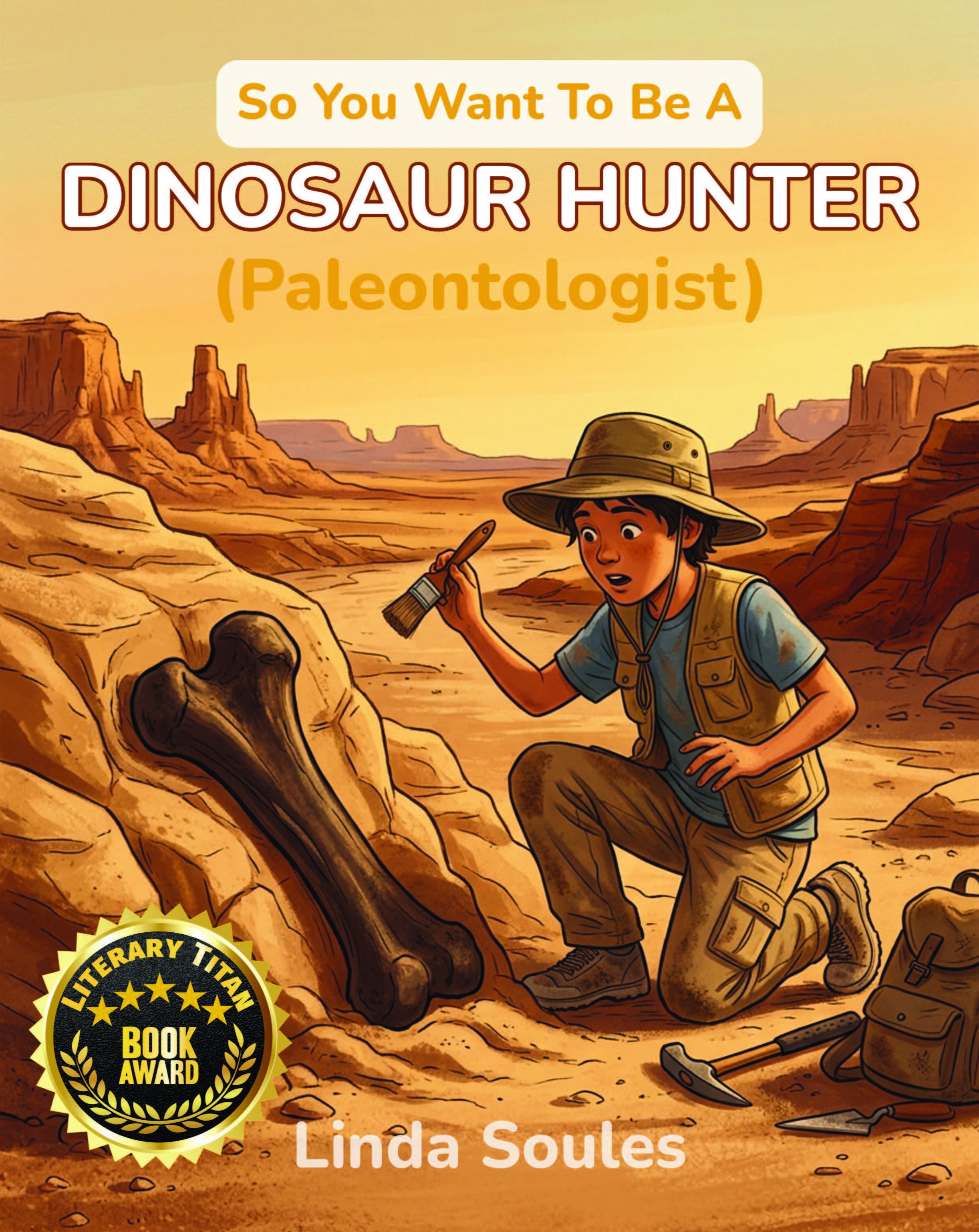
Children's Nonfiction
So You Want To Be A Dinosaur Hunter (Paleontologist)
by Linda Soules
Listen to this review
So You Want to Be a Dinosaur Hunter (Paleontologist) makes a compelling case that paleontology is more than the pursuit of spectacular bones. Its central metaphor—fossils as sentences, skeletons as chapters, and dig sites as buried libraries—gives young readers an inviting way to imagine scientific work as both investigation and interpretation. The book’s strongest achievement is making that work feel wondrous without concealing its patience, physical demands, or dependence on funding.
The opening chapters establish a useful breadth of perspective. Paleontology is defined as the study of ancient life, not simply dinosaurs, and the book ranges from fossilized plants and pollen to prehistoric insects and footprints. That broader framing enriches the title’s more playful “dinosaur hunter” hook. The explanation of the “fossil eye”—the trained ability to notice a color, texture, or shape that seems wrong for the surrounding rock—is especially effective: it turns expertise into a learnable practice of attention rather than mysterious instinct.
Specific descriptions make the work tangible. The sections on field jackets, three-dimensional mapping, consolidant, pneumatic scribes, and preparation under magnification show that excavation is not a matter of simply digging up a skeleton. The sample day, from the 5:30 a.m. field breakfast through evening notes and photographs, offers a credible sense of how observation, record-keeping, and teamwork accompany the exciting moments. The explanation that a fossil’s precise location is scientific data, not incidental detail, is a particularly clear lesson in why careful methods matter.
The book is also at its best when it treats science as provisional and collaborative. Its emphasis on skepticism about exciting discoveries, interdisciplinary curiosity, and comfort with revision gives readers more than a list of desirable personality traits; it presents scientific judgment as an ongoing discipline. The chapter on people in the field recognizes preparators, curators, geologists, students, and paleoartists, widening the picture beyond the lone discoverer. The history section adds a welcome corrective through Mary Anning, whose discoveries were published by others while she was excluded from the Geological Society. Her story gives the book a meaningful way to address credit and exclusion without losing sight of her scientific work.
Its practical suggestions are well matched to curious children. Starting a labeled rock collection, keeping a nature journal, trying a small grid-based backyard excavation, and visiting a museum translate enthusiasm into habits of observation. The glossary, questions a paleontologist might ask, and further-reading resources reinforce that invitation. The discussion of birds as living dinosaurs is a memorable example of the book’s capacity to unsettle an assumption and make the subject feel present rather than remote.
The prose is energetic and frequently lyrical. Images such as a “handshake across deep time” give emotional weight to the encounter with a fossil, while short, direct passages keep the explanation accessible. That intensity will appeal to readers who respond to wonder and big ideas. At times, however, the writing leans so heavily on dramatic language that it risks overselling the experience. The repeated promise that a find can be life-changing, or that future readers will discover what no one else has found, sometimes makes the book sound more certain and inspirational than its own account of slow, funded, collaborative work suggests. The more grounded descriptions of painstaking preparation and grant applications are ultimately more persuasive than the grandest assurances.
There is a related imbalance in the career guidance. The book candidly explains that expeditions and laboratories depend on competitive funding, and it correctly distinguishes initial discovery from the expertise needed to excavate and interpret a specimen. But its “What You Can Do” advice is mostly recreational and observational; it does not explain the educational or professional routes into paleontology. Nor does the day-in-the-life section show the range of working lives implied elsewhere by museums, universities, and research collaboration. For a book inviting readers to imagine this as a career, that missing bridge between childhood interest and professional practice is significant.
The book also presents striking facts and biographical claims with confidence, while the supplied text does not show source notes or citations that would let readers follow up on them. The “Want to Learn More?” section provides useful books, organizations, and museum resources, but a clearer trail from particular claims to their sources would strengthen the book’s model of evidence-based inquiry. Because the supplied content is text only, its visual presentation cannot be assessed here; the series note says illustrations are AI-assisted, but that disclosure alone offers no basis for judging how effectively images support this particular volume.
Overall, So You Want to Be a Dinosaur Hunter is an engaging introduction for children who are already fascinated by fossils or beginning to explore science careers. Its strongest appeal lies in its vivid explanations of field and laboratory practice, its respect for scientific patience, and its insistence that discovery is only one part of the work. Readers seeking a detailed account of academic training or a more restrained, source-heavy guide may find it incomplete. For curious readers—especially those around the series’ stated ages of 10 to 14—who want an inspiring, accessible first encounter with paleontology, it is a worthwhile place to begin.
Share-ready review images
Download square and vertical images for posts, stories, newsletters, and media kits.
For authors
Want a review page like this for your book?
Upload your manuscript, choose a review tier, and get a permanent public editorial review page you can share with readers.
Review My Book← Back to Reviews
