Children's Nonfiction
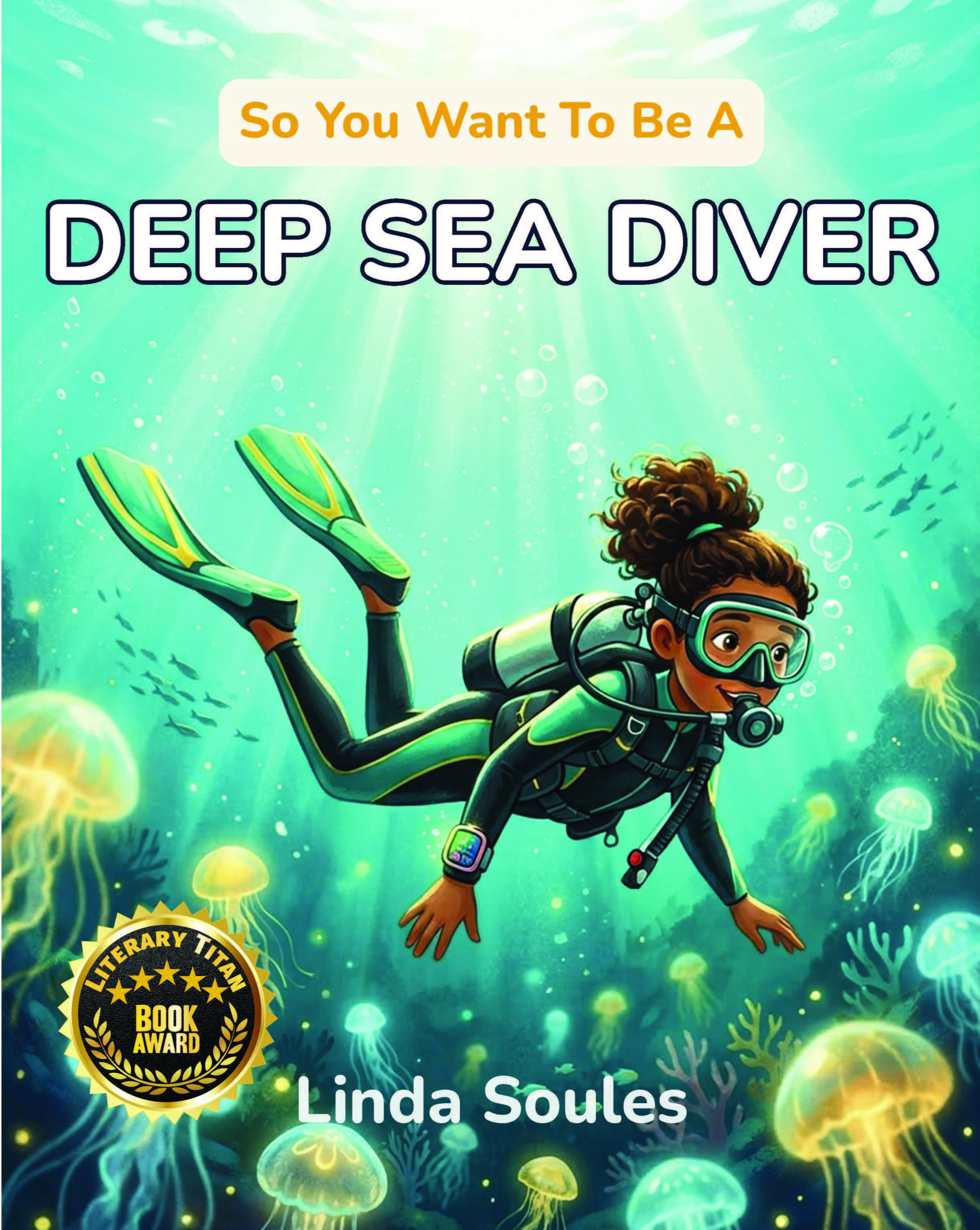
So You Want To Be A Deep Sea Diver
by Linda Soules
Listen to this review
Linda Soules’s So You Want to Be a Deep Sea Diver makes its subject compelling by treating diving as both an encounter with the unknown and a highly disciplined form of work. Addressed directly to a curious young reader, it opens with the invitation to descend “past the shallows” into a world of darkness, pressure, and unfamiliar life. The book’s strongest idea is that wonder alone does not make a diver: patience, training, and strict attention to safety are equally central to the job.
The writing is vivid and accessible, especially when it turns physical changes into sensory experience. In “What If You Were a Deep Sea Diver?” the fading light, cooling water, and muffled sounds make descent feel tangible without requiring technical knowledge. Later, the image of a diver’s hand stirring “millions of microscopic organisms” into a trail of light gives the “Best Parts of the Job” a memorable imaginative center. Such passages convey why people might be drawn to diving, while the book’s plain explanations of regulators, buoyancy compensators, and decompression help readers understand what makes the work possible.
Soules also resists presenting the profession as uninterrupted adventure. “The Hardest Parts of the Job” gives space to cold, poor visibility, repetitive tasks, and the slow wait at a decompression stop. The account of a day in the life reinforces this balance: the dive is only one part of a schedule that also includes briefings, repeated gear checks, equipment maintenance, data review, and planning. This emphasis is valuable for readers who may imagine the career as simply swimming among fish. The book instead presents diving as skilled labor, with much of its responsibility invisible to anyone watching from the surface.
The sections on teamwork and safety are among the book’s most responsible. The diver is shown as one person in a larger operation, supported by a supervisor, standby diver, medical technician, deck crew, and others. “You never, ever dive alone” is an emphatic lesson, and the chapter on fear distinguishes useful caution from panic rather than treating bravery as fearlessness. The author’s note returns to the same point: getting down is only half the dive; coming back safely matters just as much. The book’s practical suggestions—building confidence in swimming, learning about ocean science, and keeping an observation log—give young readers ways to engage with the subject without suggesting that enthusiasm substitutes for training.
The career portrait is broad, moving between commercial work, scientific research, cave and wreck diving, and saturation diving. That range underscores the variety of underwater work, and the profiles of Sylvia Earle, Jacques Cousteau, William Beebe, and Dawn Wright offer useful historical and contemporary reference points. Yet the breadth also creates the book’s main limitation: “deep sea diver” is used as an umbrella for occupations and activities that are not clearly distinguished. A saturation diver repairing infrastructure, a scientific diver collecting samples, and a cave diver exploring a confined passage face substantially different working conditions and training pathways. The book names those differences, but it does not consistently explain where one kind of diving ends and another begins, or how the reader might pursue each route. As a result, its career guidance is more evocative than practical.
That looseness occasionally affects technical clarity. The glossary describes the aphotic zone as beginning below about 200 meters, then says sunlight disappears completely at around 1,000 meters; those statements sit uneasily together, since the term is tied here to the absence of sunlight. The book also shifts between ordinary scuba dives and saturation work, sometimes without making the change in context explicit. Its “Day in the Life” schedule, for instance, describes a pipeline inspection and a relatively short decompression stop, while earlier passages explain the very different chamber-based routine of saturation divers. These examples could be clarified with more careful labeling. They do not erase the book’s general message about preparation, but readers seeking a dependable technical primer may want a more specialized source alongside it.
The structure is easy to navigate, with short, clearly named sections, a glossary, and a “What You Can Do to Prepare Right Now” chapter. At times, however, the book repeats its central themes—wonder, patience, discipline, and the importance of returning safely—across several sections. The repetition suits a younger audience and reinforces the safety message, but it can make the middle feel less progressive than the chapter list suggests. The closing author’s note offers a graceful summation, though its inspirational tone sometimes edges toward a broad promise that the ocean is “still hiring,” rather than a detailed account of the narrow, demanding routes into professional work.
Best suited to readers around the series’ stated ages of 10 to 14, this is an engaging introduction for children fascinated by the ocean and willing to learn about the unglamorous discipline behind exploration. Its strongest contribution is imaginative and motivational: it makes underwater work feel beautiful without entirely concealing its risks and routines. Readers looking for a precise guide to qualifications, career pathways, or the technical distinctions among diving specialties may find it incomplete. For a curious young reader seeking a lively first encounter with the profession—and an invitation to learn more—it is a worthwhile starting point.
Share-ready review images
Download square and vertical images for posts, stories, newsletters, and media kits.


For authors
Want a review page like this for your book?
Upload your manuscript, choose a review tier, and get a permanent public editorial review page you can share with readers.
Review My Book← Back to Reviews
