Children's Nonfiction
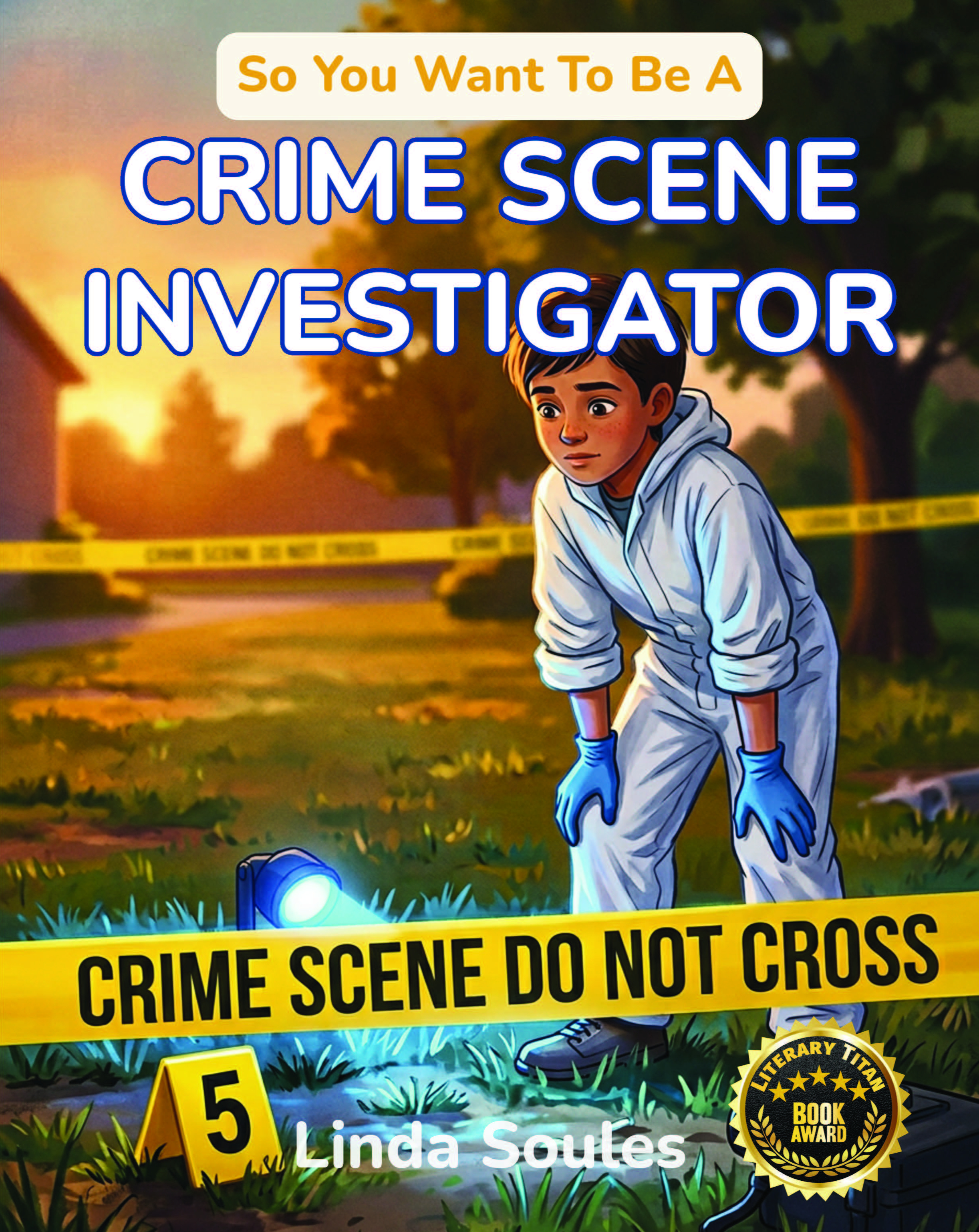
So You Want To Be A Crime Scene Investigator
by Linda Soules
Listen to this review
Linda Soules’s So You Want to Be a Crime Scene Investigator is a career introduction built around a compelling proposition: a crime scene is a record to be read, and the investigator’s first responsibility is to observe and preserve it accurately. Rather than leaning on the glamour of television forensics, the book emphasizes patience, documentation, scientific method, and the human consequences of getting evidence right. Its strongest achievement is making those less dramatic qualities feel consequential to young readers.
The writing is direct, vivid, and often memorable. A scene is described as “a story frozen in time”; the investigator must first “read the whole thing” before collecting its chapters. Such images make procedural ideas accessible without reducing the work to a collection of gadgets. The explanation of wide, mid-range, and close-up photography, for example, shows how pictures preserve relationships between items, while the account of chain of custody makes clear that careful labeling can matter as much as discovery. The book repeatedly returns to the small detail that does not fit, giving its many topics a coherent central theme: attention is both a scientific skill and a form of responsibility.
That theme is reinforced by a welcome account of professional neutrality. The CSI, the book insists, does not decide who is guilty, but reports what the evidence supports—even when findings clear someone who seemed suspicious or complicate a case against someone who seemed innocent. The sections on the people investigators work with and on helping victims and the wrongly accused broaden the career beyond laboratory technique. The account of Frances Glessner Lee’s miniature crime scenes, Edmond Locard’s exchange principle, Paul Kirk’s work on bloodstain analysis, and Juan Vucetich’s fingerprint classification gives the field a useful history. These examples also add variety: the book presents forensic science as a developing practice shaped by people, not simply as a modern collection of instruments.
The practical material is another strength. The observation exercise, fingerprint-card activity, and advice to write descriptions for a future reader translate abstract skills into things a child can try. “Treat Memory Like a Suspect” is an especially effective prompt: it introduces the fallibility of eyewitness recollection while encouraging readers to distinguish what they observed from what they assumed. The glossary supports the book’s accessible approach, and the “Want to Learn More?” section offers further reading, websites, activities, and organizations for readers ready to explore beyond the page. Together, these features make the book useful as a conversation starter for families and classrooms, not just as a description of one occupation.
The book is also commendably candid about the job’s costs. Its discussion of distressing scenes, physical strain, waiting, and repetitive documentation counters the fantasy of nonstop dramatic breakthroughs. The imagined workday—from a call-out at 2:47 p.m. to notes written after midnight—gives this message a concrete shape. The author’s note extends the same emphasis, presenting painstaking work for people an investigator may never meet as the profession’s quiet strength. This sincerity is likely to resonate with readers who are drawn to science and service rather than action-hero spectacle.
There is, however, a significant tension between the book’s commitment to accuracy and some of its most emphatic claims. Statements such as “Science doesn’t lie” and the assertion that forensic science “delivers truth with certainty” are rhetorically powerful but too absolute for a field the book itself describes as vulnerable to contamination, poor collection, and mistakes in interpretation. Its repeated contrasts between reliable physical evidence and mistaken human memory risk implying that a fingerprint, DNA profile, or other trace speaks for itself. In practice, evidence must be collected, analyzed, interpreted, and presented, and those steps can involve uncertainty. A fuller acknowledgment of the limits of particular methods—and of the difference between a scientific result and a conclusion about what happened—would strengthen the book’s otherwise valuable insistence on neutrality.
Some explanations similarly favor momentum over qualification. The text says fingerprints are unique for every person and that NGI can compare a print against more than 150 million sets in seconds, but it gives little sense of how print quality or interpretation affects a comparison. The description of the Wayne Williams case is engagingly specific, yet its compressed account moves quickly from matching fibers and dog hair to conviction and links to other crimes. These choices are understandable in a youth-oriented guide, but the book’s confidence can make complex forensic and legal questions sound more settled than its own cautions about careful procedure would suggest. The “A Day in the Life” schedule is clearly illustrative in effect, though readers could benefit from a more explicit reminder that working patterns vary by agency and case.
As a career guide, the book excels at describing the mindset and working conditions of a CSI, but offers less detail about the education and hiring routes into the profession. It directs readers to external resources for that next step, which is helpful, though a concise overview in the book itself would make the career exploration more complete. The supplied text also cannot establish how the AI-assisted illustrations function on the page; the author’s transparency about them is useful, but their quality and effectiveness cannot be assessed here.
This is a lively, thoughtful introduction for curious readers, especially those around the series’ stated ages of 10 to 14 who enjoy science, puzzles, and careful observation. Its best lessons are not about solving a crime quickly, but about documenting what is there, resisting assumptions, and understanding why method matters. Readers seeking a detailed professional training guide or a more nuanced account of forensic evidence’s limitations may need additional sources. For young readers beginning to explore the field, however, Soules offers an engaging and humane starting point—most persuasive when it celebrates disciplined curiosity rather than certainty.
Share-ready review images
Download square and vertical images for posts, stories, newsletters, and media kits.
For authors
Want a review page like this for your book?
Upload your manuscript, choose a review tier, and get a permanent public editorial review page you can share with readers.
Review My Book← Back to Reviews
