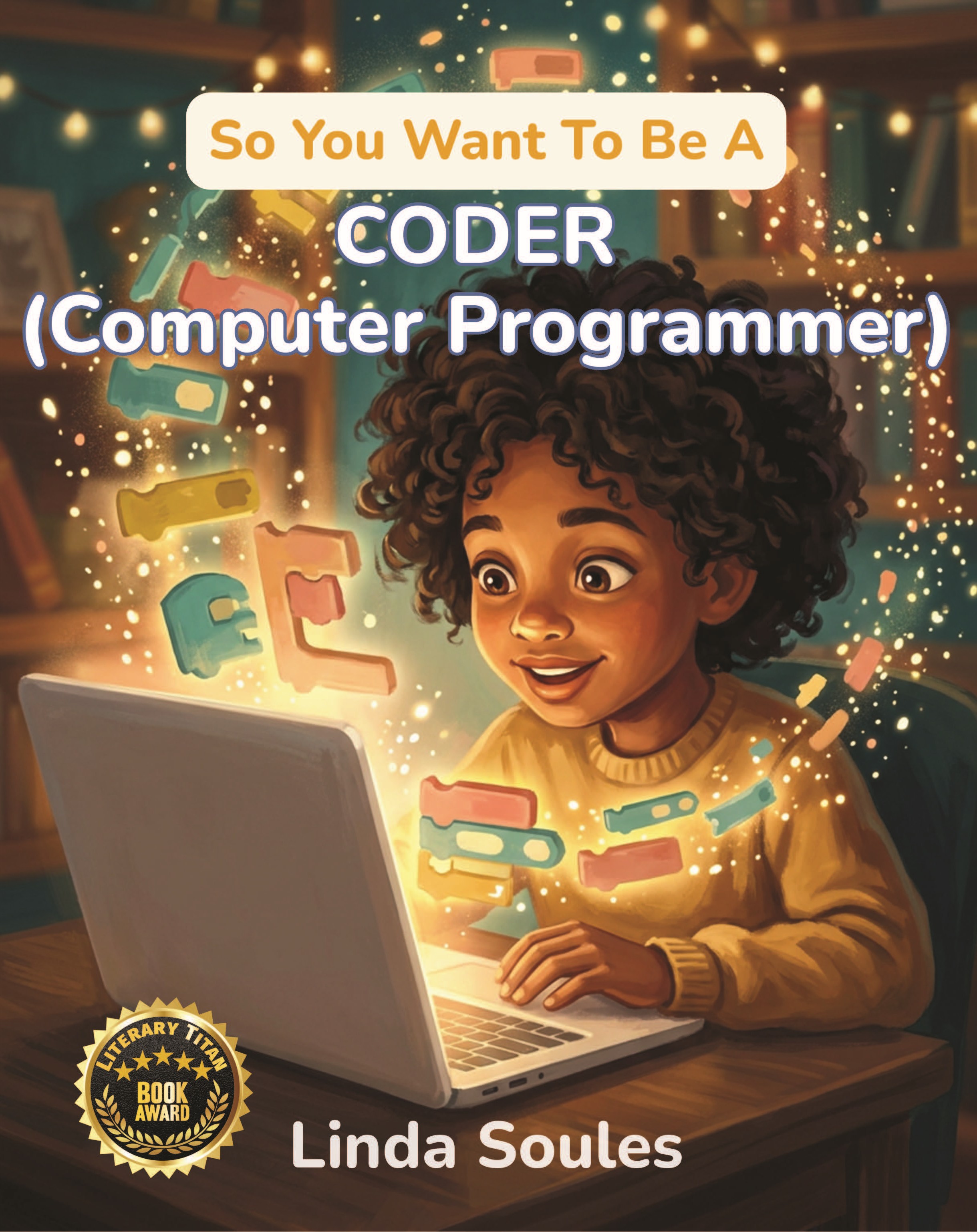
Children's Nonfiction
So You Want To Be A Coder (Computer Programmer)
by Linda Soules
Listen to this review
So You Want To Be a Coder (Computer Programmer) is a welcoming career introduction for young readers, built around a useful premise: explain not only what programmers make, but what the work feels like. Its strongest passages resist the fantasy of coding as effortless screen-side wizardry. The opening calls programming a kind of “magic,” then immediately grounds the comparison in exactness: computers follow what a person writes, not what they meant to write. That balance of wonder and practical reality gives the book its best quality. It invites children in without pretending the job is easy.
The prose is direct, energetic, and often vivid. The account of coding as a cycle—“You think. You write. You run. It breaks”—turns an abstract occupation into an experience a young reader can imagine. Similarly, the description of a debugger as a way to “peek at every variable” makes a technical tool feel approachable without drowning the explanation in jargon. The book’s conversational asides (“Your future self will thank you. Your past self never does”) keep the instructional tone from becoming dry. Its recurring emphasis on patience, curiosity, and comfort with not knowing also offers a humane picture of skill: expertise is not omniscience, but the ability to keep learning.
The structure is especially serviceable for browsers and first-time explorers. Short sections move from what a coder does and where programmers work to tools, working conditions, collaborators, and preparation. The “A Day in the Life” schedule is a valuable addition because it brings less visible routines—code review, pair programming, documentation, lunch, and walking breaks—into view. The book also makes a persuasive case that programming involves reading and communication as much as typing. Its sections on writing skill and empathy for future readers broaden the idea of who can thrive in the field, while the glossary and suggested beginner projects give readers concrete next steps. The advice to finish a small project rather than wait for mastery is particularly sound and encouraging.
The historical profiles add welcome depth. Ada Lovelace, Grace Hopper, Margaret Hamilton, and Tim Berners-Lee are presented not just as names to admire but as people whose work illustrates different aspects of computing: imagining machines’ possibilities, making them easier to use, building mission-critical software, and sharing a transformative invention. The account of Hamilton’s software during Apollo 11 gives the book a compelling example of why careful programming matters. The “Fun Facts” section likewise helps connect code to distant or familiar things, from Mars rovers and Voyager 1 to encrypted messages and the women who programmed ENIAC. Together, these details make the book’s central theme tangible: software is woven into many kinds of work, and its effects can extend far beyond the person who wrote it.
There are limits to the book’s upbeat framing. The assertion that programming has “no gatekeeper,” and that credentials and years of training “mostly do not exist here,” is too sweeping. It is true that a child can start learning or share a project without permission, but access to learning is not the same as access to paid work; professional hiring, education, and workplace expectations can still impose barriers. The book would be more useful if it separated the freedom to begin from the realities of building a career. Likewise, claims about how quickly a young person might reach a large audience risk making an exceptional possibility sound typical. The more grounded advice elsewhere—start small, keep practicing, and expect confusion—is a better guide to what beginners can count on.
Some of the book’s encouragement also comes at the cost of qualification. It presents open-source programming as “one of the most generous communities anywhere,” and describes programming as a profession that can be practiced almost anywhere with a laptop and connection. These are appealing pictures, but they smooth over differences among teams, workplaces, and kinds of access. The detailed discussion of sedentary work, changing tools, invisible labor, and repeated failure partly corrects that rosy impression; more attention to how varied a programmer’s experience can be would strengthen the overview. The “Most Important Qualities” and “Things You Might Not Expect To Need” sections also overlap: patience, curiosity, communication, and clear writing recur in slightly different forms. Some repetition reinforces the message, but tighter editing could make these lists more distinct.
The book’s greatest strength is that it treats coding as both technical craft and service to other people. Its examples of software supporting hospitals, schools, scientific research, and daily communication give readers a reason to look beyond games and apps. The author’s closing comparison of code to writing gathers the book’s ideas neatly: precise instructions require thought, revision, and consideration for whoever—or whatever—will read them. Because the supplied text does not include the illustrations, their contribution to the finished book cannot be assessed here; the prose itself, however, is designed to be accessible and lively.
This is a useful introduction for curious readers around the series’ stated middle-grade audience, especially children who enjoy puzzles or want an honest first look at computer programming. It is less suited to readers seeking a detailed technical tutorial or a fully realistic account of employment in the software industry. For young people who want to understand what coders do and try a first project, the book’s mix of practical guidance, history, and encouragement makes it a worthwhile starting point.
Share-ready review images
Download square and vertical images for posts, stories, newsletters, and media kits.
For authors
Want a review page like this for your book?
Upload your manuscript, choose a review tier, and get a permanent public editorial review page you can share with readers.
Review My Book← Back to Reviews
