Children's Nonfiction
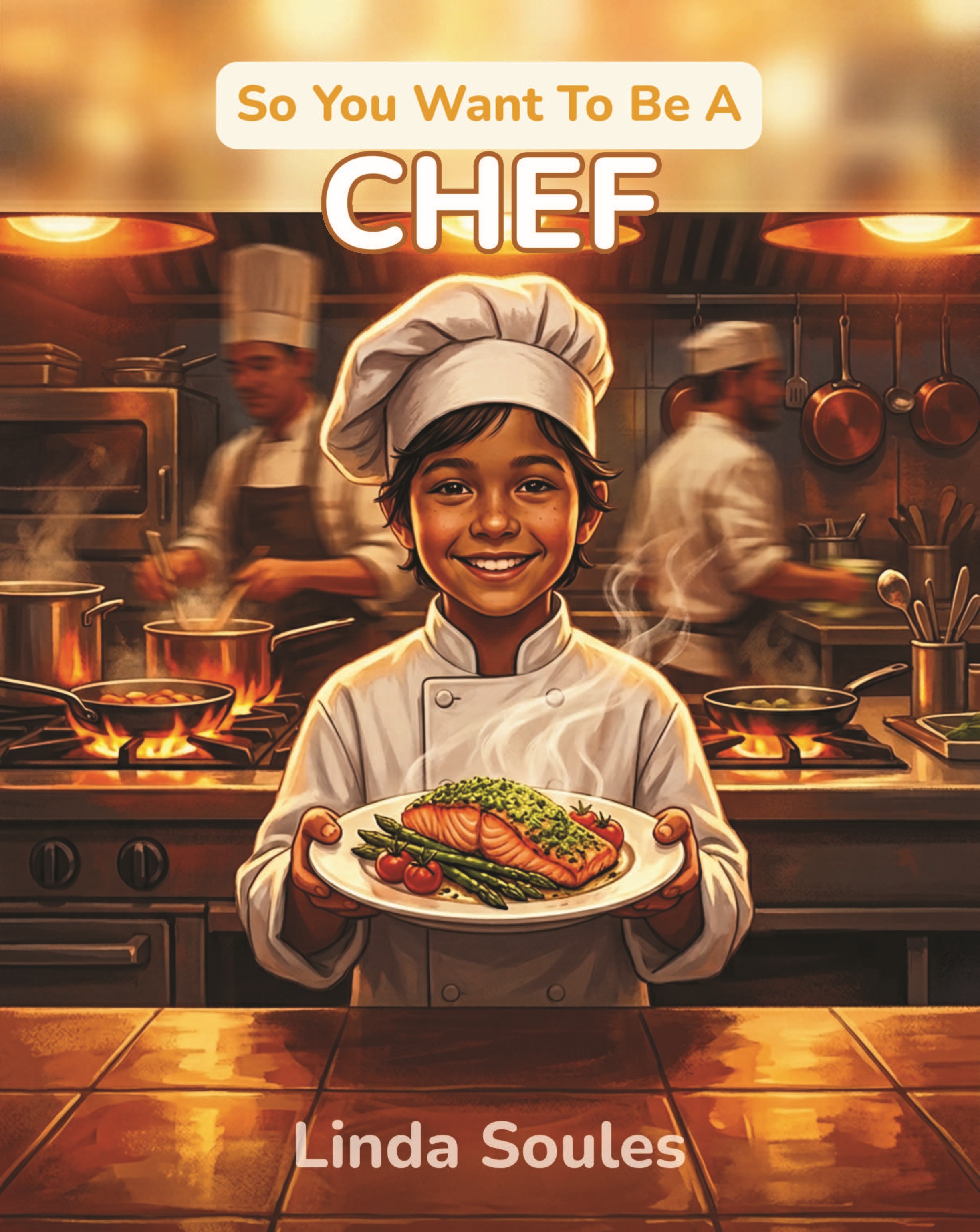
So You Want To Be A Chef
by Linda Soules
Listen to this review
So You Want to Be a Chef makes its case for cooking not as celebrity, glamour, or a collection of recipes, but as skilled work that turns attention into care. Its opening image—a chef tasting a sauce repeatedly, then sending a plate out to someone who may enjoy “ten quiet minutes”—sets the book’s emotional register. Throughout, Linda Soules connects kitchen craft to generosity, whether in a family meal or a restaurant serving a hundred guests. That humane emphasis gives this career guide more purpose than a simple inventory of duties and equipment.
The book is strongest when it makes professional cooking concrete. The sections on tools explain that a knife needs regular sharpening, but give the spoon and the trained palate greater importance: recipes are starting points, and judgment comes from tasting and adjustment. The description of service—orders arriving quickly, components needing to reach the pass at the right moment—conveys the coordination behind a finished dish. So does the day-in-the-life itinerary, from a farmers’ market and prep work to the dinner rush and the final kitchen walk-through. These details help young readers picture the labor rather than imagining a chef only at the stove.
Soules also takes care to present difficulty as part of the profession, not an obstacle that a sufficiently gifted person can simply bypass. Burned sauce, oversalted food, customer complaints, fatigue, and the pressure of service all appear. The assertion that “the kitchen rewards recovery” is a particularly useful reframing for young readers: mistakes have consequences, but they can also teach. The book’s advice to cook a simple dish, keep a taste journal, practice knife skills with an adult, and try unfamiliar foods translates that outlook into manageable first steps. Its tone is encouraging without suggesting that enthusiasm alone makes professional work easy.
The historical portraits add welcome breadth. Julia Child’s late start and persistence, Edna Lewis’s documentation of Southern foodways, and Massimo Bottura’s reinterpretation of local recipes show three distinct relationships between cooking, culture, and invention. Lewis’s account is especially significant: it insists that Black communities’ cooking belongs within the story of American fine dining, rather than outside it as mere “folk tradition.” Bottura’s community kitchens, which turn surplus food into meals for people in need, extend the book’s recurring idea of food as service. These examples make the profession feel culturally and socially varied, not just technically demanding.
The writing is direct and often vivid, with short passages and sensory images suited to readers exploring a career. Comparisons—a pastry chef working “like a watchmaker,” a kitchen as a laboratory—make unfamiliar work accessible. The glossary reinforces that introduction with terms such as mise en place, brigade, reduction, and umami. Yet the prose sometimes leans so heavily on emphatic formulations that its central points recur rather than develop. Food as generosity, tasting as judgment, and persistence as the path to mastery are all restated in multiple sections. The line “A chef is not someone who cooks food” is immediately followed by “A chef is not just someone who cooks food,” an apparent repetition that illustrates the need for closer copyediting. The lyrical voice can also romanticize the work even as the book acknowledges heat, exhaustion, and long shifts.
That tension matters because the guide gives more attention to inspiration than to the practical conditions of a career. It names roles across a kitchen and mentions business sense, costs, waste, and the possibility that restaurants close, but offers little detail about training routes, pay, working conditions, or how responsibilities vary across restaurant types. The author’s suggested resources include the Bureau of Labor Statistics and ProStart, which could help readers investigate further, but the book itself does not answer many of the practical questions a career-minded teenager might have. Some numerical or historical assertions—such as the claim that most new restaurants do not last three years—are presented without citations in the text, making the “Want to Learn More?” section useful but not a substitute for clear sourcing.
The book’s advice is most persuasive when it treats becoming a chef as a long practice of observation, repetition, and curiosity. It is less persuasive when broad claims about what “every great chef” knows or does make a varied profession sound more uniform than it is. Still, its focus on the people behind a meal, including dishwashers, farmers, servers, and guests, counters the temptation to present the chef as a solitary creative star. The author’s note about AI-assisted illustrations is transparent, though the supplied text does not include images to assess their contribution to the reading experience.
This is a warm, accessible introduction for readers roughly in the middle-grade and early-teen range who are curious about food and want to understand what professional kitchen work involves. It will be most valuable to children who enjoy both the sensory and practical sides of cooking, especially when paired with hands-on experience and further research into training and working conditions. Readers seeking a detailed career-planning manual will need additional resources, but as an invitation to pay attention, practice, and cook for others, the book has a clear and appealing purpose.
Share-ready review images
Download square and vertical images for posts, stories, newsletters, and media kits.


For authors
Want a review page like this for your book?
Upload your manuscript, choose a review tier, and get a permanent public editorial review page you can share with readers.
Review My Book← Back to Reviews
